
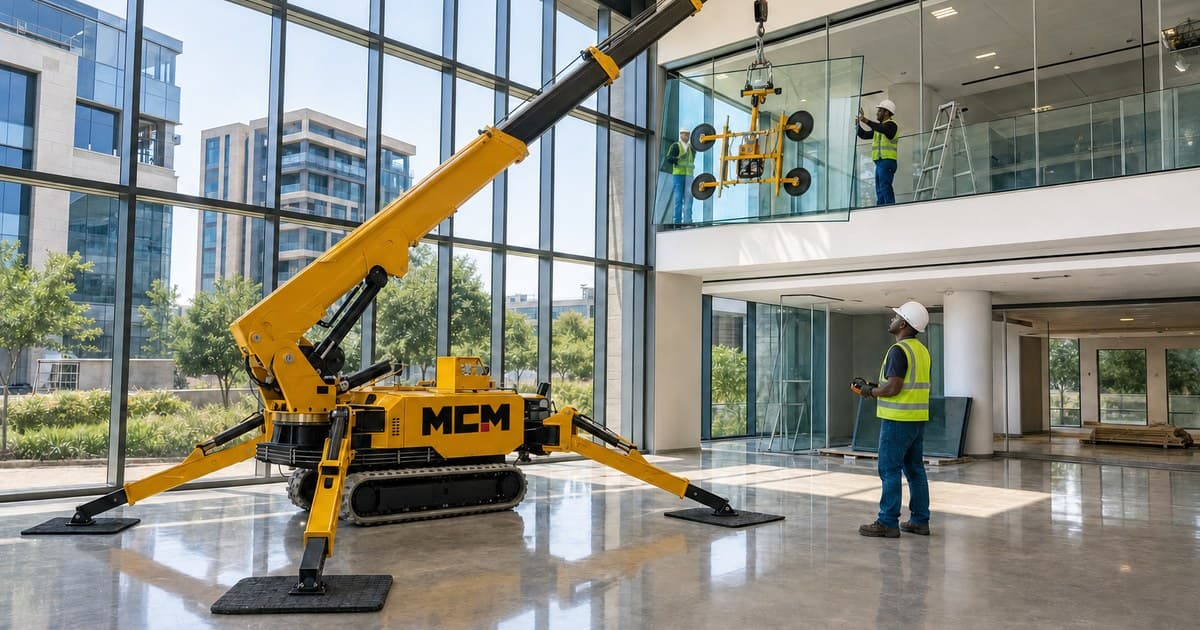
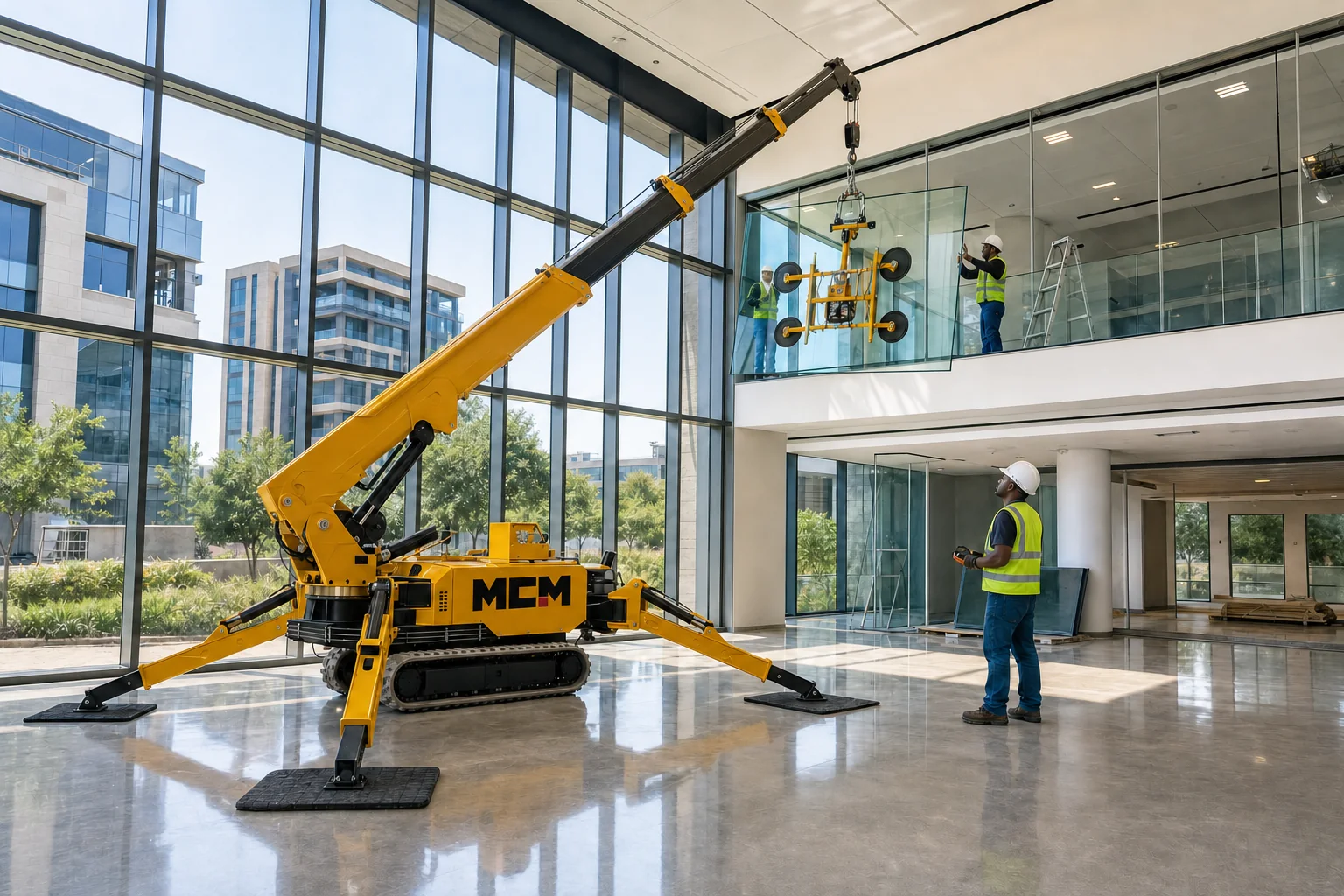
A spider crane is a compact, tracked crane that drives into places a truck-mounted crane can never reach, stands on four fold-out legs and lifts between 3 and 16 tonnes. In South Africa it earns its keep for glaziers, riggers, plant maintenance teams on mines and in factories, steel erectors and rooftop contractors. Basically, anyone whose lift is inside, behind or on top of something. Here is who really needs one, what the MCM SC50 can do, and the four checks that decide whether a spider crane is the right tool for your job.
The lift nobody wants to plan
Every contractor has had one. A 600 kg pump has to come out of a pump house built in the 1970s. A row of glass panels belongs in a double-volume foyer in Sandton. A new air-handling unit goes on a roof that sits behind three storeys of someone else’s building. Or a motor in a mill building needs replacing, but the overhead crane stops two bays short.
The usual options are all bad. A mobile crane can’t get close enough, or needs the road closed to set up. Chain blocks on scaffolding take days and put people under the load. So the job waits, the client waits, and the quote gets padded for risk.
A spider crane solves this by changing where the crane stands. It doesn’t stand outside and reach in. It drives in on rubber tracks, through a roller door, a loading bay or a gate. Then it spreads its legs right next to the work and lifts from there.
Why South Africa needs more of them
Spider cranes first caught on in crowded cities overseas. Three South African realities make them just as useful here:
- Our cities have no room to set up. Putting a mobile crane on a street in a city centre usually means applying to the municipality for a road or lane closure, plus traffic control, plus a weekend shift. A spider crane works inside the property line, so most of that disappears.
- Our industry is brownfield. Mines, smelters, power stations, food plants and factories were built decades ago and are maintained, not rebuilt. Their overhead cranes rarely cover every bay, and new equipment always arrives where the old crane can’t reach.
- We build and renovate with glass and steel. Office refurbishments, mall upgrades, warehouse mezzanines and the solar wave on commercial roofs all need precise lifts in tight places, often while the building stays open.
Who actually uses a spider crane, and for what
These are the South African trades where a spider crane pays for itself. For each, here is the job, why the spider crane wins, and the spec that matters most.
1. Glaziers and shopfitters
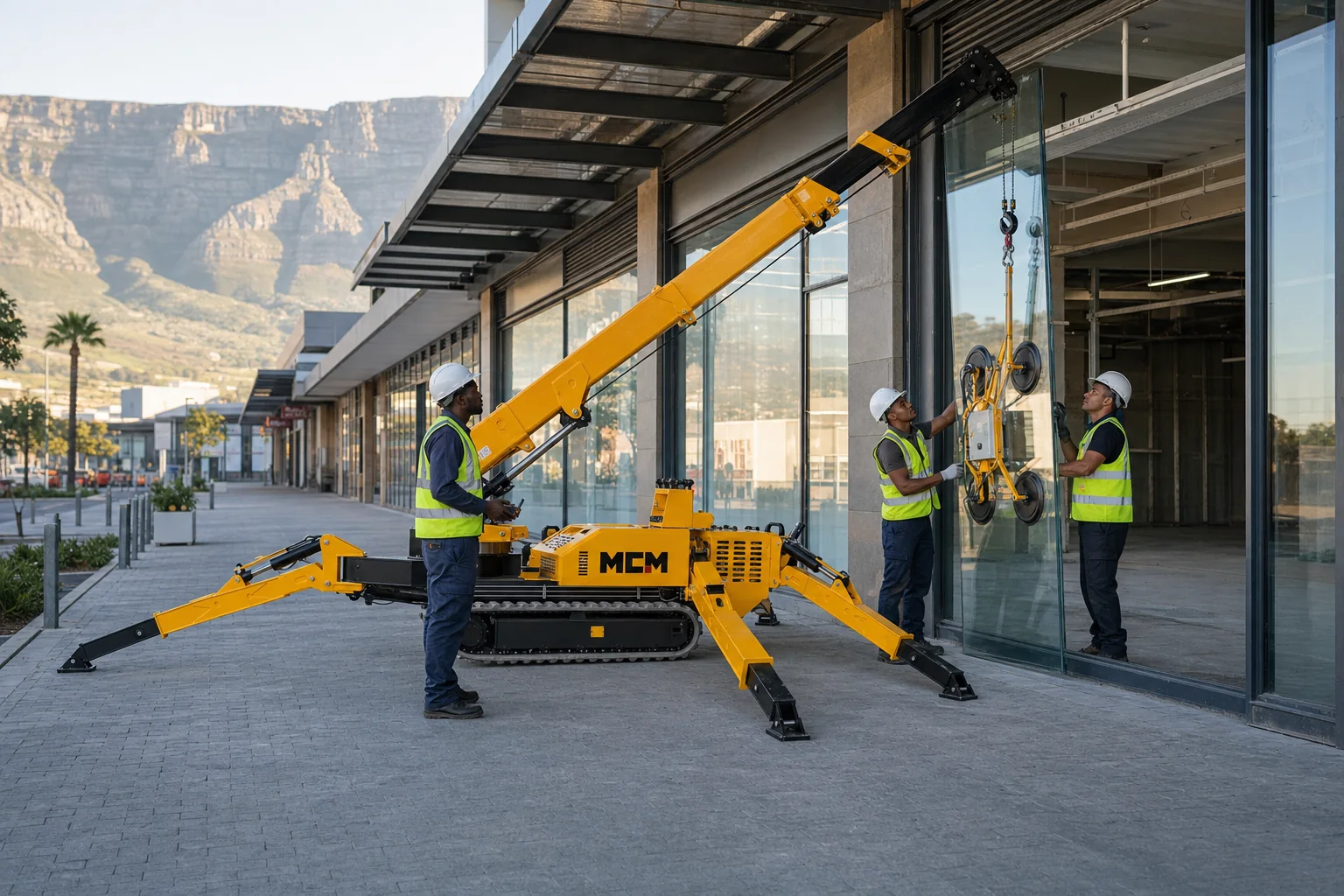
The job: heavy panes in atriums, shopfronts, curtain walls and balustrades. Why a spider crane: it sets up inside the building or on the pavement edge and places the panel slowly and precisely, with the operator standing beside the load on the optional remote control. Spec that matters: reach and lift height, plus rubber tracks that won’t mark a new floor.
2. Riggers and machine movers
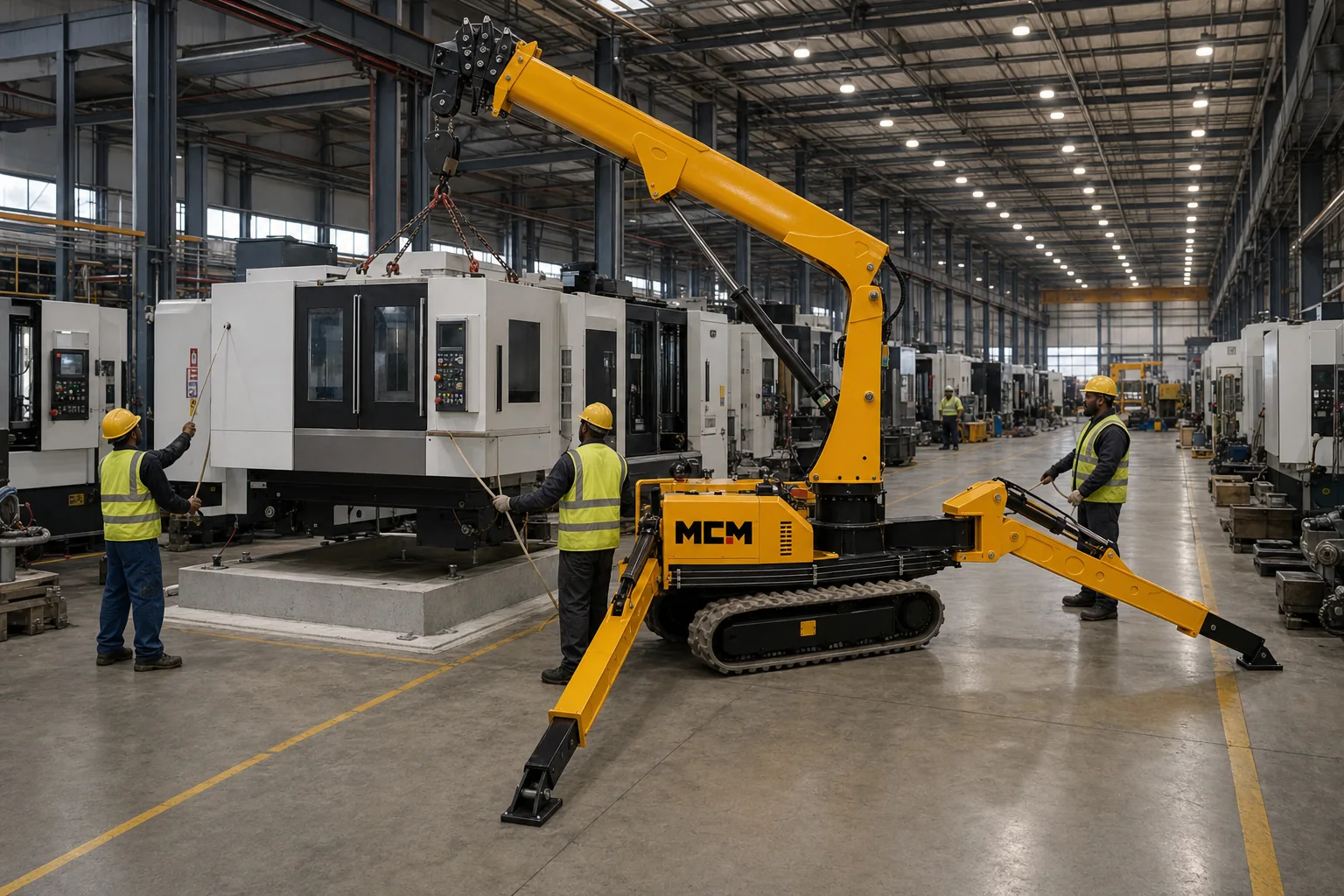
The job: installing CNC machines, presses, generators, transformers and production lines inside factories, or taking old ones out. Why a spider crane: a forklift can’t lift high enough or reach over other machines, and a mobile crane can’t get inside. Spec that matters: capacity at your radius (not the headline figure) and 360° slew, so the load swings into place without moving the crane.
3. Mining and processing plant maintenance
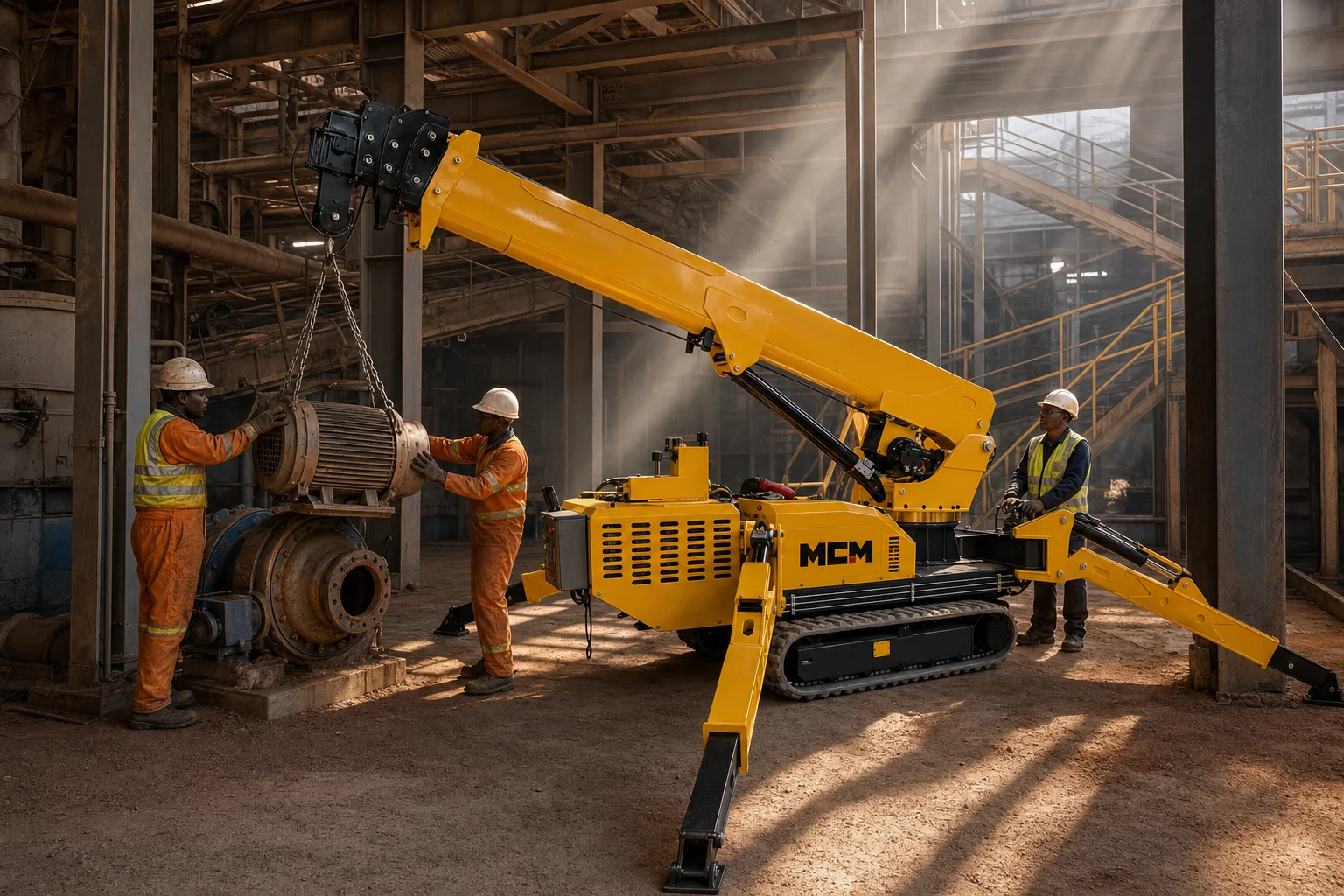
The job: swapping pumps, motors, gearboxes and valves in pump houses, mill buildings, workshops and conveyor transfer points. Why a spider crane: it tracks over rough plant roads and up ramps, sets up on uneven ground with its legs, and lifts where the overhead crane doesn’t reach. One machine can serve a whole plant during a shutdown. Spec that matters: track gradeability (25° on the SC50) and a diesel engine for outdoor work.
4. Steel erectors and mezzanine builders
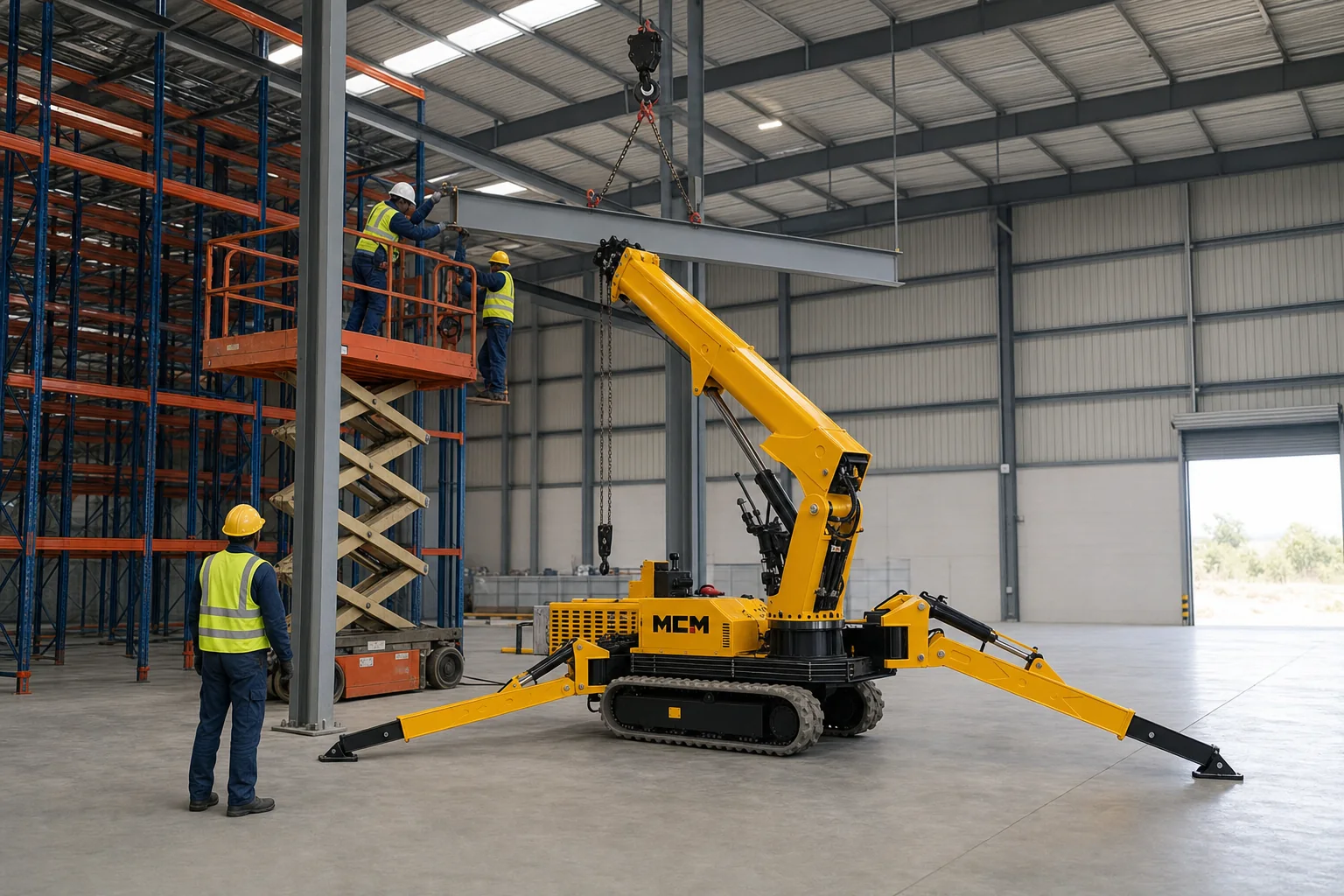
The job: beams, columns, purlins and stairs inside warehouse shells and distribution centres, where the roof is already on. Why a spider crane: a mobile crane can’t work under a roof, and a spider crane can drive between racking and columns. Spec that matters: lift height (17 m on the SC50) and the boom length at your radius.
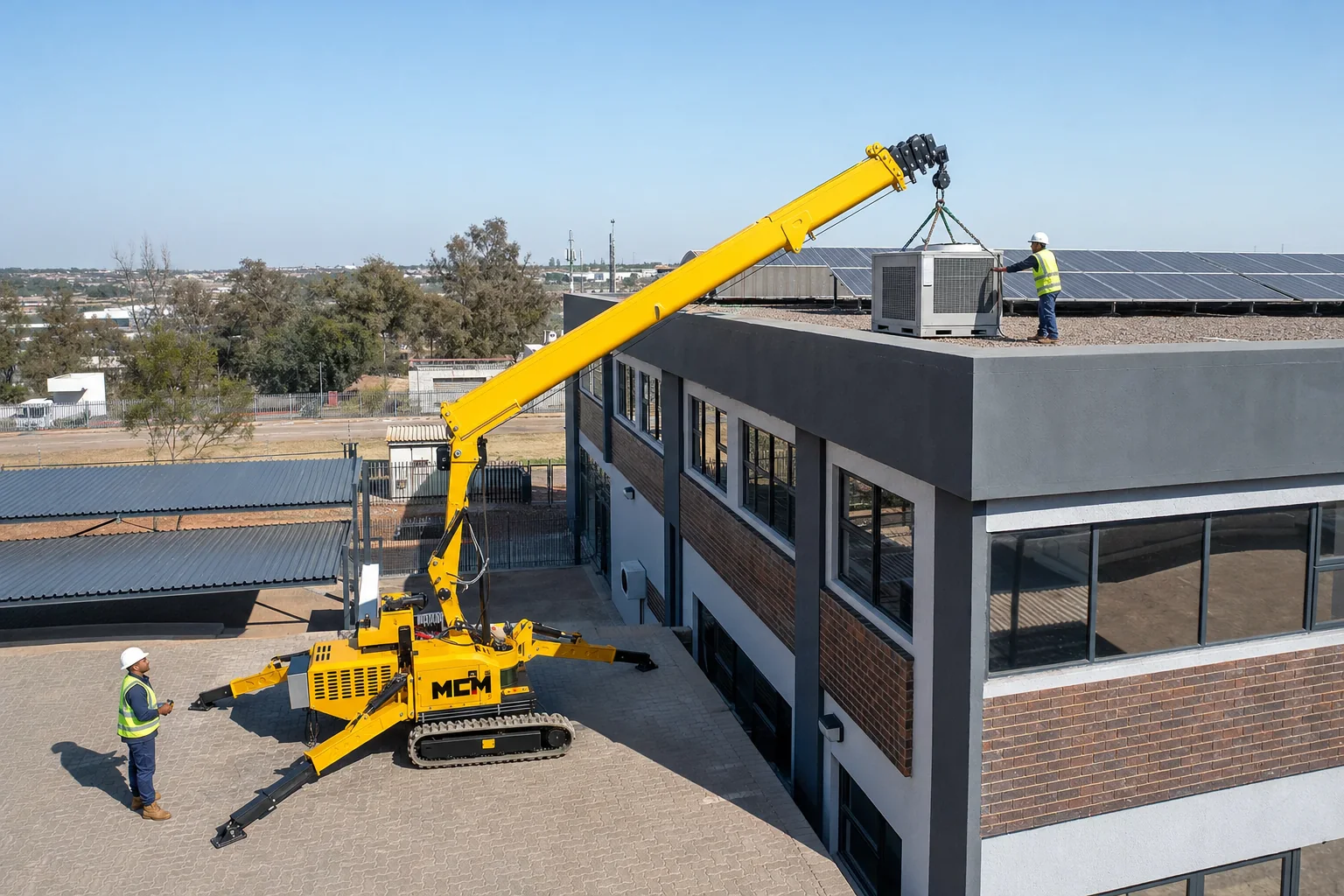
5. HVAC, solar and rooftop plant
The job: chillers, air-handling units, inverters, battery cabinets and pallets of solar panels onto roofs and plant decks. Why a spider crane: it sets up in a courtyard, parking lot or service yard behind the building and reaches over the parapet, with no road closure needed. Spec that matters: working radius (15 m on the SC50) against the weight of your heaviest unit.
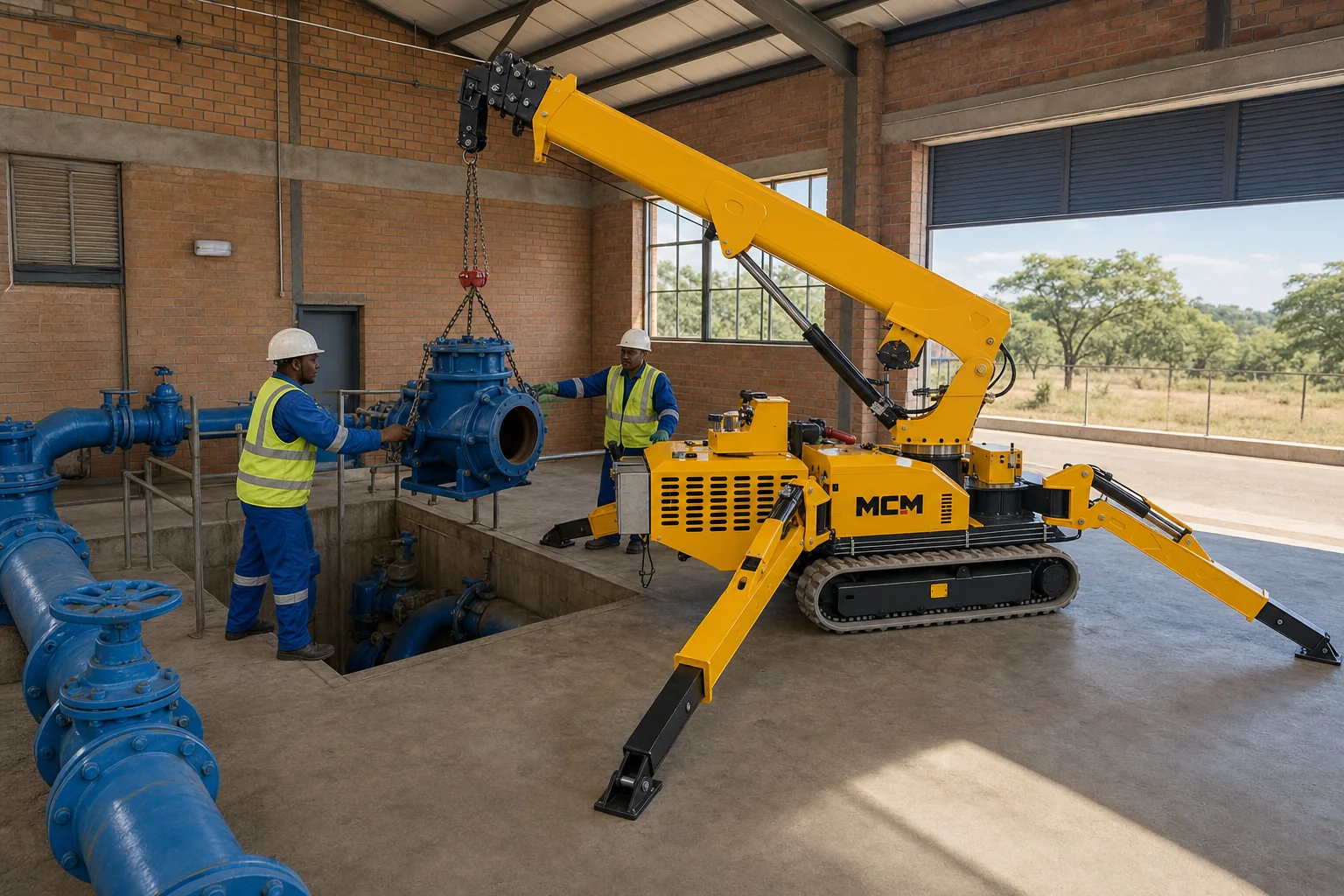
6. Water and municipal infrastructure
The job: replacing pumps, valves and pipe sections in pump stations, reservoirs and treatment works. Why a spider crane: these buildings are small, old and often fenced in, with no room for a truck crane. A spider crane fits through the gate and lifts straight out of the wet well or pump bay. Spec that matters: winch rope length (60 m on the SC50) for lifts from below ground level.
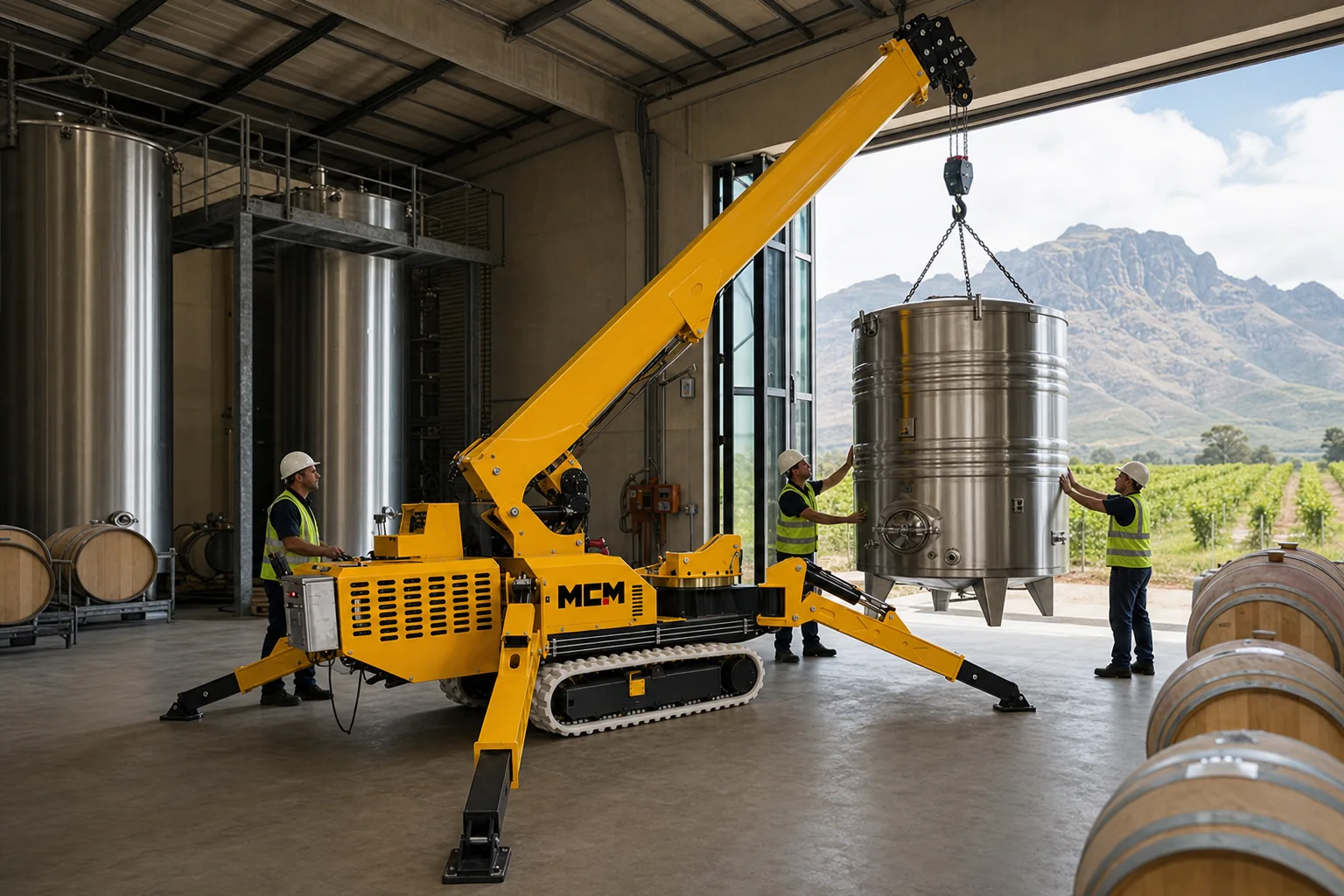
7. Wineries, packhouses and agri-processing
The job: placing tanks, presses, chillers and cold-room panels inside cellars and packhouses. Why a spider crane: the equipment is high-value, the floors are finished and the doors are narrow. Spec that matters: body width, and non-marking white rubber tracks (available for MCM spider cranes) on finished floors.
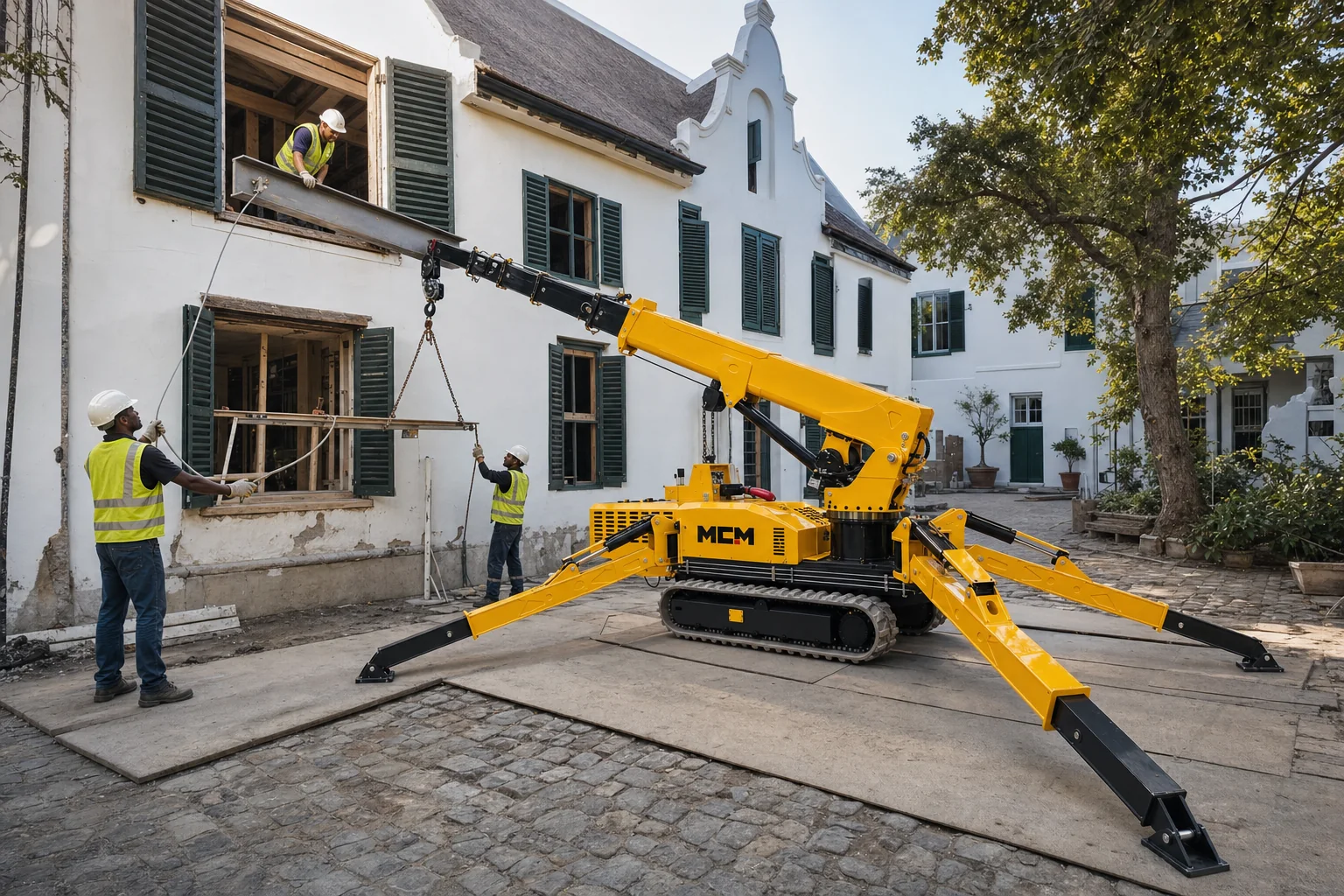
8. Heritage and renovation work
The job: lifting steel, timber and new plant into old buildings without damaging them. Why a spider crane: it spreads its weight over four pads, works quietly and can be walked into a courtyard that hasn’t seen a vehicle in a century. Spec that matters: machine weight and pad loads, which your engineer will want to see.
A contractor who owns a spider crane stops being the one who calls for a crane. They become the one everybody else calls.
Meet the MCM SC50: 5 tonnes, 17 metres, 1.5 metres wide
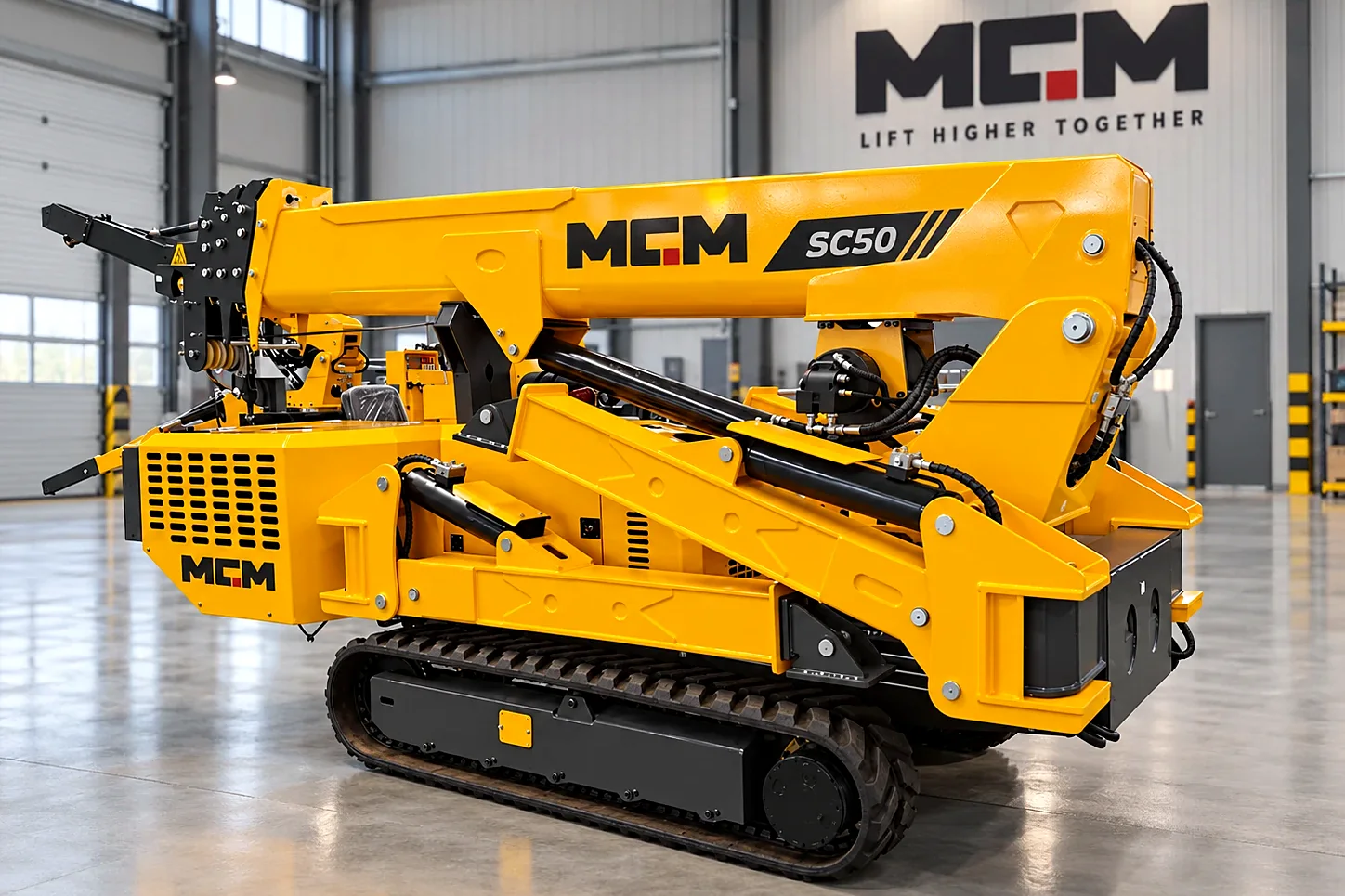
The SC50 sits in the middle of MCM’s range, and it’s the size most South African contractors should look at first. It is narrow enough for a roller door or loading bay and strong enough for glass, steel and plant. It also reaches high enough for a four- or five-storey façade.
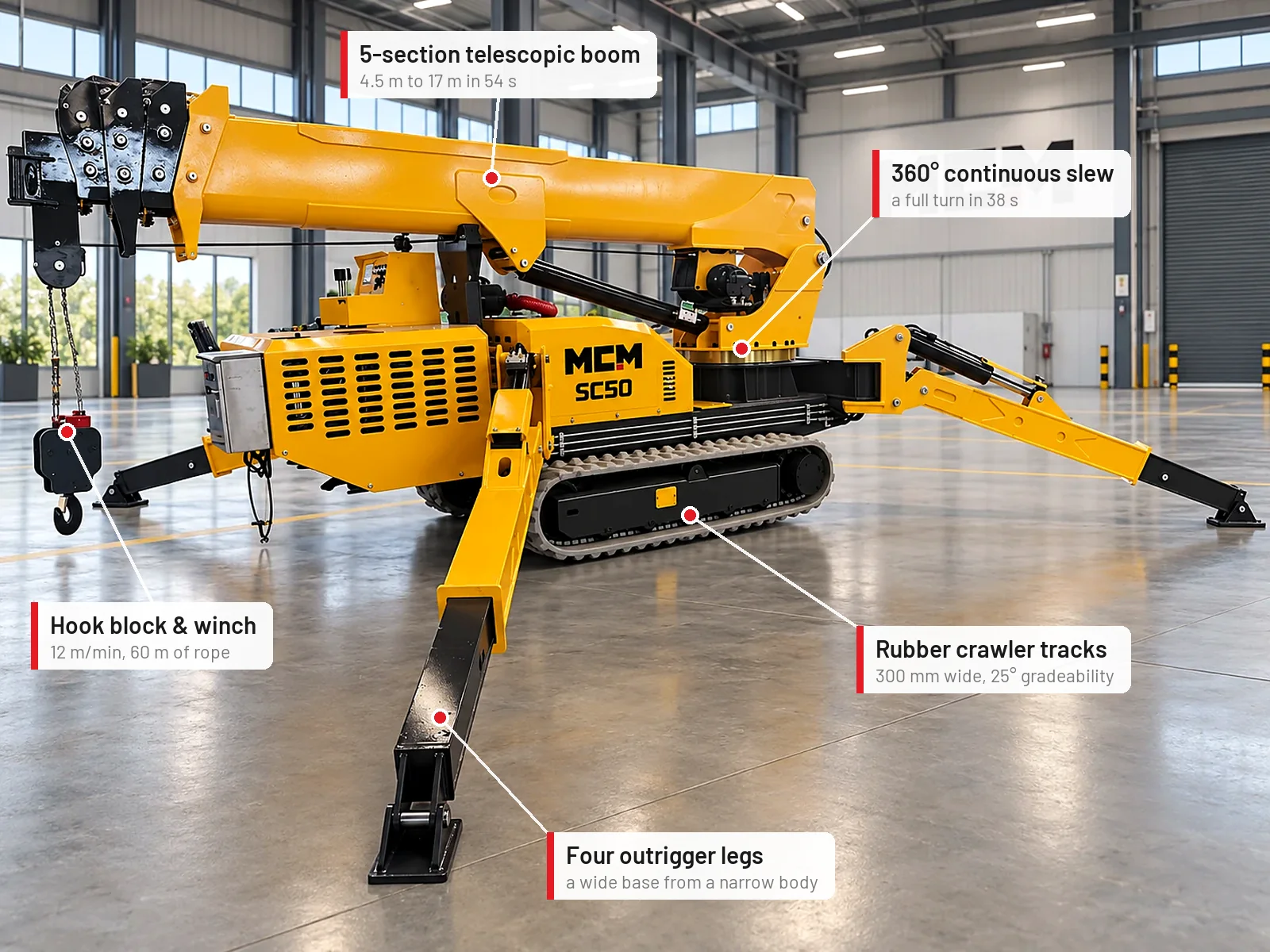
| Lifting capacity | 5 t |
| Max lift height | 17 m |
| Max working radius | 15 m |
| Boom | 5-section telescopic, 4.5 m to 17 m (extends in 54 s), 0–78° in 13 s |
| Rotation | 360° continuous (a full turn in 38 s) |
| Winch | 12 m/min hook speed, 4-rope two-speed, Ø11 mm × 60 m wire rope |
| Engine | Yuchai diesel, 58 kW, electric start |
| Tracks | Rubber, 300 mm wide, 0–2.5 km/h, 25° (36%) gradeability |
| Stowed size | 4.7 m long × 1.5 m wide × 2.25 m high |
| Dead weight | 6.7 t |
| Options | Remote control, torque (load-moment) controller, man-cage, hydraulic flying jib |
Look past the headline numbers and three details matter on a real South African site. The 25° track gradeability gets it up loading ramps and plant roads. The 60 m of wire rope lets it lift out of pits and pump wells, not just up onto roofs. And the optional man-cage turns it into a working platform for the odd job at height, as long as you follow the rules for lifting people.
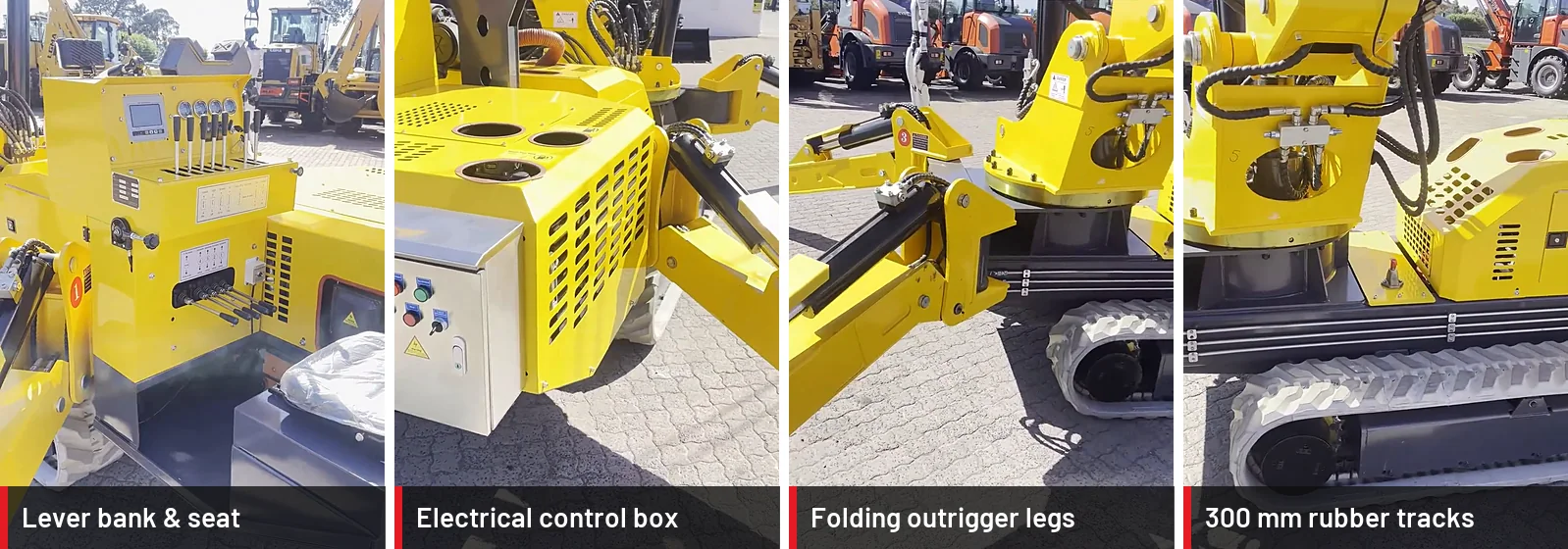
Watch the SC50 at work
Our team walks round the SC50 in the MCM yard, then puts the boom up beside our billboard and brings it back down.
Four checks before you book a spider crane
Most spider crane jobs that go wrong fail on one of these four, not on the crane. Run through them before you quote.
1. Walk the route: width, height and turns
Measure the narrowest point between the truck and the lift: gates, doors, passages, ramps and the tightest corner. Don’t forget height. Stowed, the SC50 is 1.5 m wide and 2.25 m high, so it needs a roller door, a double door or a loading bay rather than an ordinary doorway, which is only about 2 m high. For genuinely tight access, the 800 mm-wide SC30 or the 1 000 mm-wide SC40 is the better tool.
2. Read the load chart at your radius
“5 tonnes” is what the SC50 lifts close in, with the boom short. Capacity falls quickly as the boom reaches out and up. So the question isn’t “can it lift 5 tonnes?” but “can it lift my 900 kg unit at 11 metres?” Give us the weight, the distance from where the crane can stand and the height, and we’ll check it against the load chart before you commit.
3. Check what the floor can carry
The SC50 weighs 6.7 t before it picks anything up, and during a lift that weight plus the load is concentrated on four outrigger pads. On ground, use spreader mats. On a suspended slab, basement roof or old timber floor, get a structural engineer to sign it off first. It’s a small cost compared with a cracked slab.
4. Sort out compliance before the crane arrives
In South Africa a spider crane is a lifting machine under the Driven Machinery Regulations of the Occupational Health and Safety Act. That means it must be inspected and load-tested by a registered Lifting Machine Inspector at the intervals the regulations set, and operated by someone trained and competent on it. Main contractors and mines will ask for the paperwork at the gate, so have it ready. A torque (load-moment) controller, available as an option, adds another layer of protection against overloading.
Narrow in, heavy up: the full MCM range
Choose by access first, then by load. The chart shows body width against capacity for all seven MCM spider cranes.
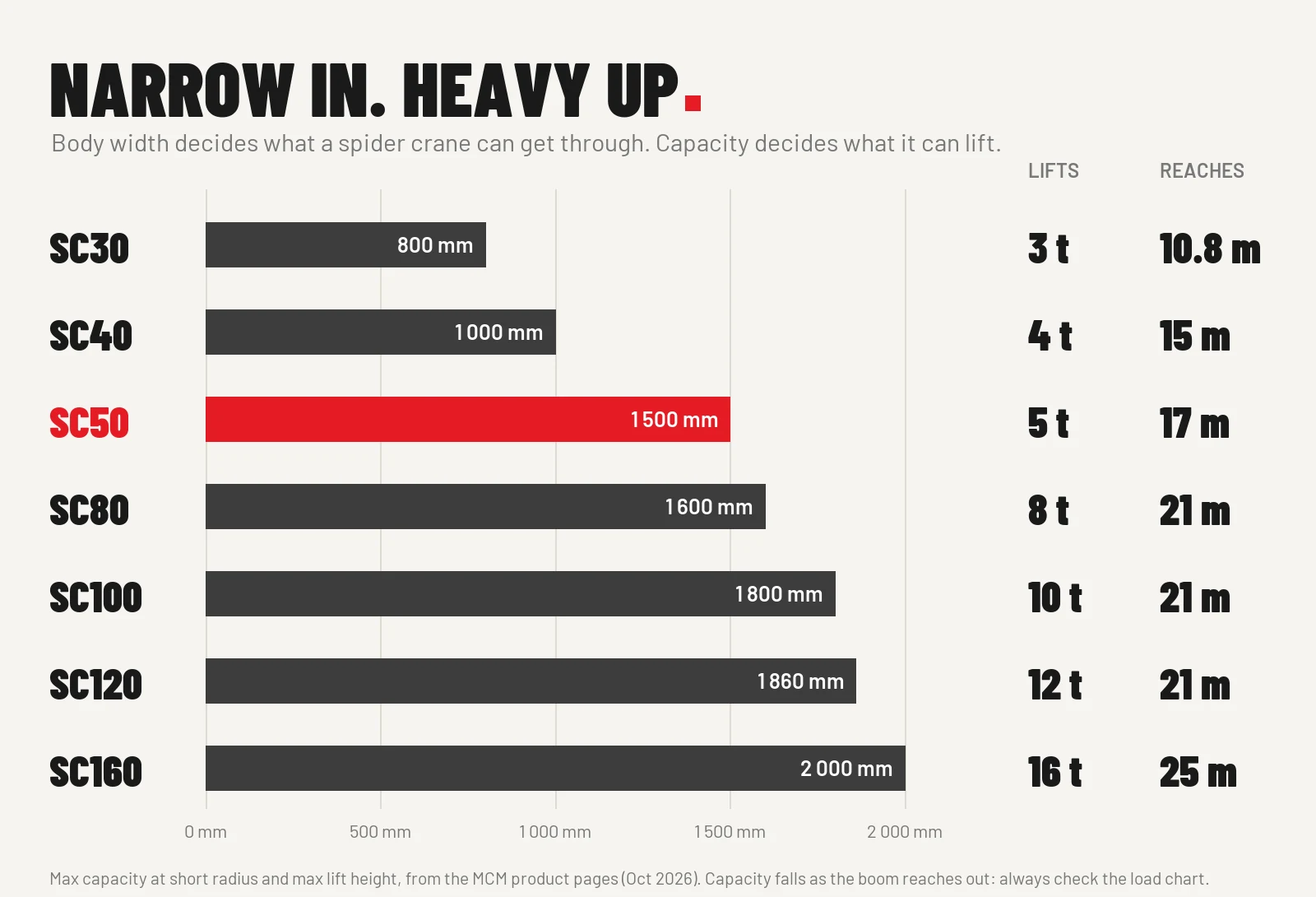
| Model | Capacity | Lift height | Working radius | Width | Weight | Price (excl. VAT) |
|---|---|---|---|---|---|---|
| SC30 | 3 t | 10.8 m | 10 m | 800 mm | 2.7 t | R655 000 |
| SC40 | 4 t | 15 m | 13 m | 1 000 mm | 3 t | R695 000 |
| SC50 | 5 t | 17 m | 15 m | 1 500 mm | 6.7 t | R745 000 |
| SC80 | 8 t | 21 m | 18 m | 1 600 mm | 8.7 t | R955 000 |
| SC100 | 10 t | 21 m | 18 m | 1 800 mm | 10.5 t | R1 095 000 |
| SC120 | 12 t | 21 m | 19 m | 1 860 mm | 12.5 t | R1 275 000 |
| SC160 | 16 t | 25 m | 23 m | 2 000 mm | 16.5 t | R1 399 000 |
- SC30 and SC40: the narrowest. They run on diesel or 380 V electric power, so they also suit indoor work where fumes and noise must stay down.
- SC50 and SC80: the all-rounders for glass, steel, plant and rooftop work on mid-rise buildings.
- SC100, SC120 and SC160: heavy steel, machinery and plant, where you need serious capacity at radius and the access is wider.
When a spider crane is the wrong choice
We’d rather you buy the right machine than the wrong one from us. A spider crane isn’t the answer when:
- The site is open, the road is close and the load is heavy at long reach. A hired mobile crane is quicker for a one-off.
- You lift in the same bay every day. A fixed overhead crane or gantry will be cheaper over time.
- Your loads are palletised and only need to go up a few metres or onto a truck. A forklift or telescopic loader does that faster.
Where a spider crane wins is the lift in between: too high or too far for a forklift, too tight or too far inside for a mobile crane. In South African industry, that lift comes up far more often than most people think.
Delivery, support and finance
MCM delivers spider cranes anywhere in South Africa from our branches in Cape Town, George, Gauteng and Bloemfontein. Transport is quoted by deck space and delivery address. Each machine comes with on-site commissioning and an operator handover, and parts and after-sales service are available from all four branches. Finance is available through South Africa’s major asset-finance providers. Read our first-time buyer’s guide to equipment finance to see how it works.
Frequently asked questions
What is a spider crane used for in South Africa?
Mostly for lifts in places a mobile crane can’t reach. That includes glass installation, machinery installation in factories, pump and motor changes on mines and in water infrastructure, steel erection inside buildings, and lifting HVAC and solar equipment onto roofs.
How much can the MCM SC50 spider crane lift?
Up to 5 tonnes, with a maximum lift height of 17 m and a maximum working radius of 15 m. Capacity drops as the boom extends, so always check the load chart at your radius.
Will a spider crane fit through a door?
It depends on the model and the door. The SC50 is 1.5 m wide and 2.25 m high when stowed, so it needs a roller door, double door or loading bay. The SC30 is 800 mm wide and the SC40 1 000 mm wide for tighter access. Measure the whole route, including height and corners.
Can a spider crane work on a suspended floor?
Sometimes, but only after a structural engineer has checked the slab against the crane’s weight and the outrigger pad loads during the lift. Spreader mats help spread the load.
Does a spider crane need an inspection certificate in South Africa?
Yes. It is a lifting machine under the Driven Machinery Regulations of the OHS Act. It must be inspected and load-tested by a registered Lifting Machine Inspector at the required intervals, and run by a trained, competent operator.
How much does a spider crane cost in South Africa?
MCM’s range runs from R655 000 (SC30) to R1 399 000 (SC160) excl. VAT, as of October 2026. The SC50 is R745 000 excl. VAT. Check the product page for the current price, and ask us about finance.
Tell us about your lift
Send us the weight, the distance from where the crane can stand, the height and a photo of the access route. We’ll tell you honestly whether a spider crane is right and which size, and check it against the load chart. Browse the full spider crane range, visit MCM in Cape Town, Gauteng, George or Bloemfontein, or contact our team.