

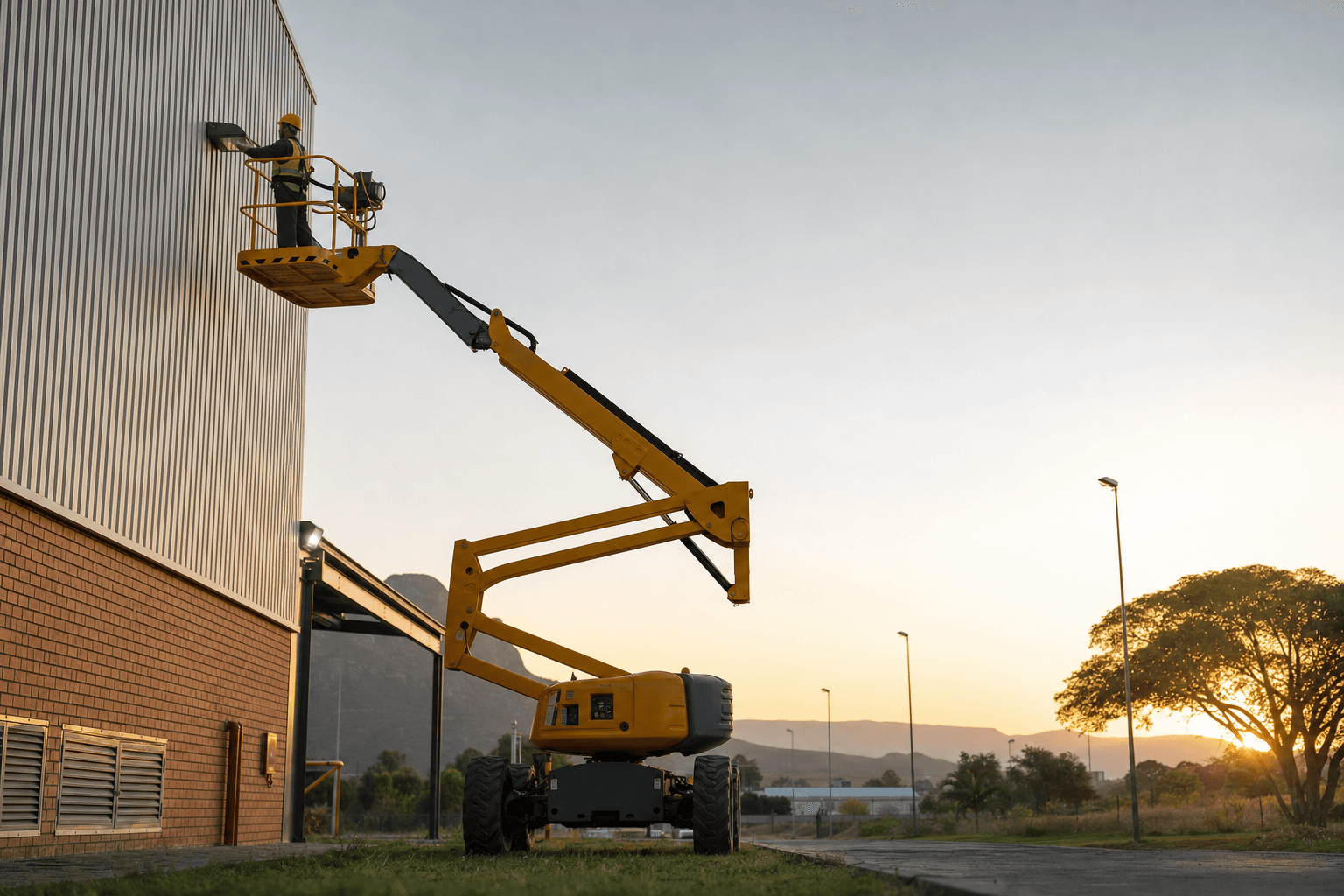
Quick answerCherry pickers (aerial work platforms / boom lifts) are used for any task requiring safe, stable access at height — from electrical and lighting installation at 6 m to large-scale industrial work above 20 m. Articulating and telescopic boom lifts, truck-mounted units and electric indoor machines each suit different applications; choosing the right type saves time, cuts risk and is almost always cheaper than erecting scaffolding.
Whether you manage a construction site in Gauteng, maintain street lights along the Garden Route or trim trees on a game farm in the Northern Cape, a cherry picker gives your team controlled, repeatable access to height without the delays and hazards of traditional ladders or scaffolding. The term covers a broad family of aerial work platforms that require regular service and compliance checks — understanding the application first is the fastest route to selecting the right machine.
This guide covers every major use case for cherry pickers in South Africa, explains the equipment types and working-height bands that match each job, and highlights the safety and cost advantages over alternative access methods — whether you are buying, financing or renting a unit through MCM Group’s branches in Cape Town, George, Gauteng or Bloemfontein.
Understanding the equipment: which cherry picker type does what?
Before diving into applications, it helps to know the main machine categories available in the South African market and what differentiates them.
| Type | Typical working height | Best environment | Power source |
|---|---|---|---|
| Articulating boom lift | 10 m – 26 m+ | Construction, trees, signage | Diesel or electric |
| Telescopic boom lift | 12 m – 43 m+ | Industrial, high-mast, large sites | Diesel (mostly) |
| Truck-mounted cherry picker | 12 m – 30 m | Street lights, overhead lines, rapid deployment | Vehicle PTO / diesel |
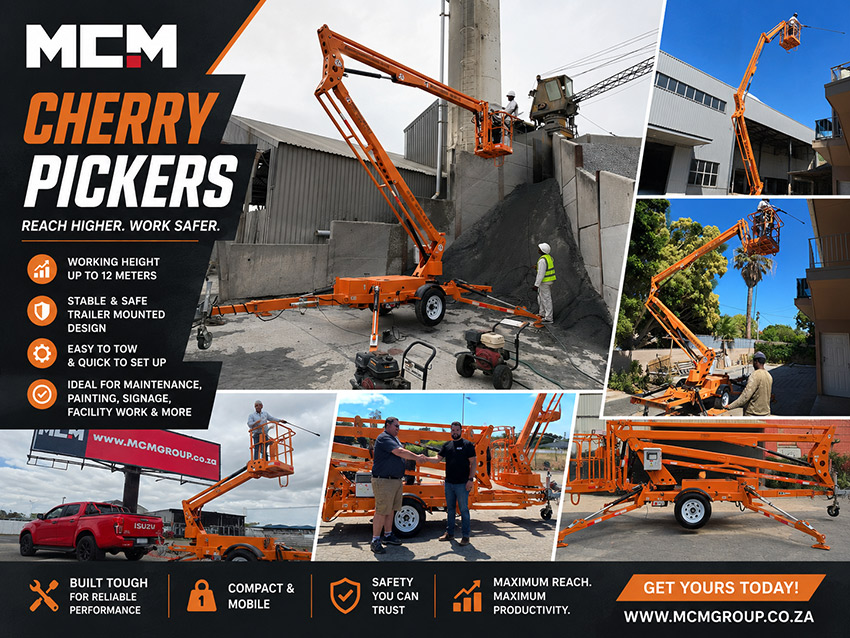
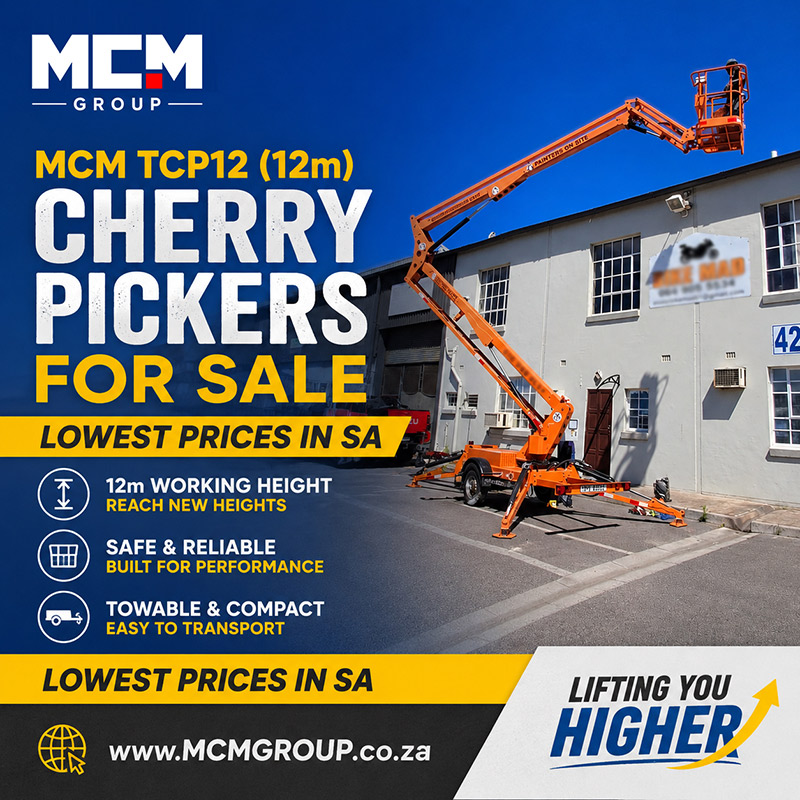
| Trailer-mounted cherry picker / towable boom lift | 6 m – 18 m | Orchards, small construction, events | Petrol, diesel or electric |
| Electric scissor / vertical mast | 6 m – 12 m | Warehouses, retail, indoor fit-out | Battery electric |
Articulating boom lifts bend at one or more knuckle joints, allowing the basket to reach over obstacles — ideal for working around roof overhangs or tree canopies. Telescopic (straight-boom) units extend in a straight line, delivering greater outreach and height on open sites. Electric machines produce zero emissions and near-silent operation, making them the obvious choice for indoor environments; diesel and dual-fuel units handle the rough terrain and extended duty cycles common on South African construction and agricultural sites.
The diesel-vs-electric decision mirrors the same trade-offs discussed in our diesel vs electric forklift load-shedding guide: diesel wins on runtime and outdoor resilience; electric wins on running costs, indoor air quality and noise.
Construction and building maintenance
Construction is the single largest use case for boom lifts in South Africa. Bricklayers, plasterers, painters and facade inspectors all need repeated, stable access to the same area of a building face — something a ladder simply cannot provide safely or efficiently.
- 6 – 10 m: Single-storey residential construction, interior ceiling work, retail fit-out.
- 12 – 20 m: Multi-storey commercial buildings, bridge maintenance, stadium work.
- 20 m+: High-rise facades, industrial chimneys, water towers and silo inspection.
Articulating boom lifts dominate here because they can position the basket horizontally beyond a parapet or over a lower roof section without moving the machine. On confined urban sites — common in Cape Town’s CBD or Johannesburg’s older industrial zones — a compact electric articulating unit can operate where a scaffolding tower would be impossible to erect.
Electrical, lighting and signage installation
Electricians installing high-bay lighting in warehouses or factories routinely specify electric scissor lifts or vertical mast lifts in the 6 – 10 m range. The quiet, emission-free operation keeps the workplace productive while work is under way, and the large platform deck accommodates a two-person crew plus tools and conduit.
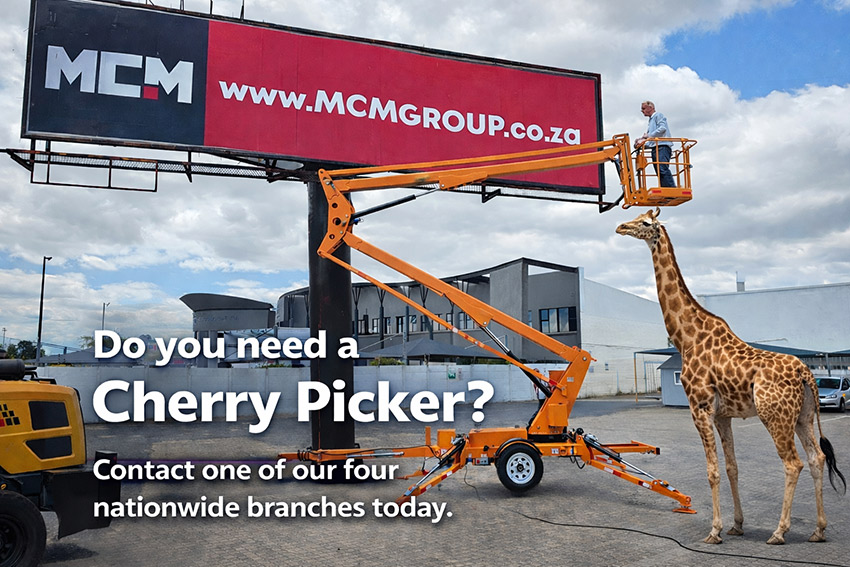
Outdoor signage and billboard rigging demands more reach. A large highway billboard can stand 15 – 20 m above ground level, and the vinyl or aluminium panels are heavy and awkward. A telescopic boom lift with a jib attachment allows the rigger to position the basket precisely at the panel edge, dramatically reducing the number of lifts required and the associated risk of dropped materials.
Street-light and high-mast maintenance — a major municipal contract category across South Africa — is almost universally handled by truck-mounted cherry pickers. The vehicle carries its own stabilising outriggers, drives to the pole, deploys in minutes and moves on. Municipalities in Tshwane, eThekwini and Nelson Mandela Bay all rely on this format for routine lamp replacement and fault-finding on 12 – 18 m street columns.
Tree trimming, felling and landscaping
Arborists working in urban environments — parks, golf estates, wine farms and game reserves — face a specific challenge: they need to reach the canopy without damaging root zones or surrounding vegetation. A trailer-mounted or compact self-propelled articulating boom lift with narrow tyres or outrigger pads solves this neatly.
For large-scale orchard management in the Western Cape fruit-growing regions, trailer-mounted cherry pickers are towed between rows by a tractor and allow pickers and pruners to work at consistent height across thousands of trees per day. This is a genuinely agricultural application — not a construction one — and the right machine here is lightweight, low ground-pressure and easily repositioned.
If heavy wood is being removed, a cherry picker is often paired with a wood chipper on the ground. Our wood chipper buying guide for South Africa explains how to match chipper capacity to the volume of material your team will generate.
Warehouse and facility management
Inside a distribution centre or manufacturing plant, access to racking, roof structure, HVAC ducting and sprinkler systems is a recurring need. Electric scissor lifts and narrow-aisle vertical mast lifts are the workhorses here, offering:
- Zero exhaust emissions — critical in food-grade and pharmaceutical facilities.
- Low noise — staff and forklifts continue working nearby.
- Precise incremental height adjustment for racking inspection or label replacement.
- Compact footprints that navigate standard 2.7 m racking aisles.
Working heights of 6 – 12 m cover the vast majority of South African warehousing stock. Facilities with mezzanine levels or very high-bay racking (above 12 m) typically step up to a compact articulating boom lift. The relationship between platform height and load capacity is worth understanding alongside forklift mast height selection when planning a new warehouse layout.
Roofing, guttering and facade maintenance
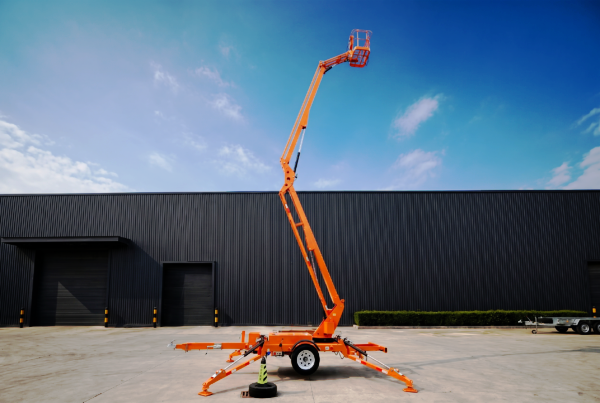
Gutters on a two-storey house sit at roughly 6 – 7 m. A small trailer-mounted or self-propelled boom lift allows one person to clear, inspect and reseal a full perimeter safely in a fraction of the time a ladder would require — and without the fatigue-related fall risk that makes ladder work statistically dangerous.
On commercial and industrial roofs, the same principle scales up. Roof-mounted solar panel installation and maintenance has become a significant growth segment in South Africa since load-shedding accelerated PV adoption, and boom lifts are the preferred access method on flat commercial rooftops where the panel arrays sit close to the parapet edge.
Film, events and camera work
The South African film and broadcast industry — centred in Cape Town and Johannesburg — uses cherry pickers extensively for lighting rigs, camera platforms and set construction. A 15 – 20 m telescopic boom lift positions a cinema camera or a 10 kW HMI light at precise angles that no crane or scaffolding tower can replicate with the same speed of repositioning. Events companies use trailer-mounted units for concert lighting and outdoor LED screen rigging where quick setup and teardown are essential.
Agriculture and emergency services: niche but critical applications
Beyond the mainstream uses, cherry pickers serve two sectors that are often overlooked in standard equipment guides.
Agriculture
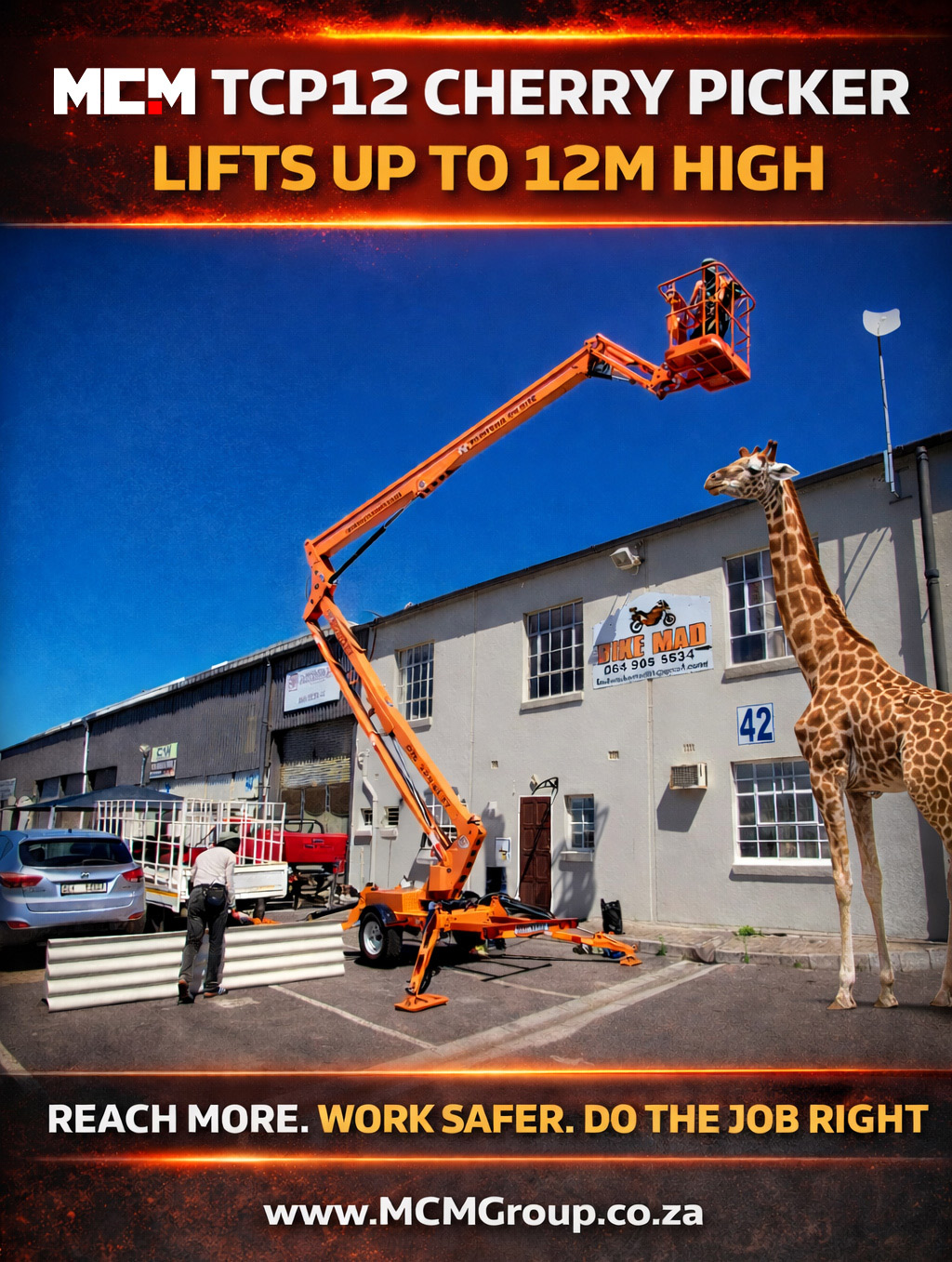
South African agriculture extends well beyond orchard picking. Grain silo inspection, irrigation pivot maintenance, greenhouse structure repair and game-fence installation on large properties all require elevated access on terrain that ranges from firm compacted soil to loose sand and rocky veld. For these conditions, a rough-terrain articulating boom lift with four-wheel drive and oscillating axles is the correct specification — the same machine that handles a construction site in Limpopo will navigate a farm track in the Karoo. Trailer-mounted units towed by a farm tractor remain the most cost-effective solution for row-crop operations where the machine moves slowly and continuously.
Emergency services
Fire departments, search-and-rescue teams and disaster-response units in South Africa use truck-mounted cherry pickers for high-angle rescue, building collapse assessment and wildfire suppression support. The ability to position a basket precisely at a window or roof opening — and to do so within minutes of arriving on scene — makes a boom lift far more effective than a ladder in a time-critical rescue. Municipalities that invest in multi-purpose truck-mounted units can deploy the same vehicle for daily street-light maintenance and emergency response, maximising asset utilisation.
Cherry pickers vs ladders and scaffolding: the honest comparison
| Factor | Cherry picker / boom lift | Scaffolding | Ladder |
|---|---|---|---|
| Setup time | Minutes | Hours to days | Seconds (but repeated moves) |
| Working height flexibility | Continuously variable | Fixed levels | Fixed length |
| Fall protection | Integral guardrails + harness point | Guardrails if fitted | None |
| Load capacity | 200 – 400 kg (platform) | High (with correct design) | Very low |
| Repositioning | Drive / tow to new position | Dismantle and rebuild | Carry and re-lean |
| Regulatory compliance (SA) | OHS Act / SANS 1418 | OHS Act / SANS 10085 | OHS Act basic |
| Cost for short project | Low (rental) | High (erection + hire) | Very low |
South African Occupational Health and Safety Act regulations and the associated SANS standards require that all aerial work platforms be inspected before use, operated only by trained personnel and fitted with functioning fall-arrest anchor points. The South African Bureau of Standards (SABS) publishes SANS 1418, which governs the design and testing of mobile elevating work platforms sold in this market. Compliance is not optional — and a well-maintained, certified boom lift is inherently easier to keep compliant than improvised ladder or scaffolding arrangements.
Buying, renting and financing your cherry picker in South Africa
For contractors who need a machine for a single project, short-term rental is almost always the most cost-effective route. For businesses with recurring high-access work — municipalities, large estates, telecoms contractors — ownership or a finance agreement makes better long-term sense. Our equipment finance guide for South African first-time buyers walks through the instalment sale, lease and rental-purchase options available through accredited financiers, including the tax treatment of each.
When budgeting, factor in the total cost of ownership: tyres, annual inspection and certification, battery replacement on electric units and hydraulic service intervals. South Africa’s dust, UV intensity and temperature extremes accelerate wear on seals and hoses — a point covered in detail in our cherry picker service and compliance guide. Buying from a supplier with local parts stock and qualified technicians is not a luxury — it is a practical necessity when a machine breakdown stops an entire crew.
The International Powered Access Federation (IPAF) provides operator training and a widely recognised PAL Card certification that many South African clients and principal contractors now require before allowing a boom lift on site.
Missed us / Want to know more? Contact MCM Group for pricing, finance and a quote on the right cherry picker for your application.
Explore the MCM Group Rough Terrain Forklift range
Ready to buy? MCM Group stocks rough terrain forklifts for every operation — here are some popular models:
MCM RTL50 Rough Terrain Forklift
MCM RS30Q Rough Terrain Forklift
MCM RS35Q Rough Terrain Forklift
MCM RS35 Semi-Rough Terrain Forklift
Browse the full rough terrain forklift range
Frequently asked questions
What types of cherry pickers are best for agricultural use in South Africa?
Trailer-mounted boom lifts towed by a farm tractor are the most practical choice for row-crop operations such as orchards and vineyards, because they move slowly and continuously between rows without needing a separate operator. For rougher terrain — silo inspection, game-fence installation or irrigation pivot maintenance — a rough-terrain articulating boom lift with four-wheel drive and oscillating axles handles uneven ground safely. Low ground-pressure tyres or outrigger pads protect root zones and soft soil. Electric or petrol-powered units are preferred where diesel fumes would contaminate produce or disturb livestock.
How do I choose the right cherry picker for emergency services?
Emergency services — fire, rescue and disaster response — generally require truck-mounted cherry pickers because rapid deployment from a moving vehicle is essential. Key specifications include a working height of at least 18 m (to reach upper floors of typical South African commercial buildings), a 360-degree continuous rotation turntable, a minimum platform capacity of 250 kg to carry two rescuers and equipment, and insulated boom options if overhead electrical hazards are likely. Multi-purpose truck-mounted units that double as municipal maintenance vehicles maximise asset utilisation for cash-constrained municipalities.
What are the safety regulations for using boom lifts in South Africa?
Boom lifts in South Africa are governed by the Occupational Health and Safety Act (No. 85 of 1993) and its Construction Regulations, as well as SANS 1418, which covers the design and testing of mobile elevating work platforms. Key requirements include: a pre-shift inspection logged in a register; operators trained and certified (IPAF PAL Card is widely accepted); a full-body harness worn and clipped to the platform anchor point at all times; ground conditions assessed before deployment; and an annual third-party inspection and load test by a competent person. Employers are liable for non-compliance, and incidents involving uncertified machines or untrained operators can result in prosecution.
Can cherry pickers be rented for short-term projects, and what are the cost implications?
Yes — short-term rental is the most common way South African contractors access boom lifts for once-off or infrequent projects. Rental rates vary by machine type, working height and duration: a small electric scissor lift for a week typically costs less than erecting and dismantling an equivalent scaffolding tower. Larger diesel articulating or telescopic boom lifts carry higher daily rates but still undercut scaffolding on projects shorter than two to three weeks. Always confirm whether the rental rate includes delivery, operator training, insurance and the mandatory pre-hire inspection — some suppliers charge these separately. For businesses with ongoing high-access needs, a finance agreement or instalment sale often becomes cheaper than repeated rentals after 18 – 24 months.
What maintenance practices are essential for cherry pickers in the harsh South African climate?
South Africa’s combination of high UV radiation, dust, temperature extremes and — in coastal areas — salt air accelerates wear on several key components. Essential maintenance practices include: inspecting and replacing hydraulic hoses and seals every 12 months or at the manufacturer’s specified interval (whichever is sooner); checking battery electrolyte levels and terminal connections monthly on electric units; greasing all pivot pins and turntable bearings after every 50 hours of operation; inspecting tyres for UV cracking and cuts after each deployment on rough terrain; and storing machines under cover or with UV-protective covers when not in use. Annual third-party certification inspections are a legal requirement and will identify wear items before they become failures.
How do cherry pickers compare to other access equipment in terms of efficiency for different applications?
For tasks requiring repeated repositioning at variable heights — electrical installation, painting, tree trimming — a boom lift is significantly more efficient than scaffolding or ladders. A single operator can reposition a self-propelled machine in under a minute; the equivalent scaffolding move takes a crew several hours. For long continuous runs at a fixed height (e.g. plastering a full building face), scaffolding can be more cost-effective because the platform stays in place. Ladders remain appropriate only for very brief, low-height tasks where the risk assessment confirms the hazard is negligible. In warehouses, electric scissor lifts outperform both ladders and scaffolding on speed, safety and floor-space impact. For high-reach outdoor work above 20 m, a telescopic boom lift has no practical alternative short of a crane with a man-basket — which is far more expensive and less manoeuvrable.