
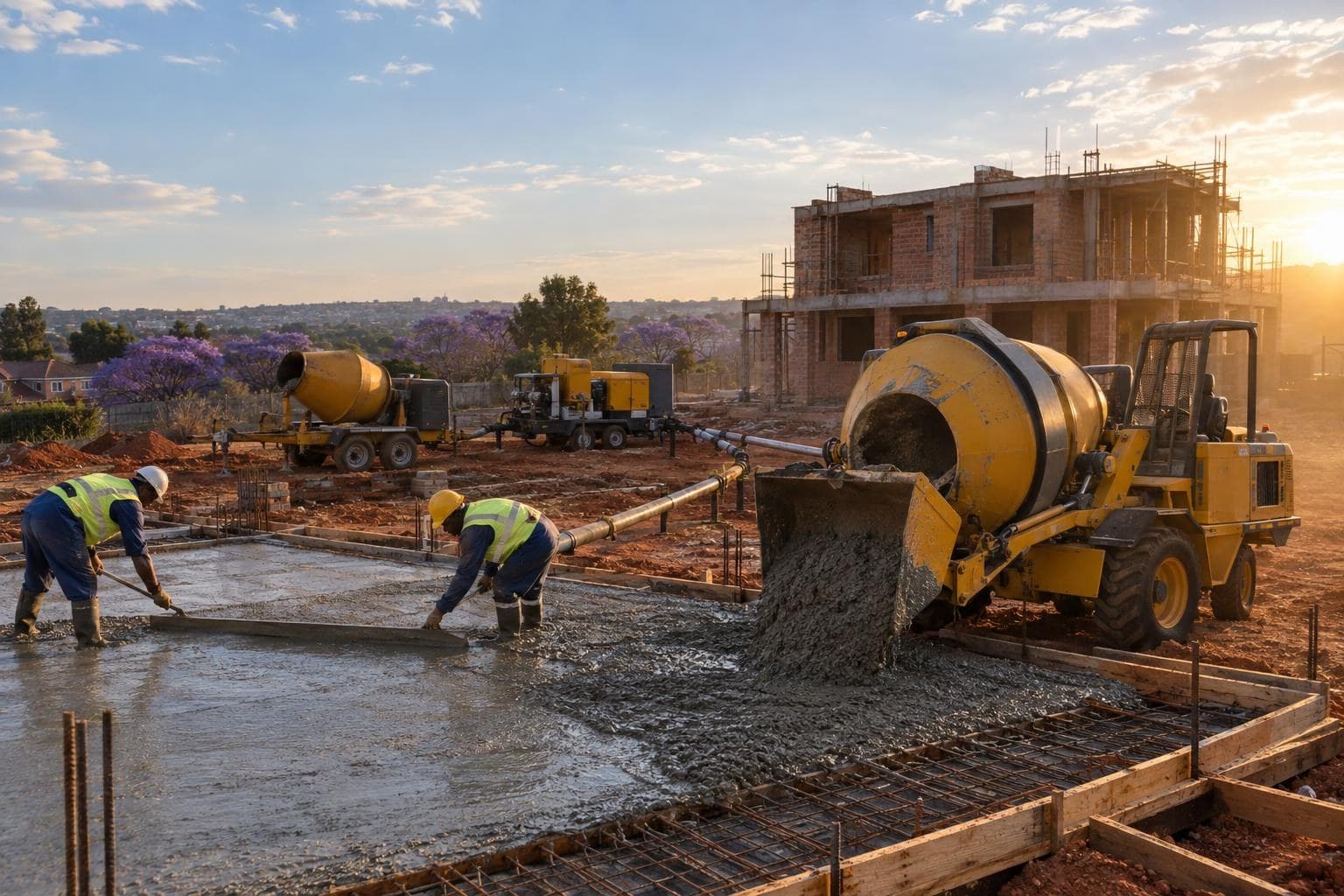
MCM Group now sells concrete mixers and concrete pumps in South Africa: ten models across three families — towable diesel drum mixers from 350 to 1 500 litres (from R129 950 excl. VAT), 4×4 self-loading mixers from the compact MCM F600 to the 2.8 m³ MCM F2800 (from R325 000), and trailer-mounted concrete pumps and mixer pumps placing 38 to 45 m³ of concrete per hour (from R499 532) — with nationwide delivery, finance and parts support from four branches. This guide explains why MCM has added concrete equipment to its earthmoving range, what each machine does, what the South African concrete market is doing in 2026, and how to pick the right machine for your pours.
Quick answer
For plaster, footings and small slabs with a crew of two or three, a towable MCM CM350, CM500 or CM750 drum mixer (R129 950 to R149 950) is the right buy. For daily pours, remote sites and work across several properties, a self-loading F600, F1300 or F2800 replaces the loader, mixer and dumper in one 4×4 machine. For multi-storey floors, columns and long-reach pours, the CP40 pump or the CMP38 / CMP45 mixer pumps place up to 45 m³ an hour up to 80 m high. Browse the full concrete mixer and pump range, or send your pour size and site details to WhatsApp 081 885 0535 for a same-day recommendation.
Why MCM Group is expanding into concrete equipment
Quick answer: South Africa is entering an infrastructure spending cycle, cement demand is growing again, and contractors increasingly want to batch and place their own concrete instead of waiting for ready-mix. MCM’s customers already own its TLBs, loaders and dumpers; concrete mixers and pumps complete the kit for the same sites.
The numbers behind the decision are public. The national 2026 Budget, tabled on 26 February 2026, commits more than R1 trillion of public-sector infrastructure spending over the medium term — R577.4 billion through state-owned companies and public entities, R217.8 billion through provinces and R205.7 billion through municipalities — with 63 public-private partnership projects in development and the first major PPP financial closures in more than five years expected this year (2026 Budget analysis). Transport, water, energy and social infrastructure all consume concrete in volume.
Demand is following the money. The South African cement market is forecast to grow 6.3% to about R29 billion in 2026 and to keep expanding at roughly 6.8% a year to 2030 (South Africa Cement Industry Report 2026). GlobalData expects construction output to grow 2.8% in real terms in 2026 on transport and energy investment, and Highways Today puts the construction market at around R160 billion this year with growth approaching 4.8% as Big 5 Construct returned to Johannesburg in June.
The equipment trend is just as clear. Globally, self-loading and volumetric mixers are the fastest-growing part of the concrete mixer market, projected to expand at over 16% a year to 2031 as remote-site economics reward on-demand batching over the loader-plus-mixer-plus-truck combination (Mordor Intelligence). Concrete pumps are growing steadily too, from about US$5.8 billion in 2025 towards US$8.6 billion by 2034 (IMARC). MCM has watched its own customers hire or import exactly these machines, and has now brought them into the catalogue with local warranty and parts.
The MCM concrete range at a glance
Quick answer: Three families cover the three jobs on a site: batching small volumes (drum mixers), producing and delivering concrete on the move (self-loading mixers), and placing it at distance or height (pumps and mixer pumps).
Towable drum mixers: CM350, CM500, CM750 and CMT 1500
The MCM CM350, MCM CM500 and MCM CM750 pair a 350, 500 or 750-litre mixing drum with a diesel engine and a hydraulic loading hopper, so aggregate goes straight from the hopper into the drum without shovelling into a raised mouth. They sit on towable chassis for moving around site and between jobs, and they are priced from R129 950 to R149 950 excl. VAT, which puts a diesel mixer with a hydraulic hopper within reach of a small building contractor or a farm. The MCM CMT 1500 steps up to a 1 500-litre mixing capacity for plant yards and civil contractors who need a steady supply for large pours without a batching plant.
Self-loading 4×4 mixers: F600, F1300 and F2800
A self-loading mixer loads its own aggregate with a front shovel, weighs it, adds water, mixes on board while driving, and discharges straight into the formwork. One operator does the work of a loader, a mixer and a dumper. The MCM F600 is the compact entry point, available with an open canopy from R325 000 or a closed, weather-protected cabin from R350 000. The MCM F1300 carries a drum of at least 1.3 m³ behind a 73 kW Yuchai 4100 turbocharged diesel, and the MCM F2800 is MCM’s largest self-loader with a drum of at least 2.8 m³ and an 85/90 kW turbo diesel for large slabs, roads and bridge works. All three are 4×4 for muddy and rough sites.
Concrete pumps and mixer pumps: CP40, CMP38 and CMP45
The MCM CP40 is a trailer-mounted diesel concrete pump with an S-pipe distribution valve, a Kawasaki hydraulic system and a 76 kW Huadong diesel. It places up to 40 m³ an hour at pumping pressures up to 11 MPa, handles aggregate up to 30 mm, weighs 3 200 kg and ships with 100 m of steel pipe and a 10 m rubber hose. It is priced at R499 532 excl. VAT.
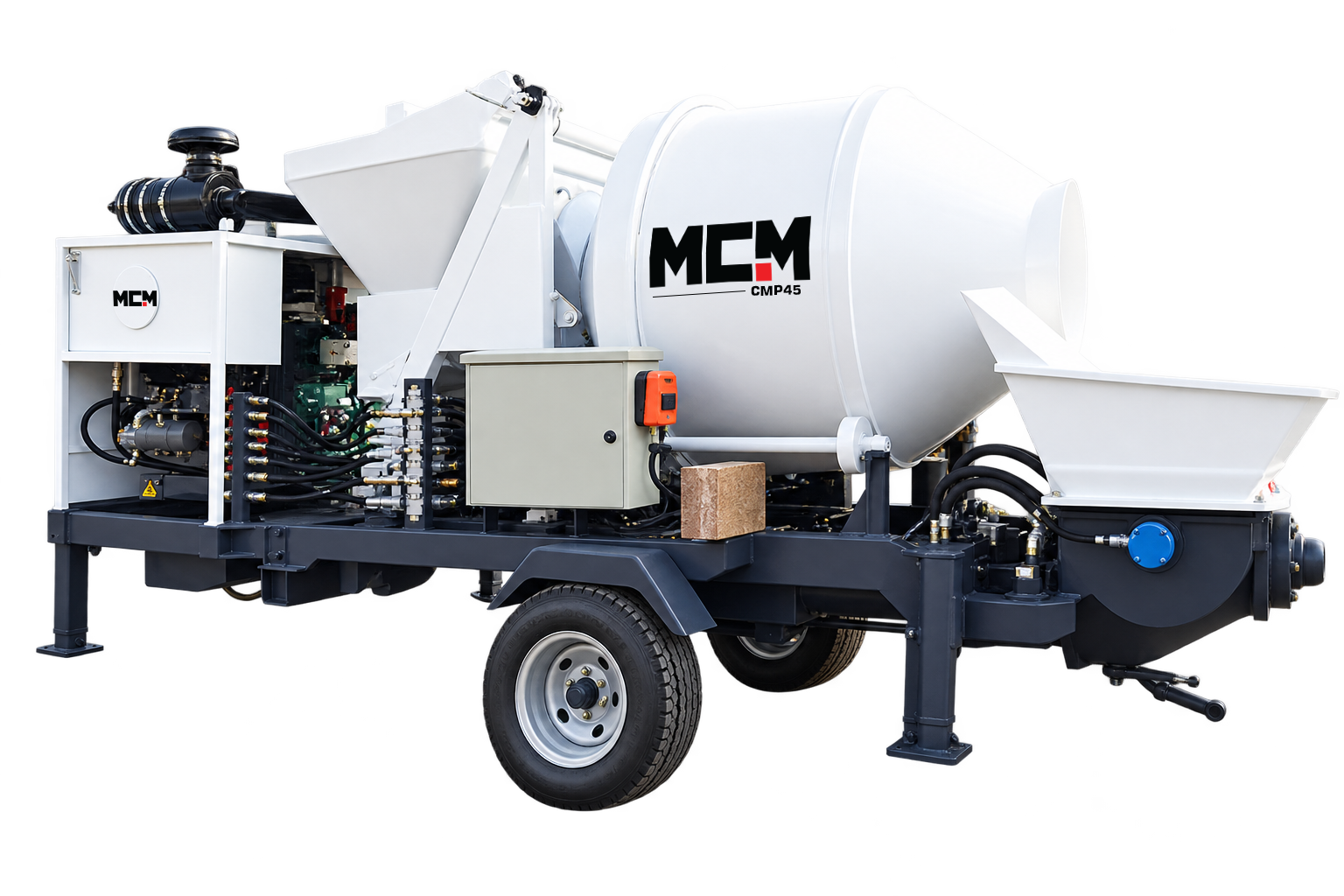
The MCM CMP38 and MCM CMP45 mixer pumps add a 0.45 m³ mixing tank and a 0.5 m³ loading bucket to the pump, so aggregate is loaded, mixed and pumped in one continuous cycle. The CMP38 delivers up to 38 m³ an hour and conveys concrete 250 m horizontally or 60 m vertically on an 83 kW Huadong diesel (R589 497). The CMP45 lifts that to 45 m³ an hour, 300 m horizontally or 80 m vertically, on a 92 kW engine (R629 499). Both handle 35 mm aggregate and include 100 m of steel pipe.
Concrete mixers and pumps compared
Quick answer: Use capacity for mixers and output plus reach for pumps, then match the price band to how often the machine will run. A drum mixer that works twice a month and a self-loader that works every day are both good buys; the mistake is buying the wrong one.
| Model | Type | Capacity / output | Price excl. VAT | Best for |
|---|---|---|---|---|
 MCM CM350 MCM CM350 | Towable drum mixer | 350 L drum, diesel, hydraulic hopper | R129 950 | Small builders, farms, plaster and footings |
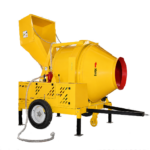 MCM CM500 MCM CM500 | Towable drum mixer | 500 L drum, diesel, hydraulic hopper | R139 950 | General building, slabs and columns |
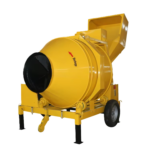 MCM CM750 MCM CM750 | Towable drum mixer | 750 L drum, diesel, hydraulic hopper | R149 950 | Civil work, kerbing, culverts |
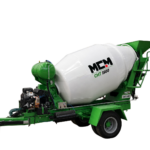 MCM CMT 1500 MCM CMT 1500 | High-output drum mixer | 1 500 L, diesel | On request | Plant yards and large continuous pours |
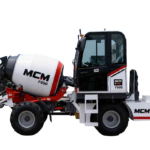 MCM F600 MCM F600 | 4×4 self-loading mixer | Compact self-loader, diesel 4×4 | From R325 000 | Multi-site contractors without ready-mix |
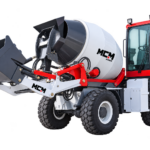 MCM F1300 MCM F1300 | 4×4 self-loading mixer | ≥ 1.3 m³ per batch, Yuchai 73 kW turbo | On request | Daily pours, remote and rural sites |
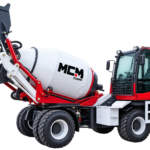 MCM F2800 MCM F2800 | 4×4 self-loading mixer | ≥ 2.8 m³ per batch, 85/90 kW turbo | On request | Large slabs, roads and bridge works |
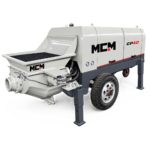 MCM CP40 MCM CP40 | Trailer concrete pump | 40 m³/h, 11 MPa, Huadong 76 kW | R499 532 | Placing ready-mix or batched concrete at height |
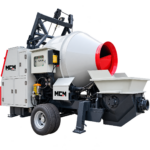 MCM CMP38 MCM CMP38 | Mixer pump | 38 m³/h, 250 m / 60 m reach, 83 kW | R589 497 | Mix and pump from one machine |
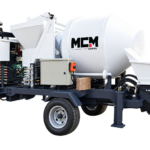 MCM CMP45 MCM CMP45 | Mixer pump | 45 m³/h, 300 m / 80 m reach, 92 kW | R629 499 | Multi-storey and long-reach pours |
Specifications and prices from MCM Group product pages, October 2026, excluding VAT and delivery. Confirm current stock and pricing with a sales specialist.
Which concrete machine for which job?
Quick answer: Match the machine to the pour, the site access and the distance from aggregate to formwork.
- House foundations, floor slabs and plaster: MCM CM500 or MCM CM750 fed by a TLB or wheelbarrows, with a site dumper to move the mix.
- Farms, game lodges and smallholdings: MCM CM350 for troughs, floors and repairs; an MCM F600 where the farm pours regularly and ready-mix will not deliver.
- Multi-site contractors and housing developments: MCM F1300 or MCM F2800 to batch at each slab without a plant, loader or truck.
- Roads, kerbing, culverts and bridge works: MCM F2800 for volume, MCM CMT 1500 at the plant yard, MCM CP40 to place where trucks cannot reach.
- Multi-storey floors, columns, retaining walls and pools: MCM CMP45 for mix-and-pump on one trailer, or MCM CP40 fed by ready-mix trucks.
- Plant-hire fleets: MCM CM750 and MCM CMP38 are the units most often hired out by the day.
What is happening in the South African concrete market
Quick answer: Cement supply is consolidating, local producers are adding capacity, and anti-dumping duties still shape import prices, so contractors who batch their own concrete with bagged cement and local aggregate keep more control over cost per cubic metre.
- AfriSam changes hands. The Competition Commission approved West China Cement’s R2.5 billion acquisition of AfriSam in December 2025, with a three-year moratorium on retrenchments and conditions to maintain South African production capacity. PPC has publicly warned that the buyer could route cement from its Mozambique operation through AfriSam’s distribution network (Business Day).
- New local capacity. PPC is building a 1.5 million-tonne-a-year integrated plant with Sinoma for around US$160 million, with commissioning scheduled by the end of 2026 (Global Cement). PPC also reported EBITDA up 31% to R2.08 billion for the year to March 2026 (CemNet), a sign that volumes and pricing have firmed.
- Import protection remains. Anti-dumping duties on cement from Vietnam and China have applied since 2023, which has given domestic producers back some pricing power in the coastal provinces where imports land.
- Infrastructure is the demand engine. Over R1 trillion of public infrastructure spending is planned over the medium term, led by transport, logistics, energy and water (2026 Budget analysis). Those are concrete-heavy programmes, and most of the work is awarded to contractors who bring their own batching and placing equipment to site.
For a contractor, the practical reading is simple: ready-mix pricing will track cement and transport costs upward, and delivery radius will not improve in rural districts. Owning the mixer, and for larger jobs the pump, converts a per-cubic-metre cost into a machine that earns on every pour.
How much does a concrete mixer or pump cost in South Africa?
Quick answer: At MCM Group, drum mixers run from R129 950 to R149 950, the self-loading F600 from R325 000, and pumps and mixer pumps from R499 532 to R629 499, all excluding VAT. The CMT 1500, F1300 and F2800 are quoted on request.
Set the purchase price against what the machine replaces. A self-loader removes the loader hire, the mixer and the dumper, plus the labour standing around a drum. A mixer pump removes the wheelbarrow line and the hours a crew loses waiting for a ready-mix truck. Most buyers finance: MCM submits one application to several banks and asset-finance houses with approval typically inside 48 to 72 hours, and VAT-registered buyers claim the input VAT. Farming businesses should also read about the Section 12B deduction and the VAT rules on construction equipment.
How to choose a concrete mixer or pump: 5 checks
Quick answer: Size the batch to your typical pour, decide who feeds the machine, check site access and reach, confirm the engine and parts support, then compare the cost per cubic metre against ready-mix.
- Size the batch to the pour. A 350-litre drum gives roughly 0.25 m³ of mixed concrete per batch; a 750-litre drum about 0.5 m³; a self-loader 1.3 to 2.8 m³. Count the cubic metres in your most common pour and the hours you have to place it.
- Decide who feeds it. Drum mixers need a loader, TLB or labour to charge the hopper. Self-loaders feed themselves, which is the whole point on sites with a small crew.
- Check access and reach. Measure the route to the pour. If the mixer cannot reach the formwork, you need a dumper or a pump; if the pour is above ground floor or more than 50 m from the road, a pump pays for itself quickly.
- Confirm the engine and the parts. MCM’s self-loaders run Yuchai turbo diesels and the pumps run Huadong diesels with Kawasaki hydraulics, all supported by the National Parts Division. Ask what filters and wear parts are on the shelf before you buy any brand.
- Do the cost per cubic metre. Add fuel, operator, cement and aggregate for your own batching and compare it with the delivered ready-mix price including waiting time and minimum loads. On most rural and repeat work the owned machine wins inside the first year.
Frequently asked questions about concrete mixers and pumps in South Africa
How much does a concrete mixer cost in South Africa?
Self-loading concrete mixer vs drum mixer: which is better?
Where can I buy concrete mixers and concrete pumps in South Africa?
Is it cheaper to mix concrete on site than to buy ready-mix?
How far and how high can an MCM concrete pump deliver?
How much concrete can these machines produce per hour?
Can I tow the drum mixers and pumps behind a bakkie?
Do MCM concrete mixers come with a warranty and parts?
Can I finance a concrete mixer or pump?
Talk to an MCM concrete equipment specialist
Tell us the size of your typical pour, how far the formwork is from the road and whether you have ready-mix supply, and a specialist will recommend a machine and quote the same working day. Browse the full concrete mixer and pump range, message WhatsApp 081 885 0535, or contact your nearest branch. For background on the machines, see how a concrete mixer and a concrete pump work.
- MCM Group Cape Town
9 Karee Rd, Kraaifontein Industria, Cape Town, 7570
+27 21 001 8686 · sales@mcmco.co.za
Mon–Fri 08:00–17:00 - MCM Group George
Jura Lands, Beach Road, Hansmoeskraal, George, 6529
+27 44 878 2917 · sales@mcmco.co.za
Mon–Fri 08:00–17:00 - MCM Group Bloemfontein
Bloem Showgrounds, Curie Avenue, Generaal De Wet, Bloemfontein, 9301
+27 84 022 7300 · sales@mcmco.co.za
Mon–Fri 08:00–17:00 - MCM Group Midrand
108 Roan Crescent, Randjespark, Midrand, 1685
+27 12 030 3451 · sales@mcmco.co.za
Mon–Fri 08:00–17:00