

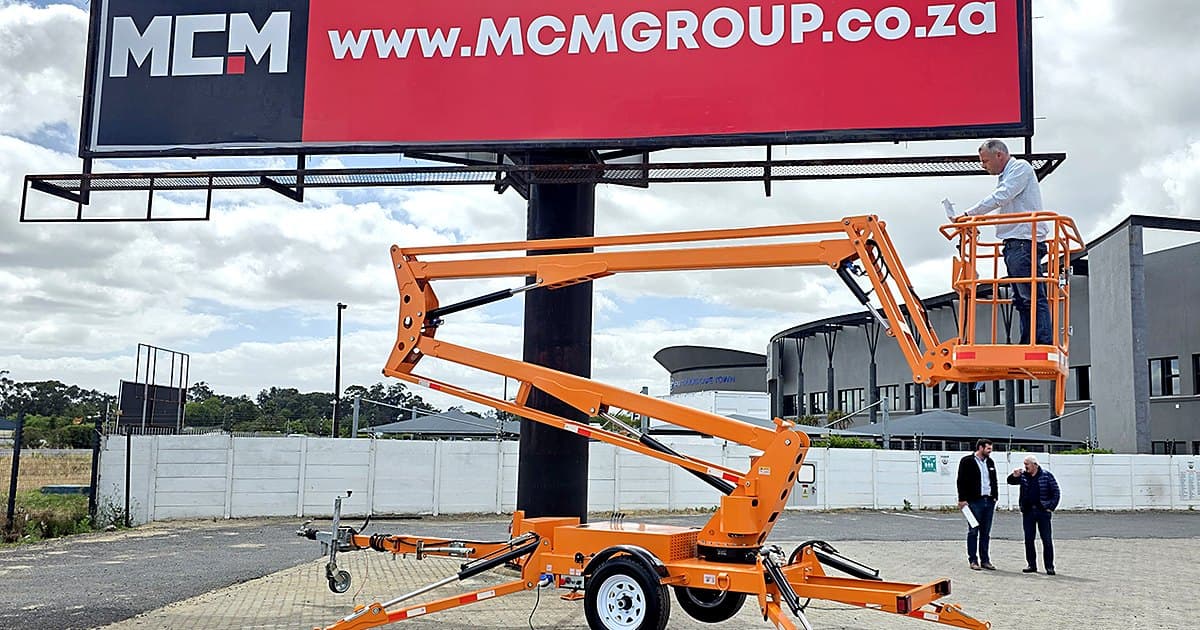
A towable cherry picker (also called a trailer-mounted towable boom lift) is the most underrated machine in South African access work. It hitches to a tow vehicle, sets up in minutes and puts a person and 200 kg of tools anywhere from 12 to 24 metres in the air. And it reaches up and over obstacles that stop ladders, scaffolding and scissor lifts dead. Here is what it can really do.
06:40, somewhere on the Highveld
Picture a signage contractor’s Tuesday. At first light a billboard on the N1 has two dead floodlights and a client who’s paying for every hour it sits dark. At eleven, a school across town wants a CCTV camera moved to the top of a three-storey block. After lunch, a hail-damaged gutter needs replacing on a double-storey house with a swimming pool exactly where the scaffolding should go.
Three sites, three heights and three very different problems. The old answer was a scaffolding crew, a hired crane truck and a lot of phone calls. The new answer is one orange machine on a single axle that follows the bakkie from job to job and is gone by lunch.
That’s the hidden versatility of the towable cherry picker. Most people look at it and see a small boom lift. People who own one see a business that can say “yes” to almost any job at height.
What a towable cherry picker actually is
Strip away the jargon and it’s three things bolted together. A road-going trailer chassis. An articulated boom that folds like an elbow. And a steel basket for one operator, their tools and their materials. When you arrive on site you unhitch, drop four hydraulic outriggers, level the machine and fly the basket to wherever the work is.
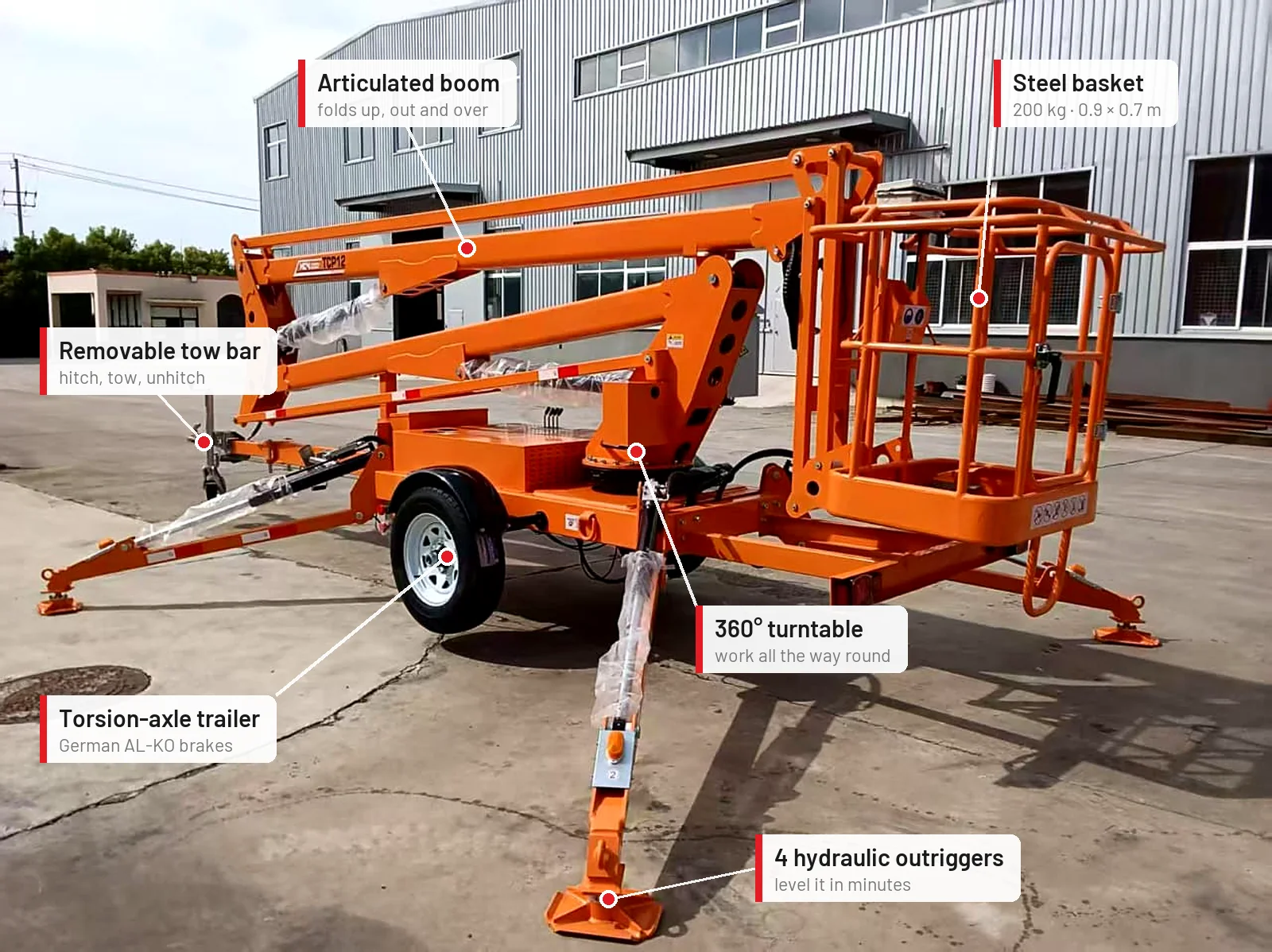
The magic is in that elbow. A scissor lift only goes straight up. A ladder only goes where it can lean. An articulated boom goes up, out and over. It can clear a boundary wall, a carport, a flowerbed or a parked car and still put the basket right against the work. The 360° turntable means you rarely have to move the machine to reach the next spot. You just swing round.
How high is high? Seven reaches, one family
MCM’s range runs from the TCP10 to the TCP22. The model number is the height of the platform floor in metres. Add about two metres for the operator’s own reach and you get the working height, which is the height you can actually work at.
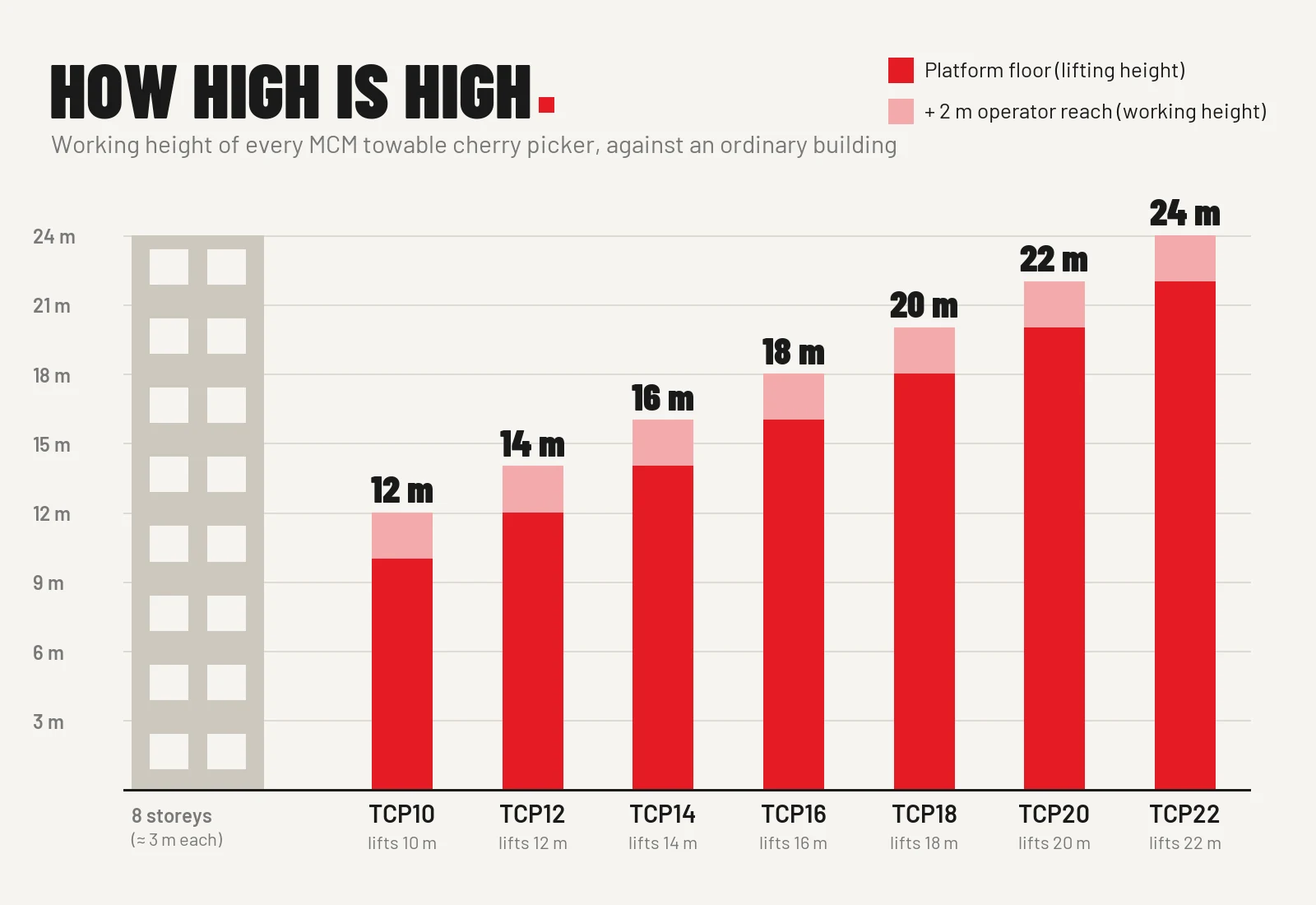
Every model carries 200 kg on a 0.9 × 0.7 m platform. That’s one operator plus a toolbox, a ladder’s worth of hardware or a pair of floodlights. What changes up the range is reach: working height climbs from 12 m to 24 m and outreach grows from 5.5 m to 12 m.
Eight jobs you probably didn’t know a cherry picker could do
Everyone knows about streetlights and tree trimming. The real story is the work nobody thinks of until a towable boom lift turns up and does it in an afternoon.
1. Billboards and signage that can’t afford to go dark
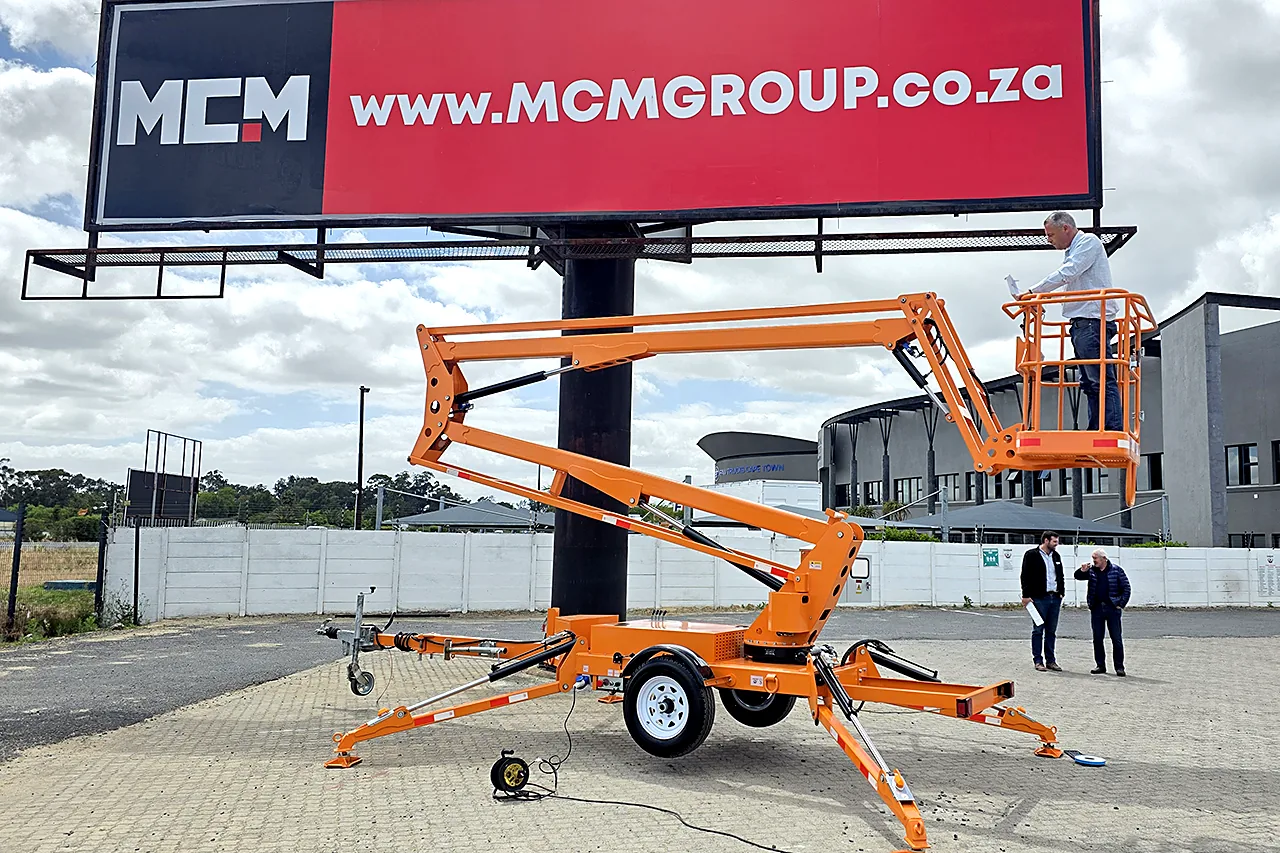
Outdoor media owners lose money every night a lamp is out. A towable lets one technician replace lights, re-skin a panel or fix a sensor without booking a crane truck. Then they hitch up and drive to the next board on the route.
2. Silos, plants and the jobs above the dust
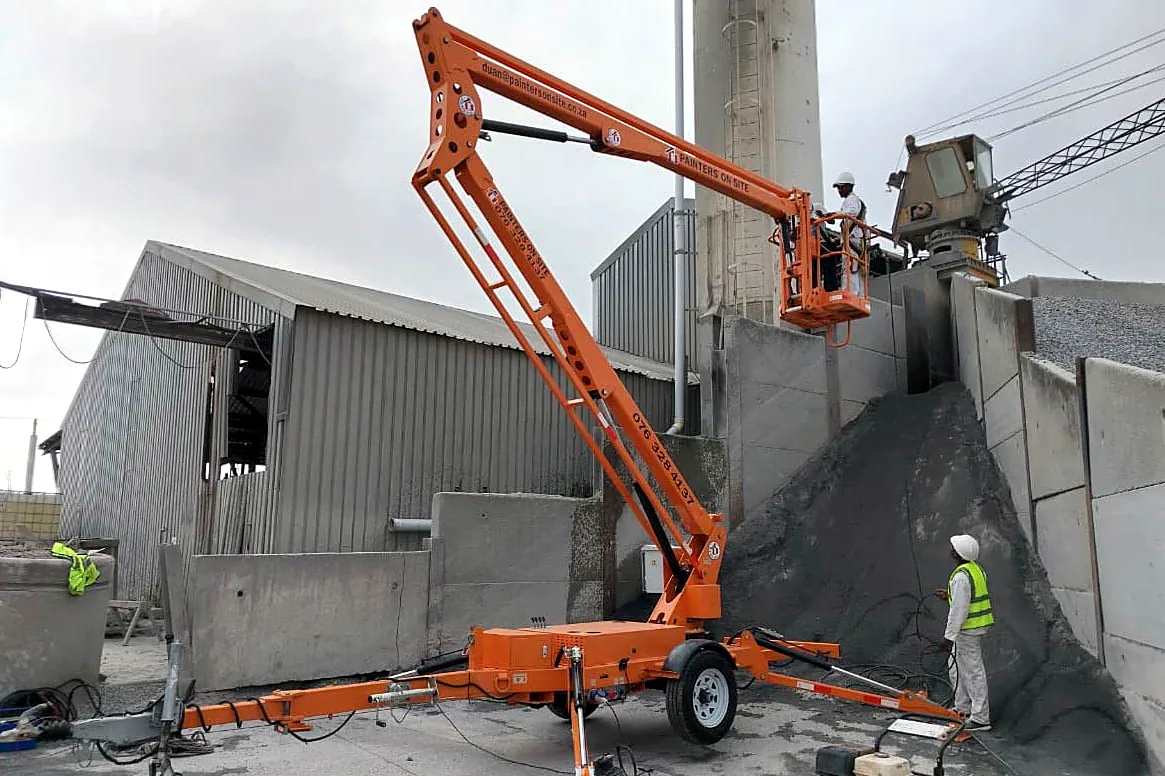
Cement plants, grain silos and packhouses are full of valves, sensors, lights and seams 10 to 20 metres up. They need inspecting, pressure-washing or replacing on a schedule. A towable rolls through a gate where a truck-mounted platform won’t fit. It sets up on the yard’s concrete and gives the maintenance team a stable platform instead of a harness and a prayer.
3. Façades, windows and heritage brickwork
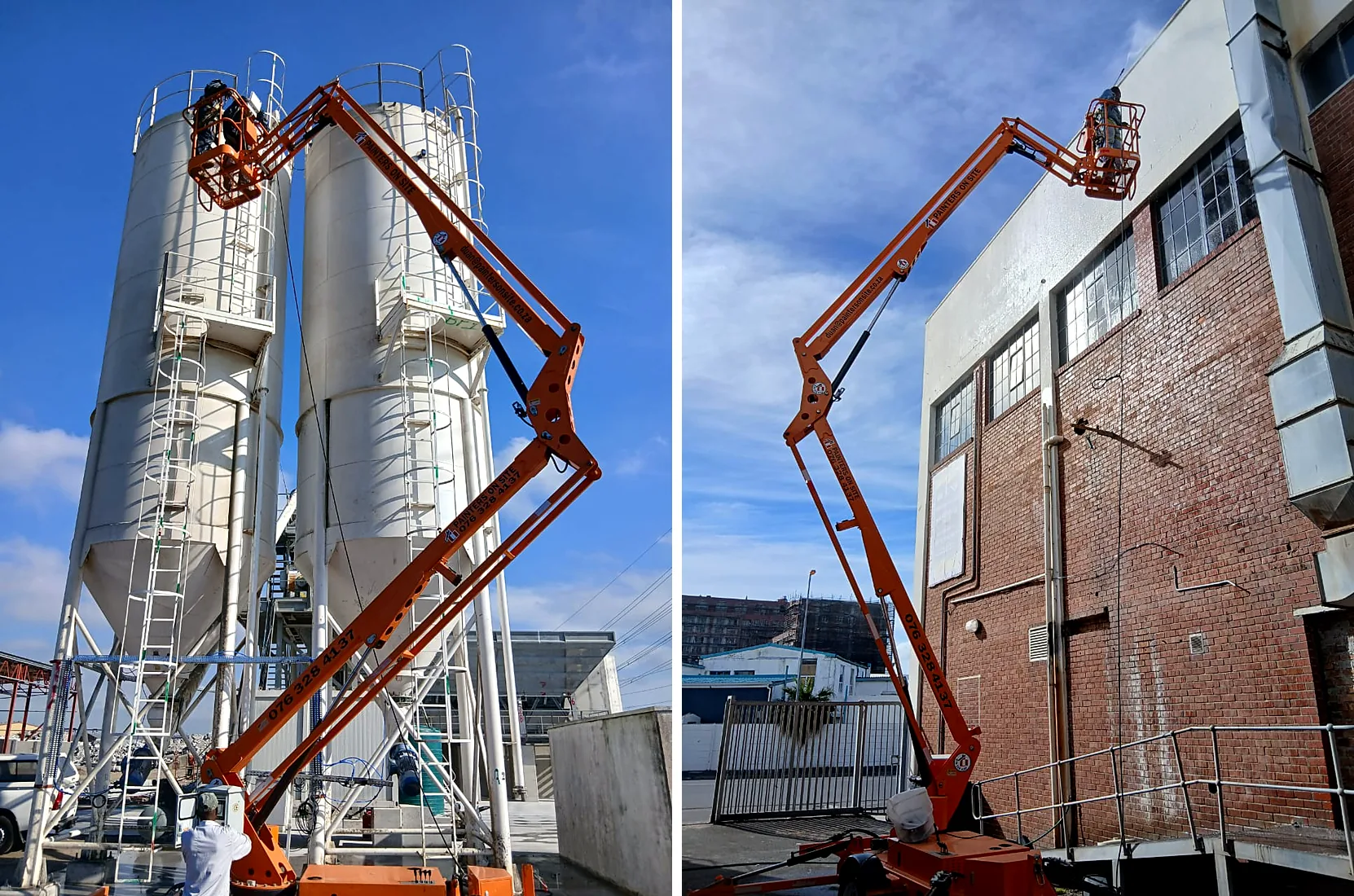
Painting, sealing, re-pointing, cleaning windows or fitting signage on a multi-storey building usually means weeks of scaffolding. A towable cherry picker can work a whole elevation in days. It also leaves the pavement, the entrance and the tenants’ parking almost untouched.
4. Hail and storm damage, before the next storm
After a Highveld hailstorm, roofers, assessors and gutter specialists all need to get up high, and quickly. A cherry picker lets an assessor photograph a whole roof safely. It lets a repair team replace sheeting and gutters without walking on damaged roofing.
5. Solar panels, geysers and rooftop kit
South Africa has put a lot of solar on a lot of roofs. All of it needs installing, cleaning, inspecting and sometimes removing. A towable boom lift gets panels, mounting rails and an installer to the roof edge without anyone carrying heavy modules up a ladder.
6. Trees that hang over things you can’t break
Arborists love the articulated boom because the problem branch is always over a roof, a pool, a fence or a neighbour’s car. The basket goes up and over the obstacle and the cut happens from a stable platform, not a swaying ladder.
7. Events, sports fields and festive lights
Rigging stage lighting, hanging banners, servicing floodlights at a club field, or putting up the town’s festive-season lights before December all share one thing. The work is short, high and in a different place every day. That’s exactly the kind of work a towable is made for.
8. CCTV, Wi-Fi and the small jobs that keep coming back
Security installers, electricians and network technicians do dozens of quick jobs at height every month. One camera, one access point, one light fitting. Each job is too small for scaffolding and too high for a ladder to be comfortable. Owning a towable turns all those awkward call-outs into billable hours.
The question isn’t “what can a towable cherry picker do?” It’s “what work am I turning away because I can’t get up there?”
Gone by lunch: the towing advantage
Here’s the part that changes the numbers. A self-propelled boom lift has to arrive on a truck, and that truck costs money every time the machine moves. A towable comes with its own wheels. It has a torsion axle, pneumatic tyres, German AL-KO brakes and a removable tow bar, so it’s already a trailer.
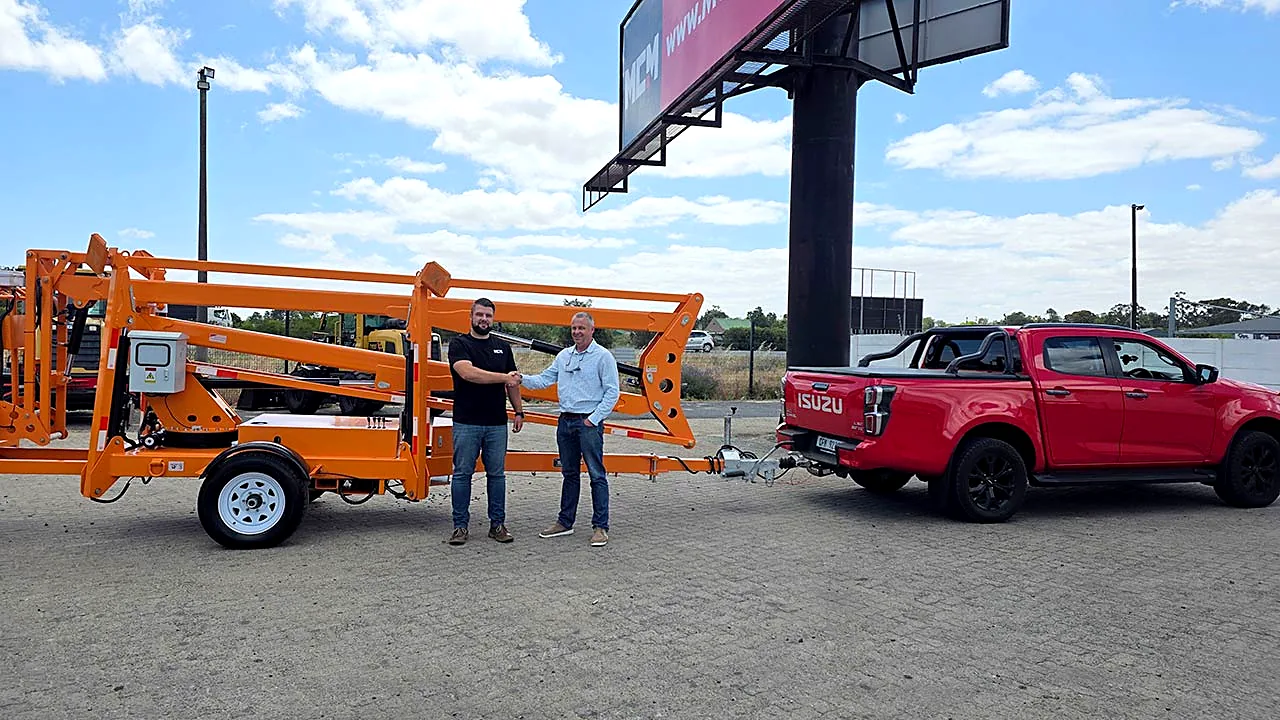
That means one operator can do a morning job in one suburb and an afternoon job in the next town, with no delivery to book, no flatbed to wait for and no transport invoice. When the job is done it unhitches and parks in a fraction of the space a self-propelled machine needs.
A word on what tows what. Net weights run from 1 855 kg (TCP10) and 2 050 kg (TCP12) to 2 800 kg for the TCP16, TCP18 and TCP20. The TCP22 is 4 500 kg. Before you tow, check two things. First, that your vehicle’s braked towing rating covers the machine. Second, that the driver holds the right licence code for a heavy trailer (usually EB). The flagship TCP22 is a job for a truck, not a bakkie. Our team will help you match machine to vehicle before you buy.
Watch it work: 30 seconds with the TCP16
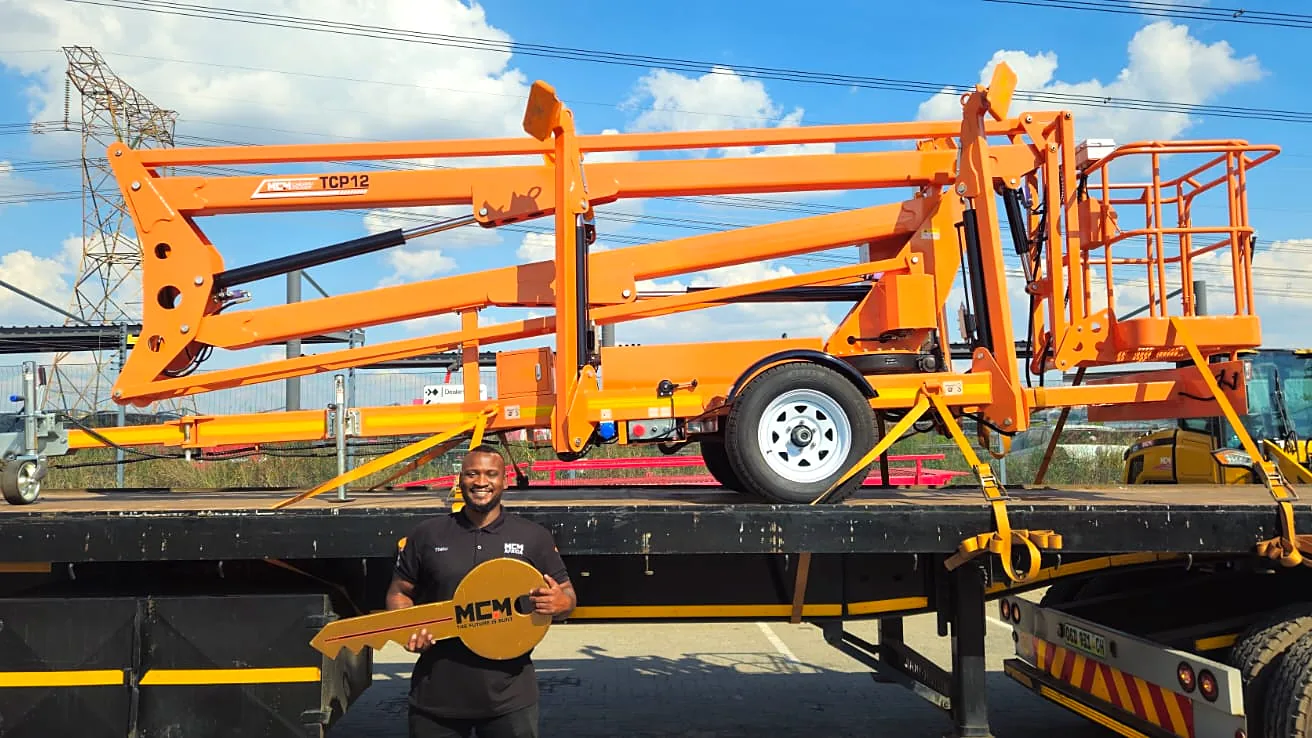
Here the TCP16 sets up next to a multi-storey brick building and climbs to the top floors. It lifts to 16 m, gives 18 m of working height and 10.5 m of outreach, and weighs 2 800 kg.
Set up in minutes, run by one person
The usual objection to “proper” access equipment is that it needs a specialist to run it. A towable cherry picker doesn’t. The basics of setting up one of the smaller TCP models look like this:
- Unhitch and chock. The removable tow bar comes off so the machine takes up less room on site.
- Drop the four hydraulic outriggers from the ground control lever bank. Each leg adjusts for angle, so uneven ground isn’t a dealbreaker.
- Check level. A tilt sensor stops the platform moving up or down if the machine is more than 4° off level.
- Climb in and fly. A waterproof control panel in the basket, with a dead-man switch, puts boom, turntable and height under the operator’s hand.
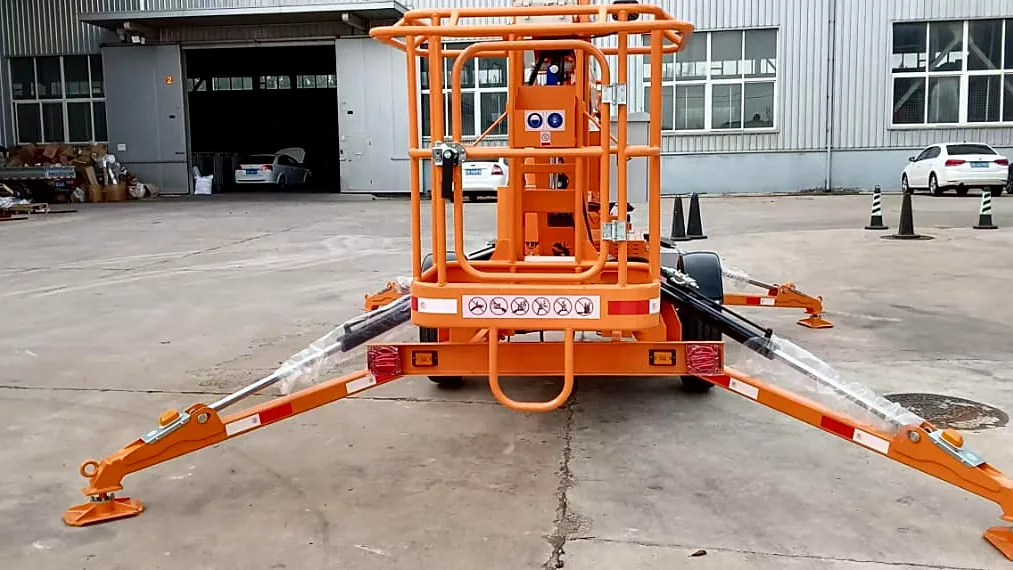
The power options are as flexible as the machine. The standard power unit on the smaller models is a Changchai diesel engine. A Honda petrol engine or a DC battery motor is available as an option. The TCP16 is offered with dual diesel + DC power. Battery power matters more than people think: it’s quiet and emission-free, which opens up malls, hospitals, schools and early-morning residential work.
Safety you can see, and safety you can’t
Working at height is serious, and a good towable is built so the machine catches mistakes before people make them. On the MCM spec sheet for the smaller models you’ll find:
- Tilt sensor: the platform won’t move up or down if the base is more than 4° off level.
- Emergency stop and emergency descent: two-way cylinders with balance valves, plus an emergency decline switch to bring the basket down.
- Dead-man switch on the basket controls, so nothing moves unless the operator means it to.
- Limit switches and a siren to warn people on the ground.
- Transport safety locks on the arm and basket, so nothing shakes loose on the road.
- Wind rating up to level 5 on the Beaufort scale (a fresh breeze, roughly 29–38 km/h). Above that, come down.
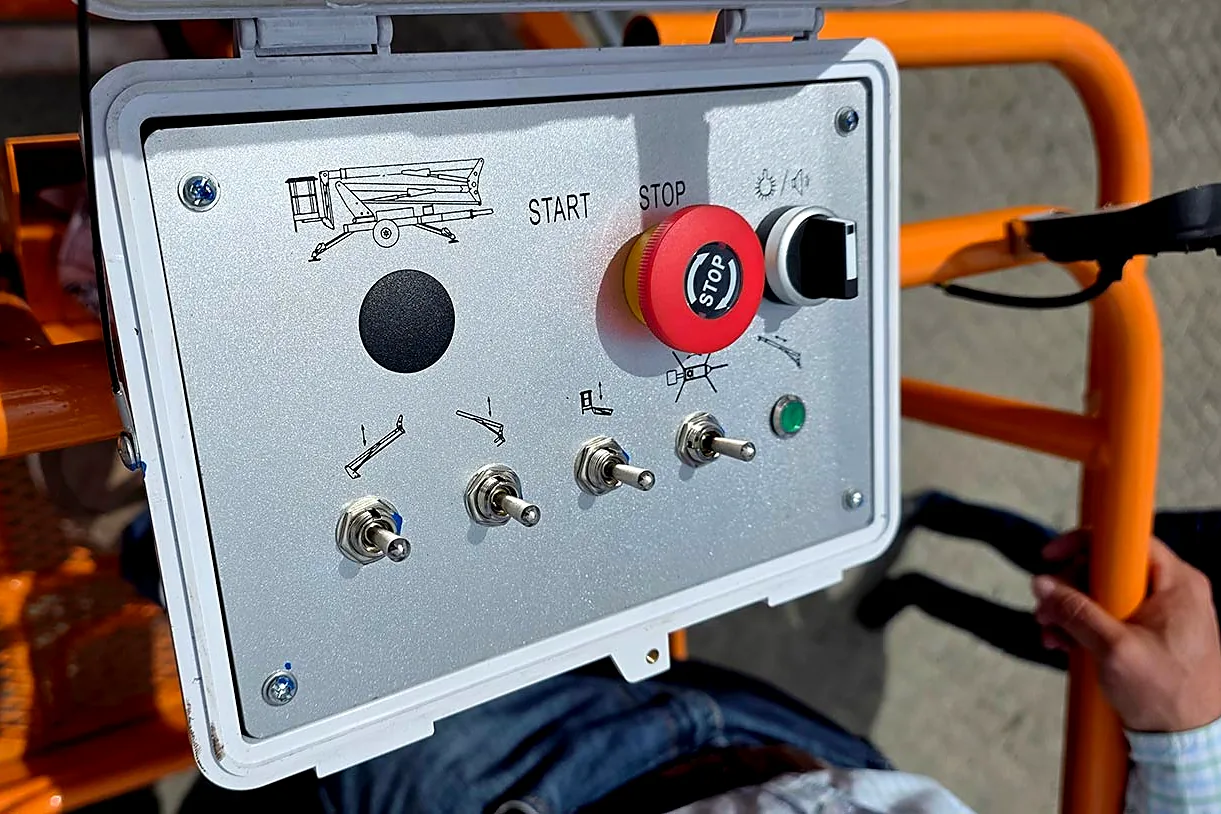
Two rules no machine can enforce for you. First, treat every overhead line as live, keep well clear, and speak to the line owner (Eskom or your municipality) before working anywhere near one. Second, the person at the controls must be trained and competent, as the Occupational Health and Safety Act requires. MCM offers on-site commissioning and operator training. Read our cherry picker service and compliance guide for the maintenance side.
Which one is yours?
Start with the highest point you work at regularly, not the highest you might ever need. Then check how far the boom has to reach out over obstacles. Use this as a starting point:
| Model | Lifting height | Working height | Working radius | Net weight | Sweet spot |
|---|---|---|---|---|---|
| TCP10 | 10 m | 12 m | 5.5 m | 1 855 kg | Shopfronts, double-storey homes, warehouse lighting |
| TCP12 | 12 m | 14 m | 6.5 m | 2 050 kg | Signage, CCTV, gutters and three-storey buildings |
| TCP14 | 14 m | 16 m | 8.5 m | 2 500 kg | Billboards, tree crowns, more outreach over obstacles |
| TCP16 | 16 m | 18 m | 10.5 m | 2 800 kg | Five-storey façades, silo tops, plant maintenance |
| TCP18 | 18 m | 20 m | 11 m | 2 800 kg | Industrial roofs and high-bay structures |
| TCP20 | 20 m | 22 m | 11 m | 2 800 kg | Tall trees, stadium and field lighting |
| TCP22 | 22 m | 24 m | 12 m | 4 500 kg | The flagship: eight storeys of reach |
Not sure? Browse the full cherry picker / trailer-mounted towable boom lift range. If you only need height now and then, ask about cherry picker rentals. For a straight-up job with a big deck, a scissor lift may suit you better, and our team will tell you honestly.
Frequently asked questions
What is the difference between a cherry picker and a towable boom lift?
Nothing, really. “Cherry picker” is the everyday South African name. “Towable boom lift” or “trailer-mounted boom lift” is the technical one. All of MCM’s TCP models are towable, articulated boom lifts on a road-going trailer chassis.
How high can a towable cherry picker reach?
MCM’s range gives working heights from 12 m (TCP10) to 24 m (TCP22). Working height is the platform height plus about 2 m of operator reach. That covers everything from a double-storey roofline to roughly an eight-storey building.
Can I tow a cherry picker with a bakkie?
The lighter models often can. The TCP10 weighs 1 855 kg and the TCP12 2 050 kg. Check that your vehicle’s braked towing rating covers the machine and that the driver has the right licence code for a heavy trailer (usually EB). The 4 500 kg TCP22 needs a truck. MCM can also deliver nationwide.
How much weight can the basket carry?
Every MCM towable cherry picker carries 200 kg on a 0.9 × 0.7 m platform. That’s enough for one operator with tools and materials.
Can a towable cherry picker be used indoors?
Yes, with the optional DC battery motor, which is quiet and has no exhaust fumes. The TCP16 is offered with dual diesel + DC power. Always check floor loading and overhead clearance first.
Should I buy or hire a cherry picker?
If you work at height every week, owning one usually pays for itself in saved scaffolding, crane-truck and labour costs. You also get to say yes to jobs you used to turn down. If you need one for a single project, hire is often the better call. MCM offers both, plus finance through approved partners.
Get up there
Tell us the highest point you work at and the obstacles in the way, and we’ll match you to the right TCP model. We’ll also book a demonstration at one of our branches or on your site. Visit MCM in Cape Town, Gauteng, George or Bloemfontein, or contact our team today.