
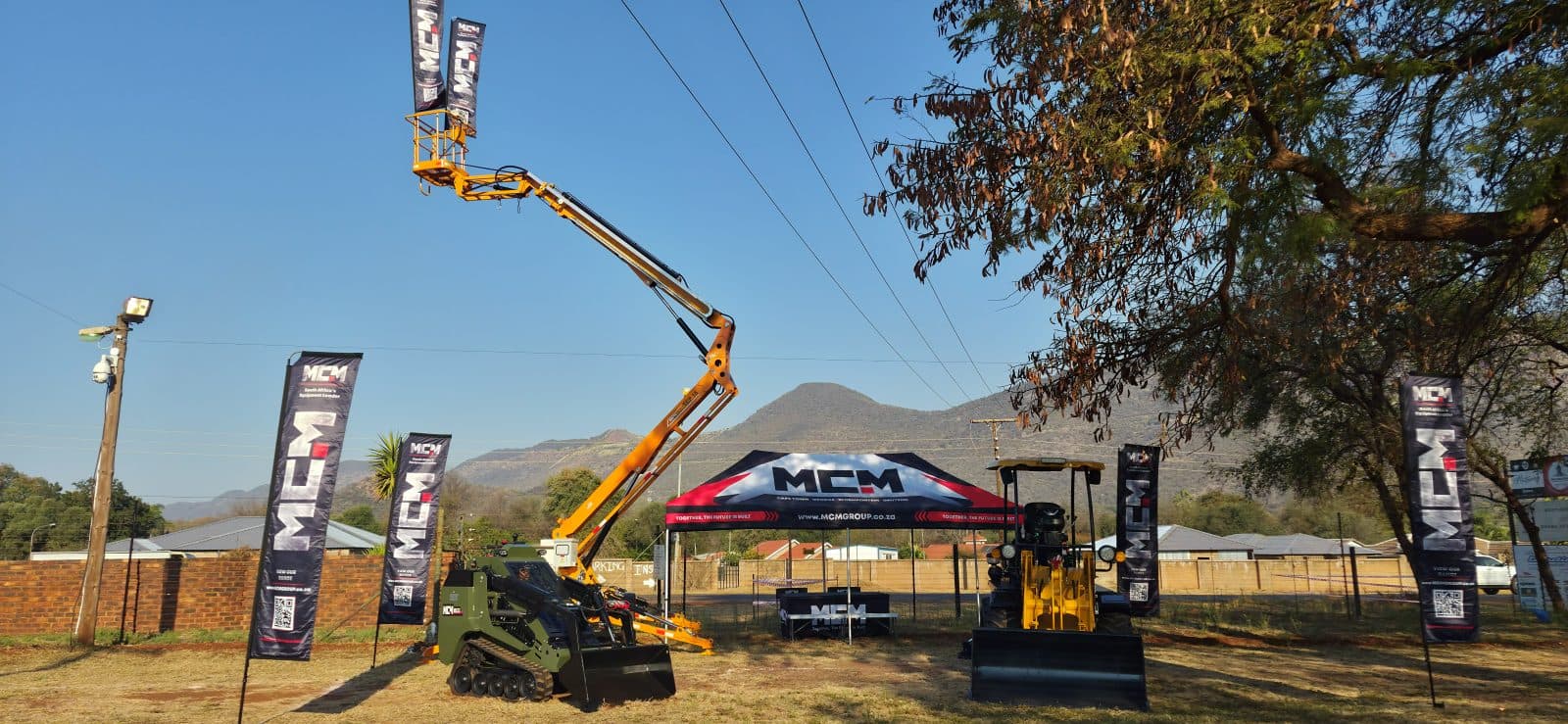
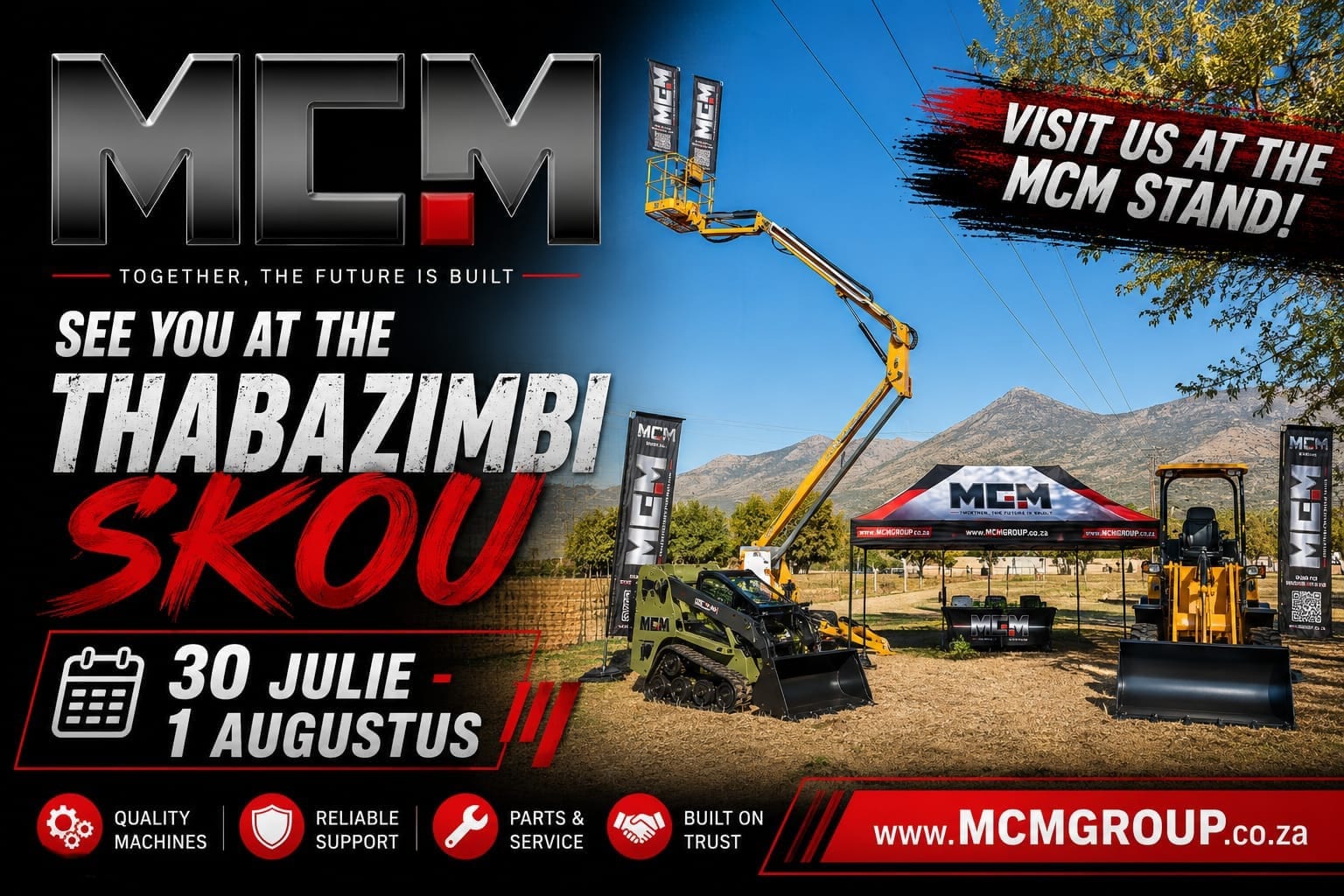
MCM Group’s Gauteng branch flew the flag at the 2026 Thabazimbi Landbou & Nywerheid Skou (30 July – 1 August 2026), showing three compact, high-value machines built for the way the Waterberg actually works: the MCM TCP-Range Cherry Picker / Trailer-Mounted Towable Boom Lift, the MCM 27X Jack Russell TLB and the MCM MS33 Mini Track Skidsteer. As always, every machine is backed by nationwide support from Cape Town, George, Gauteng and Bloemfontein.
Established in 1954, the Thabazimbi Expo remains an important meeting point for the region’s agricultural, industrial, mining, contracting and business communities. For MCM, the event provided far more than an opportunity to display machinery. It created a valuable platform to meet customers face to face, understand their operational challenges and demonstrate how carefully selected equipment can improve productivity across farms, mines, construction sites, estates and industrial operations.
Missed us at the show? Contact MCM Group for pricing, finance and a quote on anything you saw at Thabazimbi.
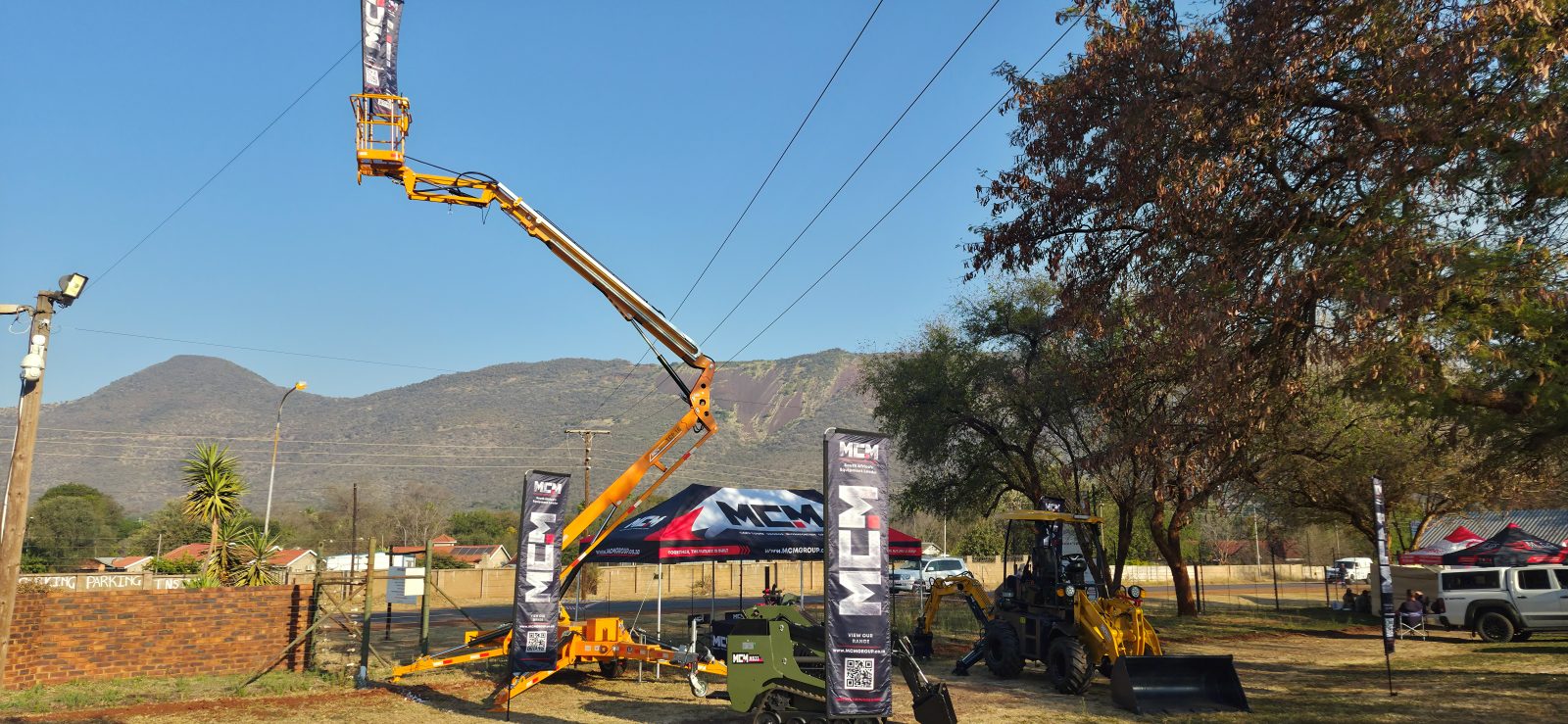
The MCM Gauteng team showcased three highly versatile machines — the MCM TCP-Range Cherry Picker, the MCM 27X Jack Russell TLB and the MCM MS33 Mini Track Skidsteer. Although each machine serves a different operational purpose, all three share a common value proposition: professional capability in a practical, transportable and cost-efficient package.
Bringing MCM Equipment Directly to the Thabazimbi Market
Thabazimbi sits within the Waterberg District, an economy shaped strongly by mining, agriculture, tourism, game farming and associated service industries. Mining remains the largest economic contributor within the broader Waterberg District, while agriculture continues to play a substantial role across Thabazimbi and the surrounding areas. That mix makes the Thabazimbi Expo particularly relevant to MCM.
Businesses operating in this region do not merely require impressive specifications on paper. They need equipment that can work reliably in demanding environments, move between sites, access confined areas and perform multiple functions without creating unnecessary operating costs. The experience of the MCM Gauteng team during the expo reinforced this reality — conversations with visitors repeatedly returned to the same practical considerations:
- Can the machine be transported economically?
- Can it work in confined or difficult-to-access areas?
- Can one machine perform several different jobs?
- Are parts and technical support available locally?
- Is finance available?
- Will the equipment deliver a commercial return?
These are the questions that guide MCM’s product strategy. Rather than supplying machinery simply because it is available, MCM focuses on equipment that addresses real operating conditions within the South African market.
More Than a Machinery Display
One of the most valuable aspects of attending the Thabazimbi Expo was the opportunity to move beyond brochures, photographs and online specifications. Visitors could stand next to the machines, inspect their construction, examine the controls and assess their dimensions for themselves. This physical interaction is particularly important when purchasing capital equipment.
A machine may appear compact in a photograph but still be too large for a customer’s access requirements. A loader may offer impressive capacity but be difficult or expensive to transport. An access platform may provide sufficient height but lack the horizontal reach required for a particular job. At the MCM stand, these considerations could be discussed directly with experienced equipment specialists, across applications such as farm maintenance, trenching and pipe installation, building and roof maintenance, tree cutting and vegetation management, material handling, loading and backfilling, estate and lodge maintenance, mining support services, electrical and telecommunications work, landscaping and irrigation, municipal maintenance, and small construction and civil projects.
This consultative approach is central to MCM’s business model. The objective is not simply to sell a machine. It is to match the customer with an equipment solution that fits the work, the site, the transport requirements and the available budget.
The MCM TCP Cherry Picker / Trailer-Mounted Towable Boom Lift: Taking Work to New Heights
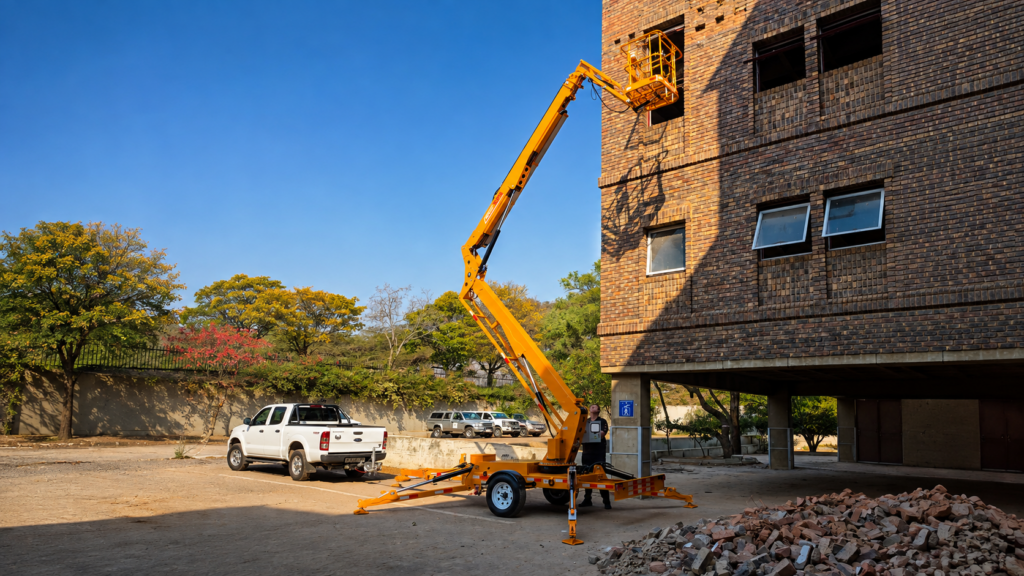
The MCM TCP Cherry Picker created a strong visual presence at the expo. Cherry pickers are becoming increasingly important across South Africa as businesses seek safer and more efficient methods of completing elevated work. Traditional ladders, scaffolding and improvised lifting arrangements can be slow, labour-intensive and unsuitable for many professional applications.
The MCM TCP Series provides a purpose-built solution for working at height. The towable articulated range extends from the TCP10 to the TCP22, with lifting heights from 10 metres to 22 metres and maximum working heights of up to 24 metres. Models across the range provide a 200 kg platform capacity, allowing space for an operator, tools and selected equipment.
Why the TCP Cherry Picker Attracted Attention
Visitors were particularly interested in the combination of reach and mobility. Unlike permanently truck-mounted platforms or large self-propelled boom lifts, a towable cherry picker can be transported between jobs without requiring a dedicated heavy transport solution for every movement. That creates a compelling business case for electrical contractors, solar installation companies, telecommunications teams, signage installers, tree-felling contractors, property maintenance companies, municipalities, schools and institutions, warehouses, shopping centres, industrial plants, farms and agricultural businesses, and mining and engineering service providers.
The articulated boom design also allows the machine to provide both vertical height and horizontal outreach — important where the operator cannot position the machine directly underneath the working area, such as reaching over walls, trees, structures, machinery or landscaping.
A Practical Asset for Maintenance Teams
The conversations at Thabazimbi highlighted an important point: many businesses only recognise the value of an access platform once they calculate the cumulative cost of outsourced elevated work. Hiring contractors, erecting scaffolding or repeatedly renting access equipment can become expensive, and it can delay routine maintenance while a business waits for external availability. For organisations with regular elevated work — roof and gutter maintenance, high-level painting, lighting replacement, security camera installation, electrical repairs, tree pruning, solar panel maintenance, building inspections, signage installation and warehouse maintenance — owning a cherry picker provides greater operational control. The MCM TCP Cherry Picker therefore represents more than access to height: it becomes a productivity asset that helps maintenance teams respond faster and work more professionally.
The MCM 27X Jack Russell TLB: Compact Size, Serious Capability
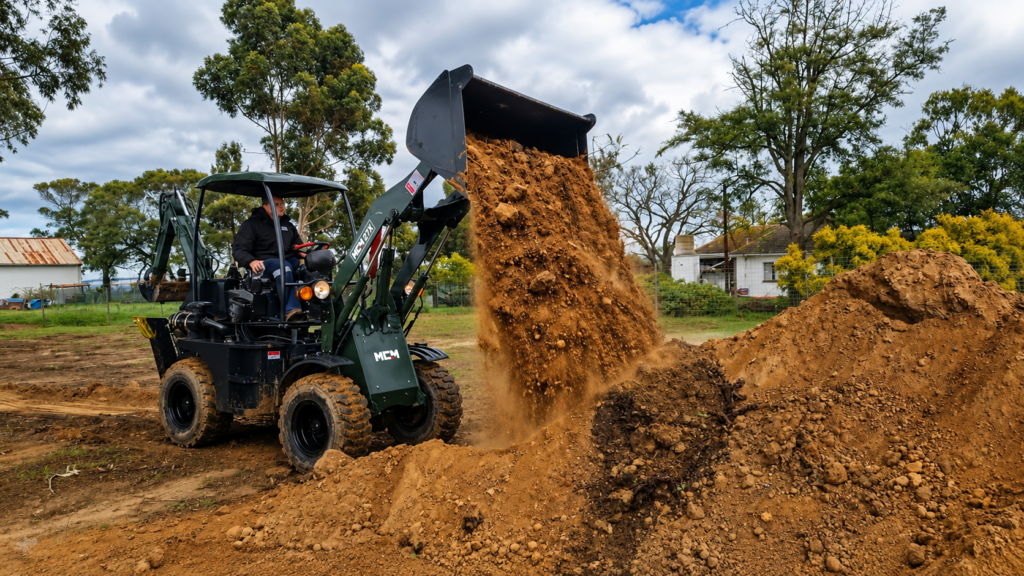
The MCM 27X Jack Russell TLB was another major attraction at the MCM stand. The nickname “Jack Russell” accurately captures the machine’s character: compact, energetic and always ready to work. Developed and tested for South African conditions since 2017, the MCM 27X has established itself as a highly practical mini TLB for farmers, contractors, landscapers, property owners and construction businesses.
Key MCM 27X Specifications
The MCM 27X is powered by a 37 kW (approximately 50 hp) diesel engine and has an operating weight of approximately 2,800 kg. Its key capabilities include:
- Rated lifting capacity of up to 1,000 kg
- Maximum digging depth of approximately 1.6 metres
- Approximately 0.45 m³ loader bucket capacity
- Compact overall dimensions
- Front-loader and rear-backhoe functionality
- Multiple attachment options
- Trailer-friendly operating weight
These characteristics make the 27X substantially easier to transport and manoeuvre than a conventional full-sized TLB, while retaining the ability to perform meaningful loading, digging, trenching and material-handling work.
Why Thabazimbi Customers Understand the 27X
The 27X aligns closely with the needs of the Thabazimbi market. Many customers in the region operate across farms, lodges, mines, workshops, small construction projects and large rural properties, and their equipment may be required to complete a different task every day. On one day the machine may excavate a water line; on the next it may load feed, move soil, clean a site, repair a road or dig foundations. Typical applications include:
- Digging irrigation trenches
- Installing underground cables and pipelines
- Loading compost, gravel, soil and rubble
- Excavating small foundations
- Cleaning drainage channels and repairing farm roads
- Maintaining game farms and lodges
- Loading trailers and preparing building sites
- Handling logs and agricultural materials, and backfilling trenches
Customers are increasingly seeking machinery that can generate value throughout the year rather than equipment limited to one specialised application. The 27X answers this by combining a front loader and rear excavator in one compact unit.
Transportability Creates Commercial Flexibility
One of the 27X’s strongest advantages is its approximately 2,800 kg operating weight. For contractors, transportability directly influences profitability — a machine that can be moved more easily between smaller projects gives the owner greater flexibility to service multiple customers and reduce mobilisation costs. For farmers and property owners, the compact size means the machine can operate where a full-sized TLB may be excessive or difficult to manoeuvre. The result is a machine capable of productive earthmoving work without the logistical footprint of a large conventional backhoe loader.
The MCM MS33 Mini Track Skidsteer: One Compact Machine, Multiple Applications
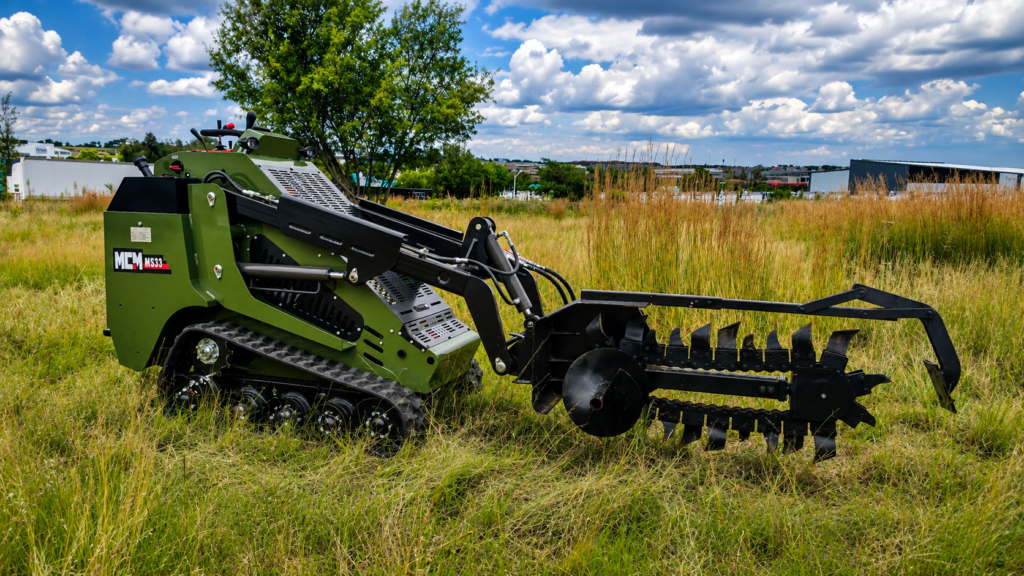
The MCM MS33 Mini Track Skidsteer demonstrated another important trend in the equipment market: the growing demand for compact tool carriers. At just over one metre wide, the MS33 is designed to access confined working areas while providing the hydraulic capability required to operate a broad selection of attachments. It is powered by an 18.8 kW (25 hp) Kubota diesel engine and offers a 300 kg rated operating capacity, while its rubber-track undercarriage provides improved traction on loose, uneven, muddy or sensitive surfaces.
Key MCM MS33 Specifications
- 18.8 kW Kubota diesel engine
- Rubber-track drive system
- 300 kg rated operating capacity
- Hydraulic flow of approximately 67.2 litres per minute
- Overall operating width of approximately 1,033 mm
- Travel speed of up to 8 km/h
- Compact, manoeuvrable configuration
- Compatibility with multiple hydraulic attachments
The combination of compact width, track traction and strong hydraulic flow allows the MS33 to perform tasks that would otherwise require substantial manual labour or several separate machines.
The Real Value Is in the Attachments
A mini skidsteer should not be viewed only as a small loader — its strategic value comes from the attachments it can operate. Depending on the selected attachment, the MS33 can be configured for loading, trenching, auger drilling, sweeping, levelling, grappling, breaking, soil preparation, material movement, landscaping, vegetation management, pallet handling and site cleaning. That makes it particularly relevant to landscaping companies, irrigation installers, fencing contractors, nurseries, builders, farmers, estates and property-maintenance businesses. A customer can invest in one power unit and expand its capabilities over time by adding attachments as new operational requirements emerge.
Built for Confined-Space Productivity
Many projects do not require a large skidsteer — they require a machine that can fit through restricted access points and work without damaging large sections of the surrounding area. The MS33 is well suited to residential construction sites, gardens and landscaped areas, greenhouses and nurseries, courtyards, narrow passages, farm buildings, workshops, animal enclosures, irrigation installations and commercial properties. Its rubber tracks distribute weight across a larger ground-contact area than conventional wheels, which improves traction and reduces the tendency to sink into softer surfaces — valuable on farms, lawns, sandy areas and uneven terrain.
Three Machines, One Practical Equipment Strategy
The three machines showcased by MCM Gauteng represented three different areas of work:
| Machine | Primary Role | Typical Applications |
|---|---|---|
| MCM TCP Cherry Picker | Working safely at height | Maintenance, electrical work, tree cutting, signage and inspections |
| MCM 27X Jack Russell TLB | Digging, loading and lifting | Farming, construction, trenching, road maintenance and property development |
| MCM MS33 Mini Track Skidsteer | Confined-space loading and attachment work | Landscaping, trenching, irrigation, material handling and site preparation |
Together, they demonstrated MCM’s broader equipment philosophy: the right machine should not be judged only by its physical size, but by the amount of productive work it can complete, the number of applications it can serve and the operating value it can create for its owner.
What MCM Learned at the Thabazimbi Expo
1. Customers want compact equipment without compromised performance
Businesses want machines that are easier to transport and manoeuvre, but they still expect meaningful digging, lifting, hydraulic and working-height capability. The 27X and MS33 demonstrate that compact machinery can still deliver serious commercial output.
2. Versatility is becoming a purchasing priority
Customers are increasingly evaluating how many tasks a machine can perform. This is particularly relevant for farmers, contractors and property-maintenance businesses that may not have continuous work for a highly specialised machine. Equipment that accepts multiple attachments or combines more than one core function can provide a stronger return on investment.
3. Customers value direct access to technical advice
Buying equipment requires more than comparing headline specifications. Customers want to understand transport requirements, attachments, maintenance, finance, parts availability and whether the machine is genuinely suitable for their application. The expo gave customers the opportunity to discuss these considerations directly with the MCM Gauteng team.
4. After-sales support remains critical
A machine only creates value while it is operational. Customers want confidence that their supplier can provide technical assistance, spare parts, service support and ongoing product knowledge after the sale. MCM supports its equipment through its branch network and National Parts Division, serving customers from Gauteng, Cape Town, George and Bloemfontein, with nationwide delivery and assistance with equipment-finance applications.
Supporting Customers Beyond the Expo
The conclusion of the Thabazimbi Expo does not mark the end of MCM’s engagement with the region. The Gauteng branch remains available to assist customers throughout Limpopo, North West, Gauteng and surrounding areas with equipment selection, quotations, product demonstrations, attachment recommendations, finance applications, nationwide transport, spare parts, technical support and servicing guidance. Customers who visited the stand are encouraged to continue the conversation, and those who could not attend can arrange a consultation or visit the Gauteng branch to inspect selected machinery.
Thank You, Thabazimbi
MCM Group extends its sincere appreciation to the organisers of the Thabazimbi Landbou & Nywerheid Skou and to every visitor who took the time to engage with the Gauteng branch team. The event once again demonstrated the importance of regional agricultural and industrial exhibitions in connecting South African businesses with practical machinery solutions. Most importantly, it gave MCM the opportunity to listen — the discussions, questions and feedback received during the expo will continue to shape how MCM selects, supports and presents equipment to the South African market. We look forward to building on the relationships established at the 2026 Thabazimbi Expo.
Frequently Asked Questions
What machinery did MCM showcase at the 2026 Thabazimbi Expo?
What is the MCM 27X Jack Russell TLB used for?
Is the MCM MS33 suitable for farms?
What working heights are available in the MCM TCP Cherry Picker range?
Does MCM provide equipment finance?
Where is MCM’s Gauteng branch?
Looking for Construction or Agricultural Equipment in South Africa?
Whether your operation requires a compact TLB, mini skidsteer, cherry picker, excavator, front-end loader, forklift, telehandler or other specialised machinery, MCM can help identify the right solution. Contact MCM Group for professional equipment advice, nationwide delivery, finance assistance and dependable after-sales support.
See the machines in person at any MCM Group branch: Cape Town (+27 21 001 8686), George (+27 44 878 2917), Gauteng (+27 12 030 3451) and Bloemfontein (+27 84 022 7300). National Sales: +27 81 885 0535 · sales@mcmco.co.za. We deliver nationwide.