

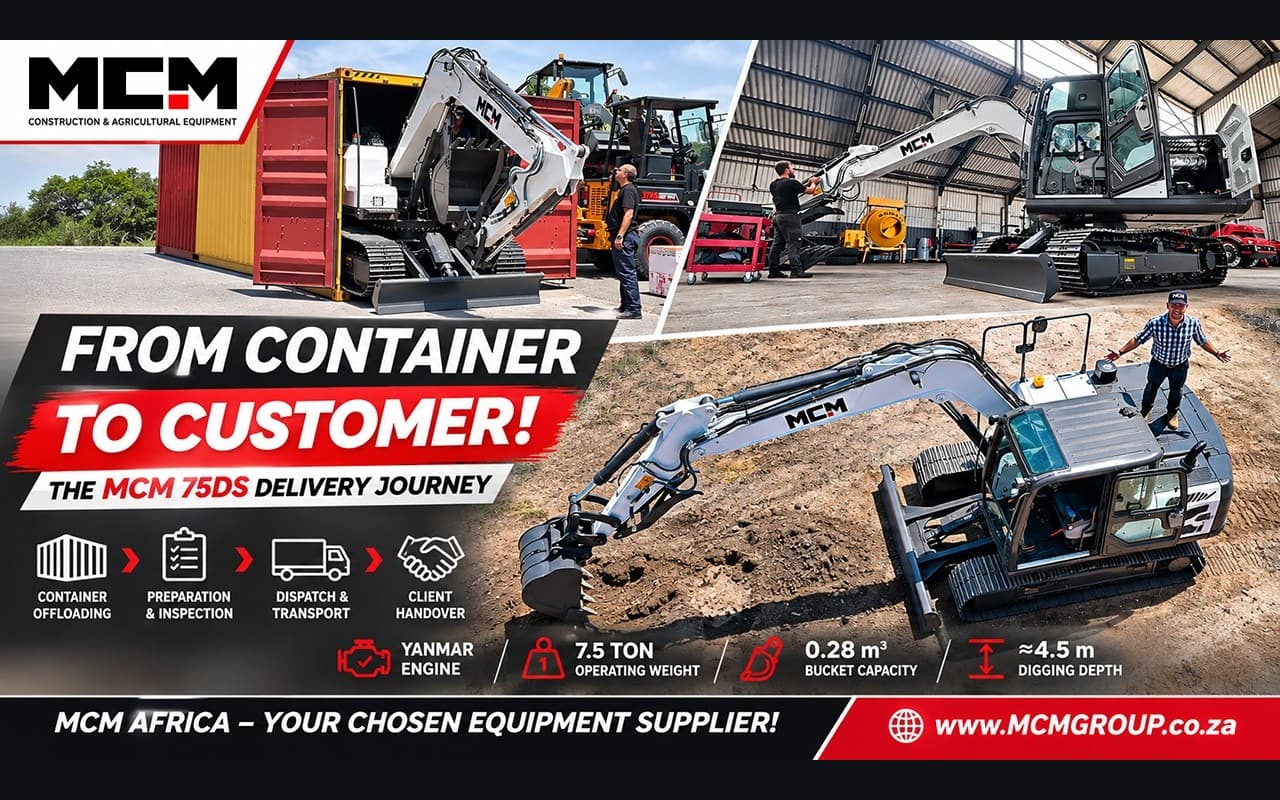
A new excavator spends weeks at sea, folded into a steel box. Here’s what happens before it ever reaches its owner. We followed one brand-new MCM 75DS, a 7.5-tonne Yanmar-powered crawler excavator, from the moment the container doors opened in Cape Town to the moment its new owner took over. Here is every step, and why each one matters to the person who signs for the machine.
Why the delivery is part of the machine
When you buy an excavator, you’re buying years of productive work. The best of those years start on day one, with a machine that arrives fully checked, set up correctly and proven under load, and an owner who knows exactly how to get the most out of it.
That’s why every machine goes through our workshop before it goes to you. Between the docks and your site there is a workshop, a checklist and a test dig, so your excavator is ready to work from the moment it rolls off the truck. This is what that looks like at MCM.
Step 1: The doors open
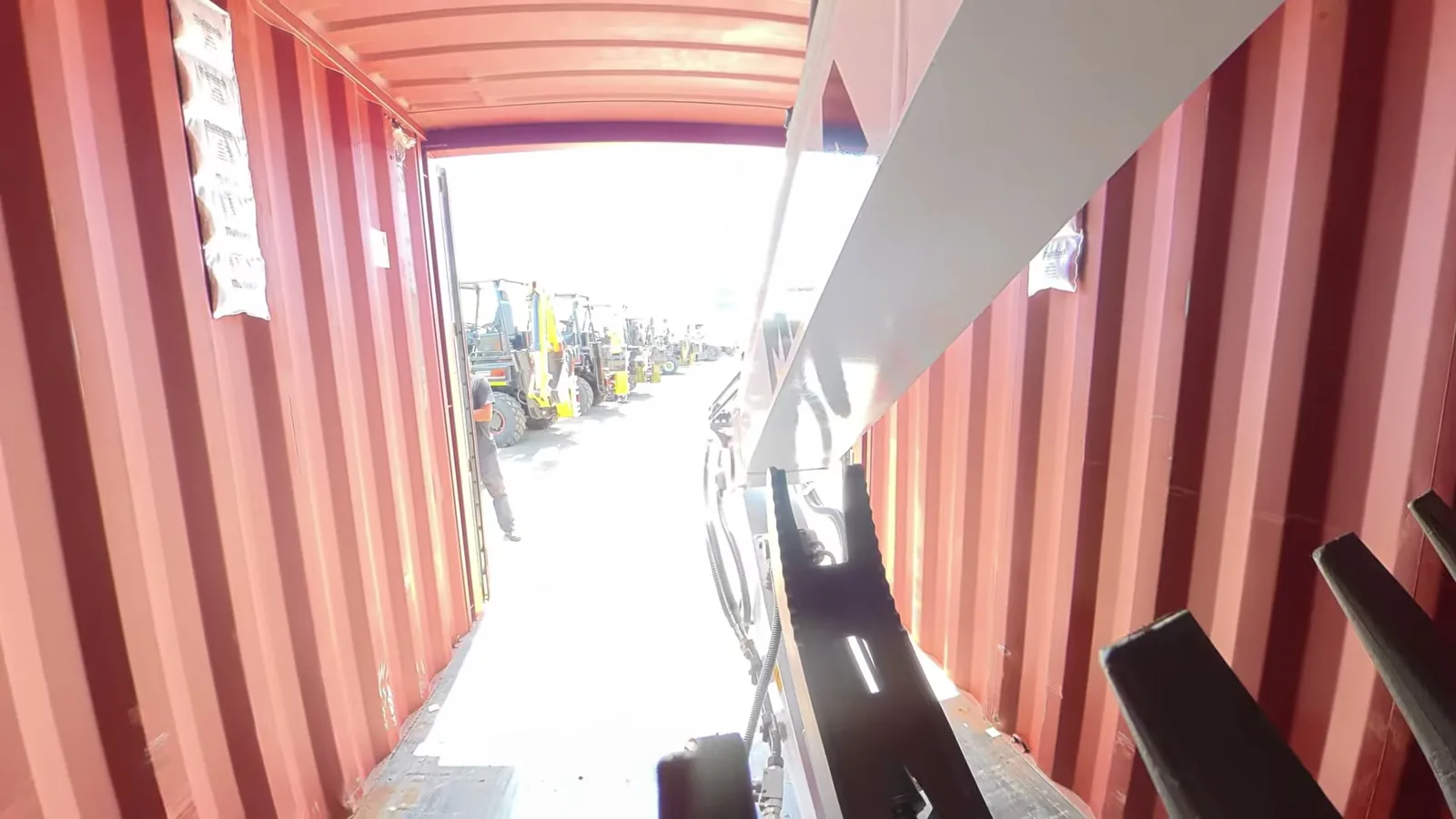
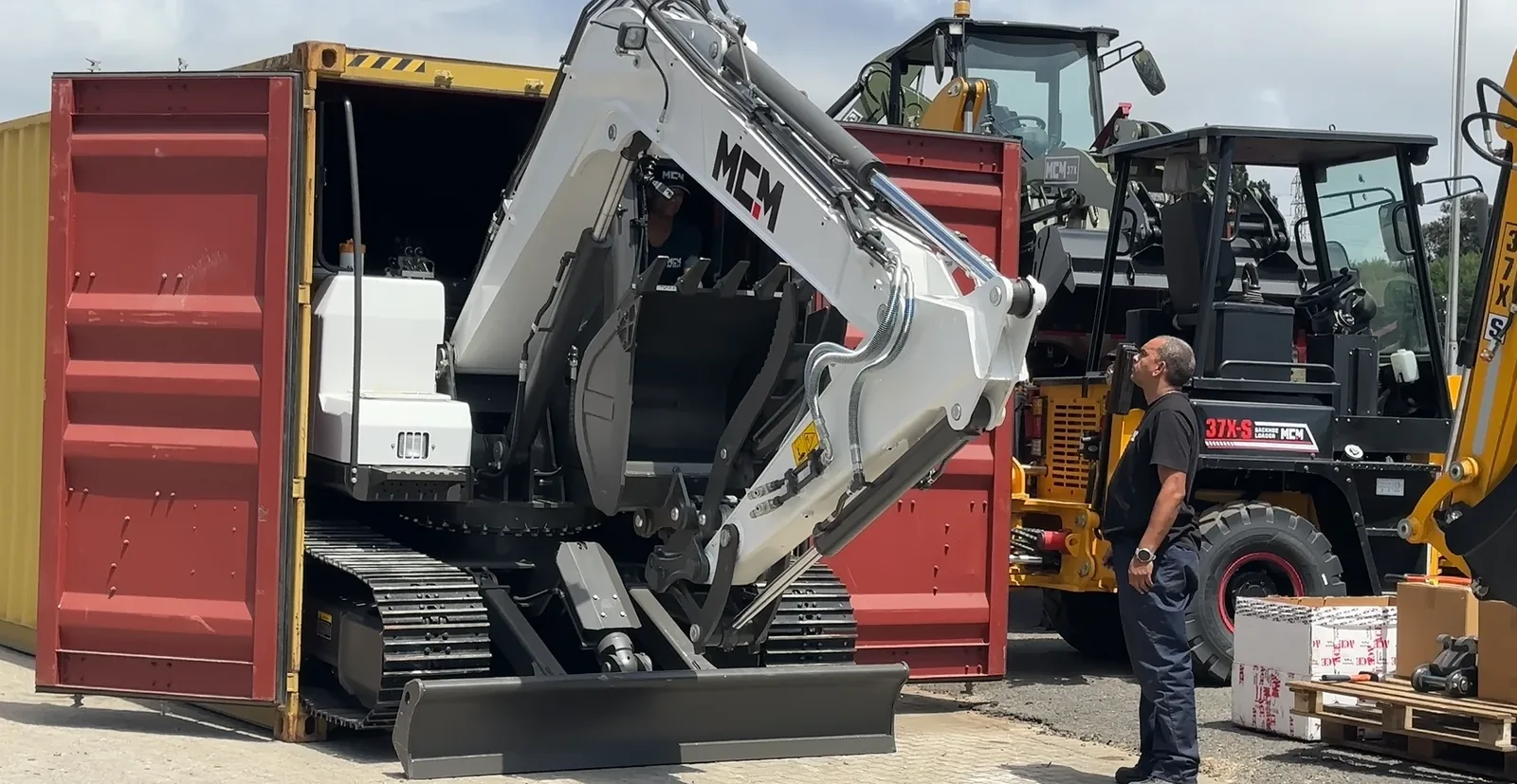
The 75DS ships inside a standard shipping container, with its boom folded and its bucket curled in so it fits. That’s one of the quiet advantages of a machine this size: at 2 216 mm wide and 2 672 mm high it travels in a container, not as oversized deck cargo.
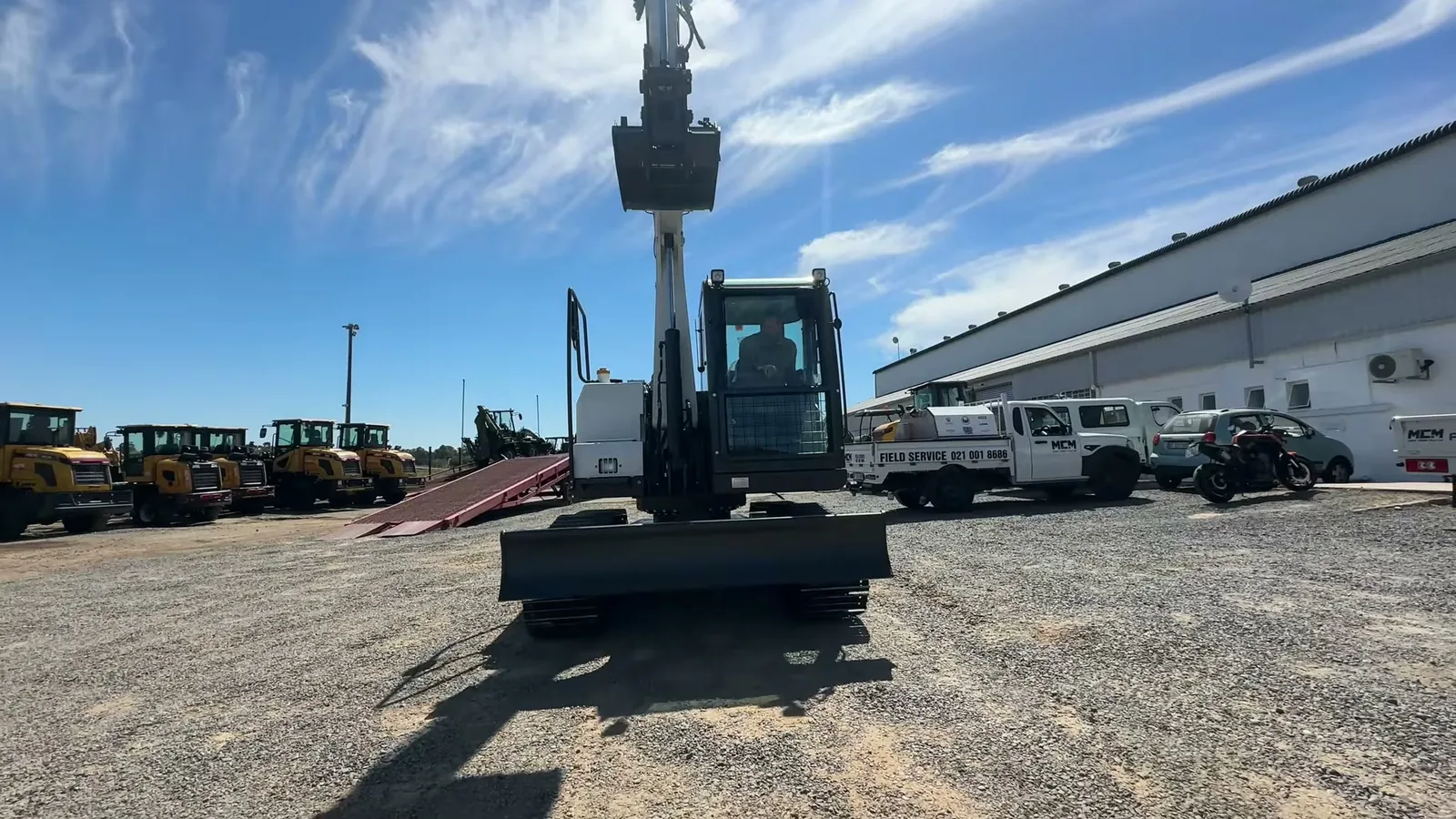
Offloading is the first real test. The machine is started and driven out of the container under its own power, slowly, with a spotter watching the clearance on every side, so the machine reaches the yard in exactly the condition it left the factory.
Step 2: Into the workshop
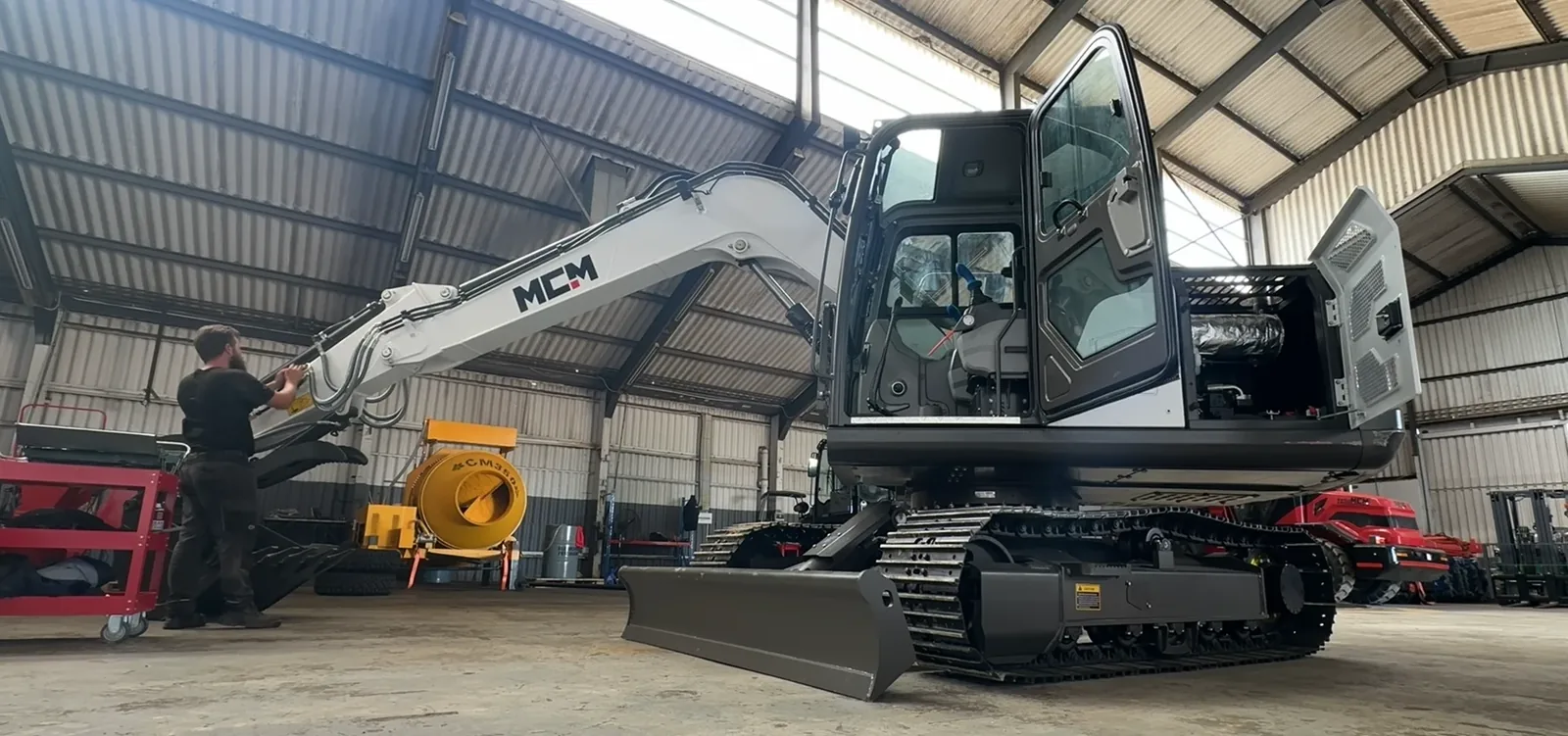
Next, the 75DS goes into the workshop with every door and cover open. This is where a technician goes over the whole machine before anyone else operates it: engine bay, hydraulic lines and fittings along the boom, fluid levels, the cab and the undercarriage.
It’s slow, deliberate work, and it’s meant to be. After weeks at sea, every clamp, fitting and fluid level gets a technician’s full attention under workshop lights, so the machine you receive is right from its very first start on your site.
Step 3: The checklist
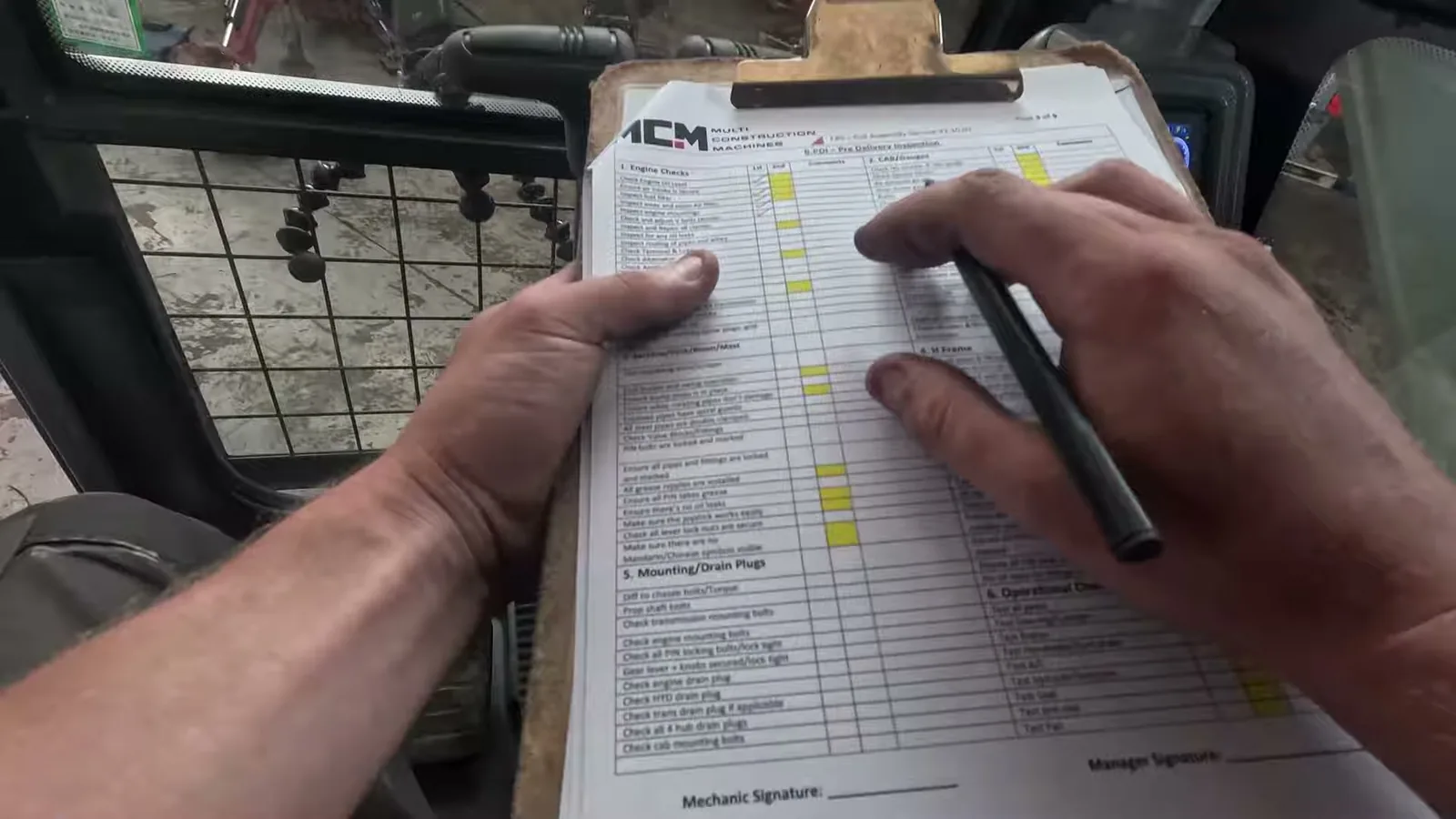
Nothing relies on memory. The inspection runs off an MCM pre-delivery checklist, worked through item by item on a clipboard and finished with sign-off lines for both the mechanic and the manager. Two signatures means two people stand behind the machine before it leaves.
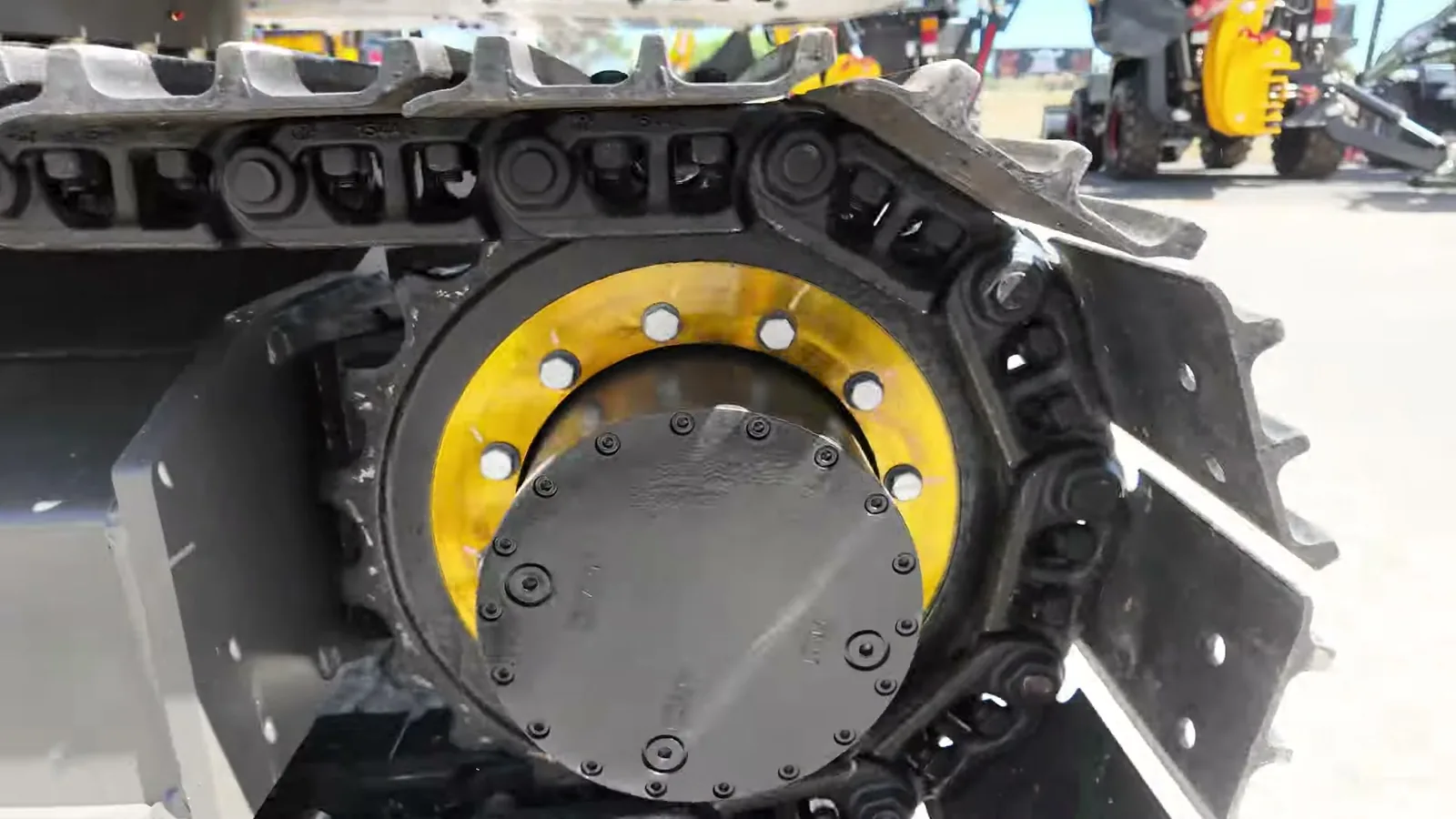
The undercarriage gets the same attention as the engine. Final drives, sprockets, rollers and track tension carry all 7 500 kg of the machine, and they take the punishment every time it tracks over rubble. On a crawler excavator, that’s where a lot of the long-term running cost lives.
Step 4: The cab, still in its plastic
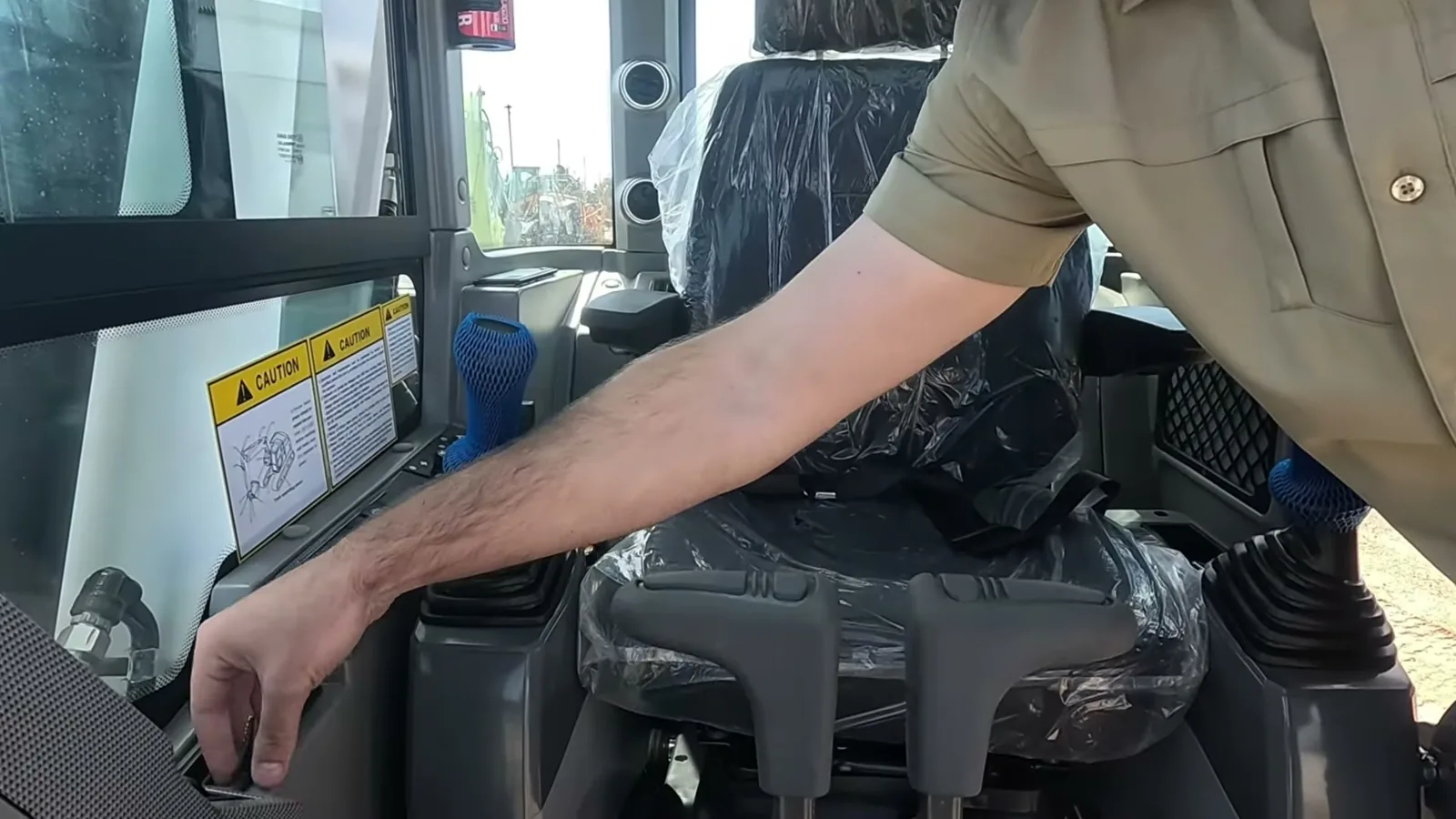
The seat is still in its factory plastic, a small detail that tells you this is a genuinely new machine. Before anyone sits in it, the controls are checked: joysticks, safety lever, travel pedals, the monitor and keypad, lights and wipers. Every one is confirmed to respond exactly as it should before the machine moves on to its test.
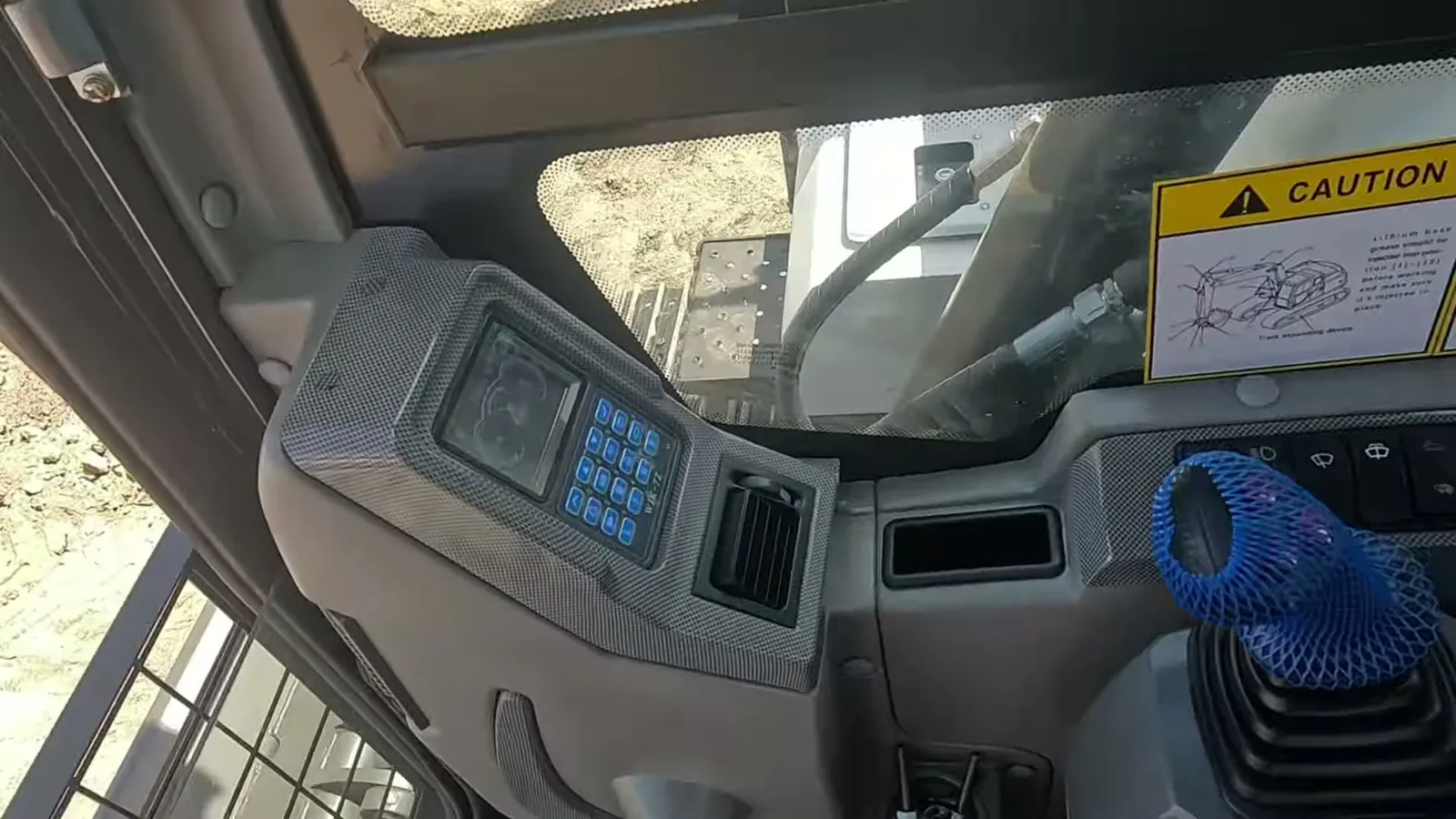
Step 5: Dig it, don’t just start it
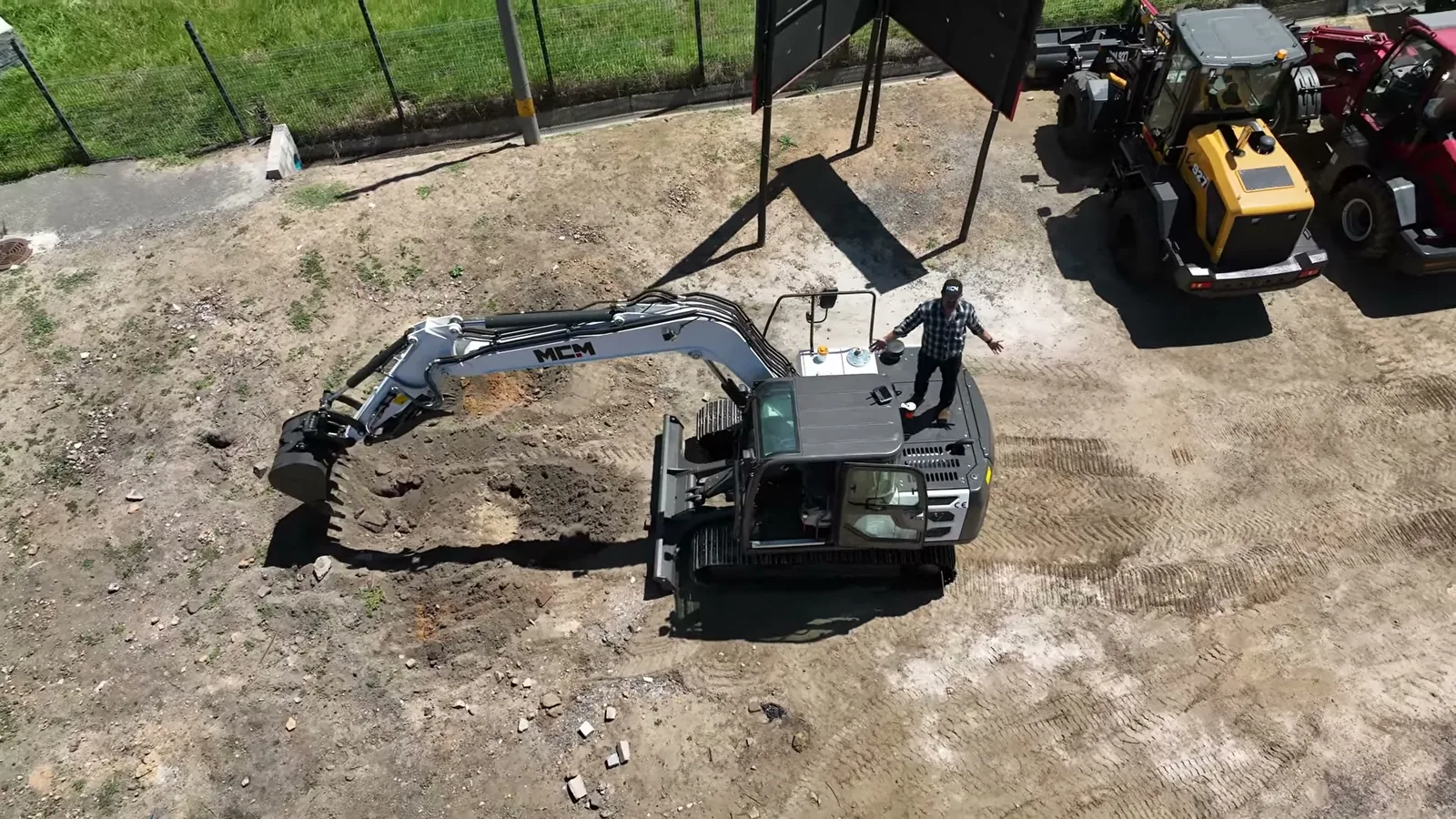
The best proof of a machine is watching it work. So the 75DS goes out to the yard’s dirt area and does what it was built to do: dig. Boom, arm and bucket work through full cycles under load. The machine slews, tracks and pushes with the blade, while the operator listens and watches for anything out of the ordinary.
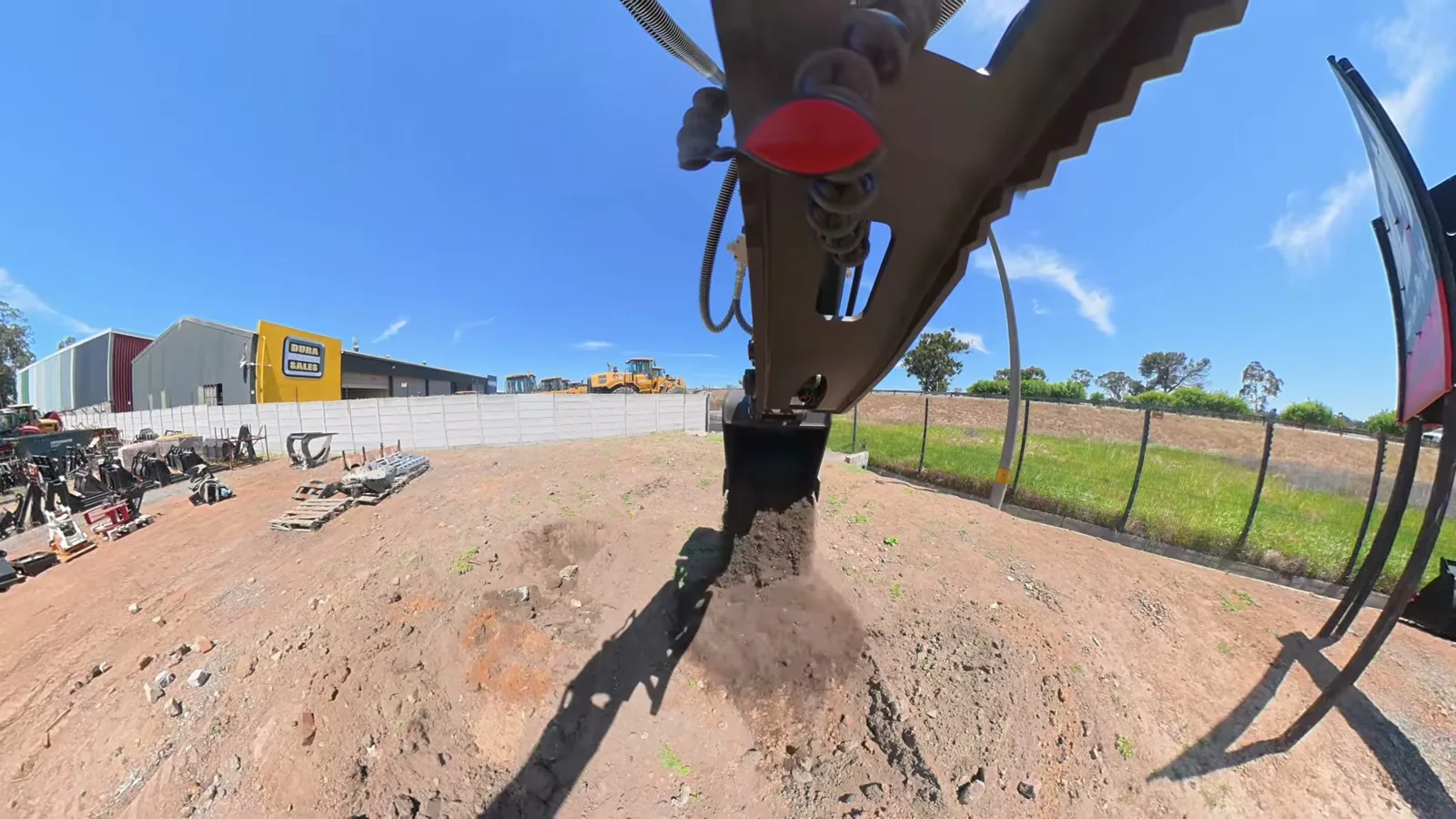
This is where the 75DS’s numbers stop being numbers. The 0.28 m³ bucket breaks out with 56 kN of digging force, backed by a 27 MPa hydraulic system. It digs to 3 898 mm and dumps at 5 195 mm, high enough to load a tipper truck from ground level.

Step 6: Handover
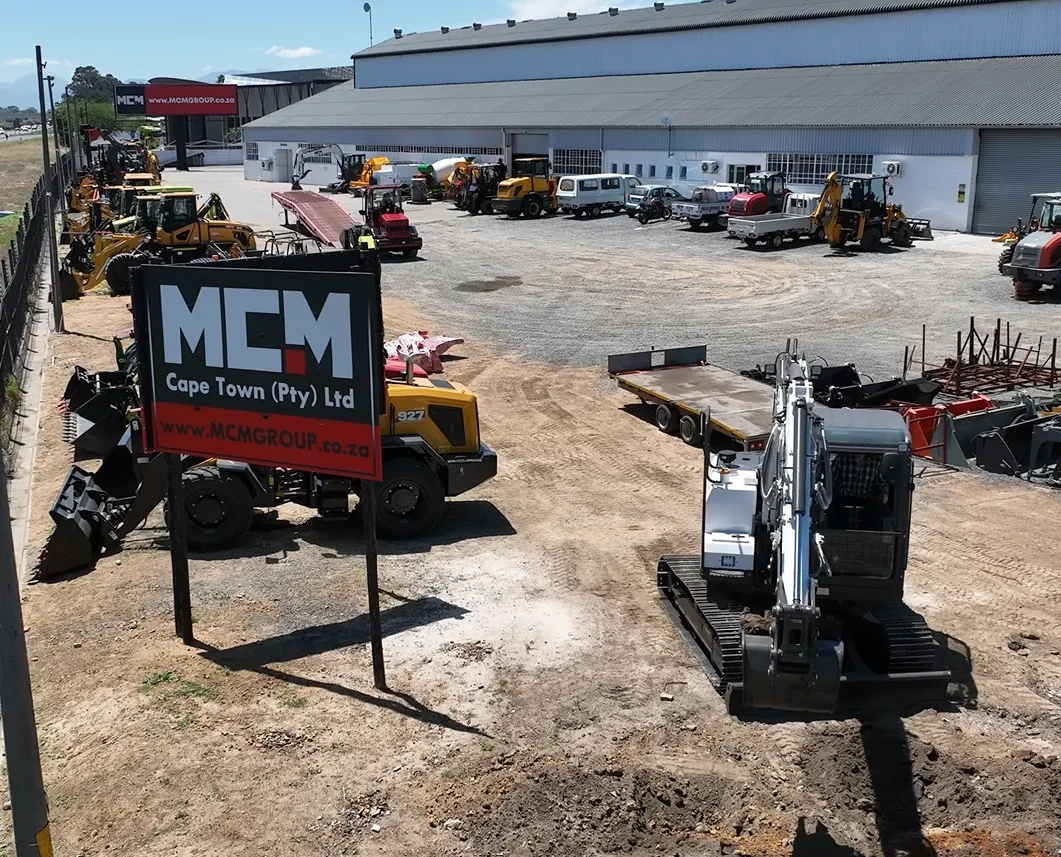
Only after the checklist is signed and the test dig is done does the machine get dispatched for delivery. Handover is the last step, and it isn’t just handing over keys. It’s where the new owner gets to know the machine before their operator takes it onto site: the controls, the daily checks and who to call for parts and service.
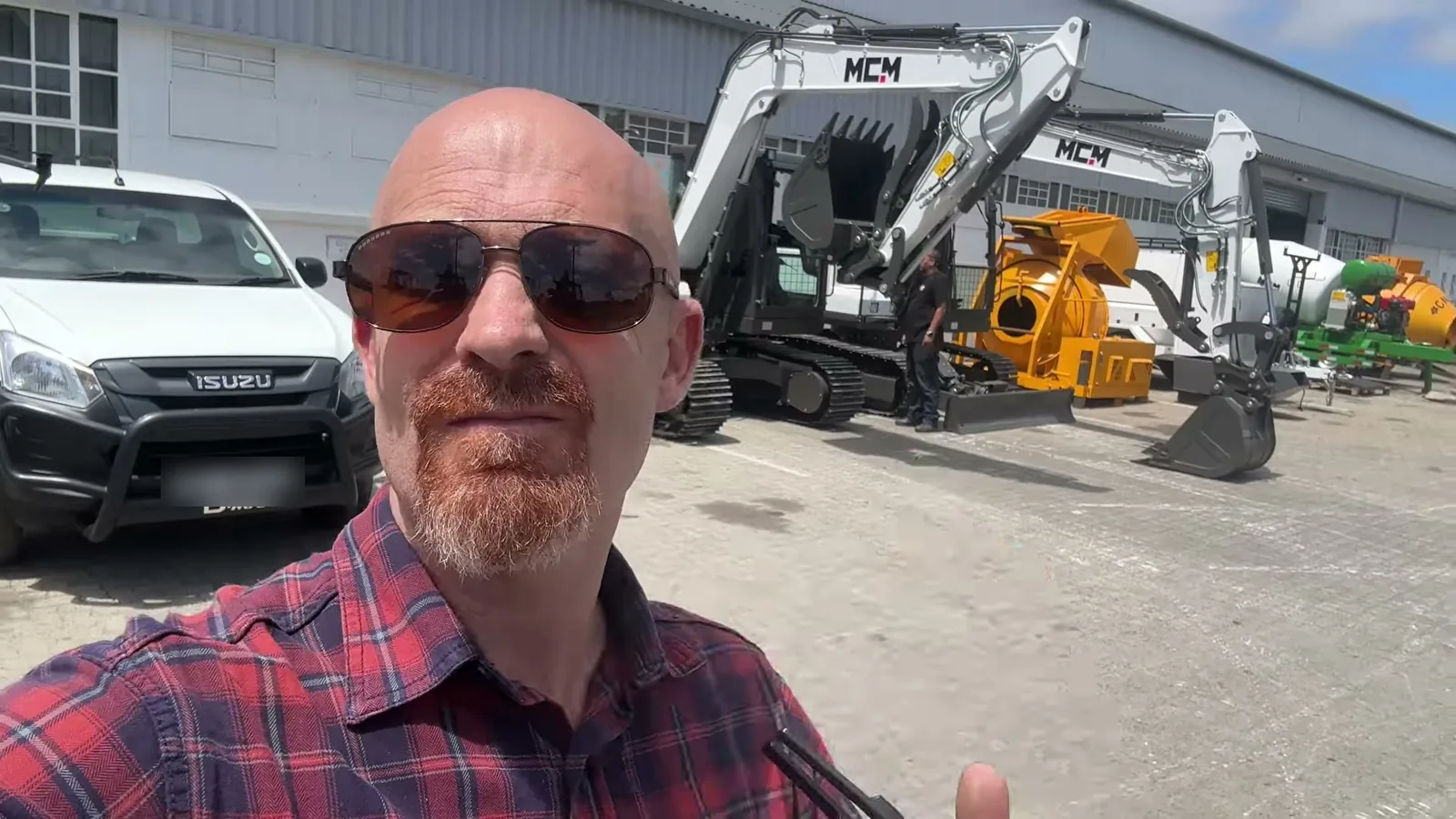
To our newest 75DS owner: congratulations, and thank you for choosing MCM. May it dig many profitable hours.
The machine: MCM 75DS at a glance
The MCM 75DS sits in the sweet spot of the excavator range. It’s big enough for serious trenching and truck loading, and small enough to travel in a container and work on tighter sites. It is driven by a four-cylinder Yanmar 4TNV98 diesel rated at 52 kW at 2 500 rpm, and it is also offered with a Kubota engine.
| Operating weight | 7 500 kg |
| Engine | Yanmar 4TNV98, 52 kW at 2 500 rpm (Kubota option available) |
| Bucket capacity | 0.28 m³ |
| Max bucket digging force | 56 kN |
| System pressure | 27 MPa |
| Max digging depth | 3 898 mm |
| Max digging reach | 6 182 mm |
| Max dumping height | 5 195 mm |
| Max digging height | 7 023 mm |
| Tail swing radius | 1 730 mm |
| Gradeability | 35° |
| Length × width × height | 6 054 × 2 216 × 2 672 mm |
| Price | From R 799 500 excl. VAT (Yanmar); R 875 500 excl. VAT (Kubota) |
Who it suits
- Civil and pipeline contractors: 3.9 m of digging depth handles trenches, culverts and foundations, and the dump height loads trucks without a ramp.
- Farm dam and road work: a 0.28 m³ bucket and a dozer blade for backfilling and tidying up, on steel tracks that handle rough ground.
- Plant hire fleets: a 7.5-tonne machine with a Yanmar engine, backed by parts stocked in South Africa.
What to expect when you buy one
- Delivery anywhere in South Africa, by our own transporter or a third party, with transport quoted by deck space and delivery address. A machine in stock is prepared for collection or delivery the same or next day once payment is confirmed, and is delivered in most cases within 4 to 8 business days.
- Finance in 48 to 72 hours: we submit your application to several banks and asset-finance houses at the same time and handle the paperwork.
- Local warranty and parts, through MCM Group’s National Parts Division and our branches in Cape Town, George, Bloemfontein and Midrand.
Want the next 75DS to be yours? See the full specs and get a price on the MCM 75DS product page, call us on +27 81 885 0535 or email sales@mcmco.co.za.