
Quick answer
Equipment finance is a loan or lease that is designed to spread the cost of a machine over its working life, so a first-time buyer provides a deposit and repays the balance from the income the machine earns.
Approval involves credit history, deposit size and affordability, and a dealer like MCM allows you to submit one application to several banks and asset-finance houses at the same time.
Understanding the basics first provides confidence, and this guide describes what lenders look for, what documents you need and how a first-time buyer improves the odds of finance approval in South Africa.
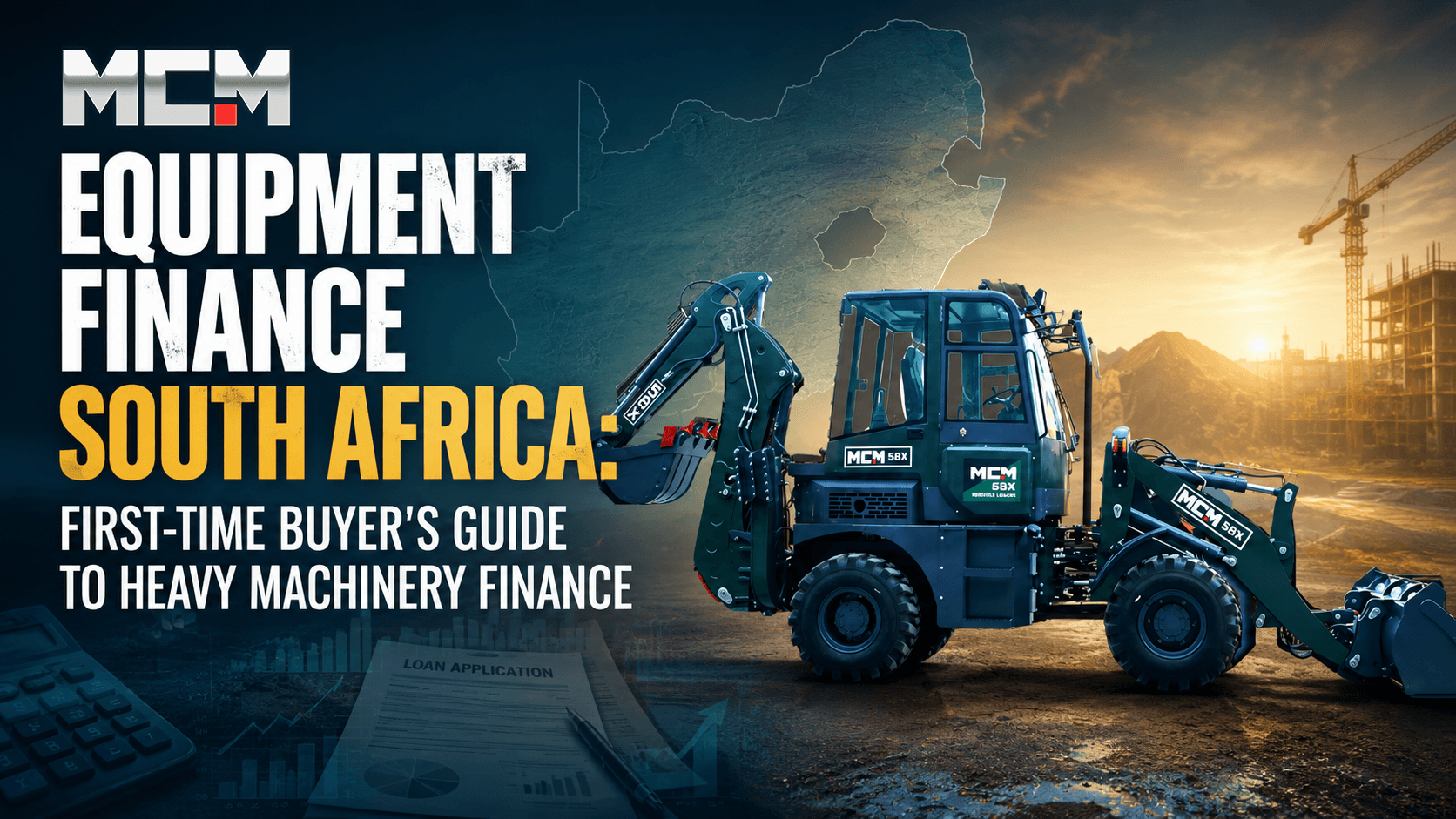
Buying your first piece of heavy equipment is a big step, and equipment finance South Africa is the bridge that gets the machine on site for most first-time buyers. The process is well-trodden but full of small details that trip up new applicants: the wrong documents, the wrong deposit, the wrong lender for the asset. This guide walks through equipment finance South Africa step by step, so you know what to expect, what to prepare, and what to watch out for before signing. MCM Group works with several equipment finance partners and can help structure the deal end-to-end.
The Quick Answer
- Deposit: typically 10–30% of the purchase price, depending on lender and buyer profile.
- Term: usually 36–60 months for new equipment; shorter for used.
- Interest rate: usually quoted as a margin above prime, set case by case from your profile, deposit, asset type and lender — rather than from an advertised “from” rate.
- Residual / balloon: some structures include a final lump-sum payment to lower the monthly.
- Approval timeline: 5–10 working days from full document submission.
- What you’ll need: a registered business, six months of bank statements, ID/company docs, a tax clearance, and a quote for the machine.
The rest of this guide walks through each step in order. In addition, the final FAQ covers the questions MCM hears most often from first-time buyers.
Step 1: Pick the Machine for Equipment Finance South Africa
Equipment finance South Africa starts with a quoted machine, not a wishlist. Specifically, banks need to know exactly what they’re financing — make, model, year, serial number (if used), and the all-in price including VAT and delivery. A formal quote from a supplier like MCM Group is the starting document for any equipment finance application.
Furthermore, the bank will assess the machine itself, not just the buyer. Mainstream brands and models hold their value, so they finance easily on standard terms. Obscure imports or niche specialty equipment can attract higher rates or require larger deposits — sometimes the bank simply declines the asset.
Step 2: Get Your Paperwork Ready
This is where most equipment finance South Africa applications stall. Therefore, pull these documents together before you approach a lender:
For a Registered Company or CC
- CIPC registration documents (certificate of incorporation, MOI / founding statement)
- Latest annual financial statements (audited or independently reviewed)
- Management accounts for the current year if AFS are older than six months
- Last six months of business bank statements
- Director / member IDs and proof of residence
- SARS Tax Compliance Status (TCS) PIN for the company
- VAT registration certificate (if registered)
- Director / member personal financial statements (lenders often want this for a director surety)
For a Sole Proprietor or Farmer
- Personal ID and proof of residence
- Last six months of personal and farming bank statements
- Last two years of tax assessments (ITA34) and a current SARS Tax Compliance Status (TCS) PIN
- Statement of personal assets and liabilities
- Proof of farming or trading income (invoices, contracts, off-take agreements)
In addition, the bank may ask for a business plan or cashflow forecast — especially if the equipment is for a new venture rather than replacing an existing machine.
Step 3: Compare Equipment Finance South Africa Lenders
South Africa has a competitive equipment finance market — and most first-time buyers will see equipment finance South Africa quoted by at least two of the lenders below. Specifically, the main players are:
- WesBank — dominant in vehicle and equipment finance, broad asset book.
- Absa Vehicle and Asset Finance — strong on agricultural equipment.
- Standard Bank Vehicle and Asset Finance — broad asset book, well-developed online process.
- Nedbank MFC / Nedbank Asset Finance — competitive on yellow metal and construction equipment.
- FNB Asset-Based Finance — well-suited to existing FNB business banking clients.
- Investec Asset Finance — targets larger transactions and established businesses.
- Land Bank — specialist agricultural lender; can be competitive on farm equipment.
Furthermore, MCM Group works with several of these lenders and can submit a single application to multiple banks at once. As a result, you compare real offers rather than guessing at indicative rates.
Step 4: Choose the Right Finance Structure
Instalment Sale Agreement (ISA)
The most common structure. The bank pays the supplier, you take possession and use of the machine, and you repay the bank in monthly instalments over the term. In many instalment sale structures, legal ownership only transfers once the agreement has been fully settled — though the asset is normally used in your business from day one. The tax treatment (capital allowances, wear-and-tear deductions, interest claim) depends on the structure, asset and use, so confirm with your accountant before signing.
Finance Lease / Rental
Alternatively, the bank owns the machine and rents it to you for the term. Monthly payments are usually treated as an operating expense. As a result, the cashflow profile is smoother but you don’t own the asset at the end (unless you exercise a buy-out).
Balloon / Residual Payment
You can structure either of the above with a balloon — a final lump-sum payment at the end of the term that reduces the monthly instalment. In addition, this works well when you intend to trade the machine in or refinance the balloon at term-end. However, if cash isn’t there when the balloon falls due, you can be forced into a hurried sale.
Deposit Size
First-time buyers often try to put down as little as possible. Specifically, a 10% deposit is achievable for strong applicants; 20–30% is more common for first-time buyers and reduces the rate the bank offers. Therefore, a larger deposit is one of the most effective ways to bring down the monthly instalment and the total interest cost.
Finance Structures at a Glance
| Finance option | Best for | Main benefit | Watch out for |
|---|---|---|---|
| Instalment sale | Buyers wanting long-term use and eventual ownership | Predictable monthly repayment | Legal ownership/title may only transfer at full settlement |
| Finance lease / rental | Businesses wanting use without immediate ownership | Smoother cashflow profile | End-of-term ownership depends on the structure |
| Balloon / residual | Buyers needing a lower monthly repayment | Lower monthly cashflow pressure | The final lump sum must be properly planned |
Step 5: Submit the Application
Once the documents and structure are in place, an equipment finance South Africa application is submitted via the supplier’s finance desk, a finance broker, or directly to the bank. In practice, most equipment dealers — MCM Group included — have direct portals into the major lenders and can submit on your behalf in a single pass.
After submission, the bank will run a credit check, verify documents, and may call for additional information. Furthermore, expect a few back-and-forth questions — clarifying a bank statement entry, confirming a creditor balance, or asking for an additional surety. Treat each request as urgent; delays here add days to approval.
Step 6: Approval, Documentation, and Delivery
On approval, the bank issues an offer letter detailing the rate, term, deposit, monthly instalment, and any conditions. Read this carefully — specifically, check the rate quoted versus indicative, the term, balloon if any, insurance requirements, and any director-suretyship clauses. Then sign and return.
Subsequently, you pay the deposit to the supplier (or directly to the bank), the bank pays the balance to the supplier, the supplier releases the machine, and the first monthly instalment falls due about 30 days later. In addition, the machine must be insured (typically comprehensive cover) before it leaves the supplier’s yard — most banks require proof of insurance as a condition of release.
Equipment Finance South Africa: Costs Beyond the Monthly Instalment
- Initiation fee. A one-off fee charged by the bank to set up the agreement, capped by the National Credit Act.
- Monthly service fee. Small admin fee added to the instalment, also capped by the NCA.
- Insurance. Comprehensive cover for the machine; often quoted separately or bundled into the instalment.
- Credit life cover. Optional but commonly offered — pays off the balance if the principal director dies or is disabled.
- Maintenance plan. Optional; bundled service contracts can be financed alongside the asset.
- Delivery and commissioning. Usually a one-off cost paid separately to the supplier.
Importantly, many consumer and small-business credit agreements are affected by the National Credit Act (NCA), which regulates certain fees and affordability checks. The exact application of the NCA depends on the applicant type, transaction size and business profile — large business agreements above certain thresholds can fall outside parts of the framework. For background and prime rate context, see the South African Reserve Bank and the National Credit Regulator.
Equipment Finance South Africa: Common Mistakes First-Time Buyers Make
- Applying without bank statements ready. Six months is standard. Pulling them at the last minute slows everything down.
- Treating indicative rates as final. The rate on a brochure is the best case. Your actual rate depends on your profile.
- Over-leveraging with a small balloon. A low monthly looks attractive — until the balloon falls due and the machine isn’t worth what’s owed on it.
- Forgetting insurance. The machine cannot leave the yard without cover. Get a quote in parallel with the finance application.
- Ignoring tax structure. A small accounting conversation upfront can change which structure (ISA vs lease) makes most sense for your business.
- Choosing the cheapest rate without checking residuals. A lower rate with a punitive residual can cost more over the term than a higher rate with no balloon.
Equipment Finance from MCM Group
In South Africa, MCM Group works directly with the major equipment finance South Africa lenders. Specifically, our finance desk can package your application, submit to multiple banks in parallel, and negotiate the structure on your behalf — usually at no direct extra cost to the buyer. Furthermore, our sales team can quote the machine, structure deposit and term scenarios, and coordinate insurance through our preferred partners so the deal closes cleanly.
Also, looking at the wider machine range? Browse our full equipment catalogue — every product page includes a “Starting from” indicative price plus a finance contact route. In addition, our branches in Midrand, Cape Town, Bloemfontein, and George each have a dedicated finance contact who can walk you through the process face-to-face.
Before You Apply: Quick Checklist
- Choose the exact machine and get a formal quote.
- Confirm whether VAT, delivery and commissioning are included.
- Pull together the last six months of bank statements.
- Get your SARS Tax Compliance Status (TCS) PIN ready.
- Ask your accountant whether an instalment sale or lease treatment suits your business.
- Get an insurance quote in parallel with the finance application.
- Decide whether you can afford a higher deposit to reduce the monthly cost.
- Avoid agreeing to a balloon unless you have a clear end-of-term plan.
Important Disclaimer
This guide is for general information only and does not constitute financial, tax or legal advice. Finance approval, interest rates, deposits and terms depend on lender criteria, applicant profile, asset type and supporting documents. Buyers should confirm tax treatment with their accountant and review all finance agreements with their own advisor before signing.
Your Questions Answered
Below are the most common equipment finance questions MCM Group gets from first-time buyers. Furthermore, if your situation isn’t covered here, our finance desk is happy to walk through your specific setup over a quick phone call.
How much deposit do I need for equipment finance in South Africa?
How long does equipment finance approval take?
Can I finance used equipment?
What interest rate should I expect?
More Equipment Finance Questions
In addition, here are a few less common but important questions on sole-proprietor finance, balloon structures, and what happens if your application is declined.
Can a sole proprietor or farmer get equipment finance?
Should I include a balloon payment?
What happens if my application is declined?
Can MCM Group handle the finance application for me?
Talk to MCM Group About Equipment Finance
Ultimately, if you’re sizing up your first equipment finance application, send us the machine you have in mind plus a brief outline of your business or farming setup. Our finance desk will reply with realistic deposit, term, and monthly scenarios — and walk you through which lender is the best fit for your profile.
Contact MCM Group for a quote, a finance pre-approval, or a sit-down with our finance team at your nearest branch.