
Quick answer
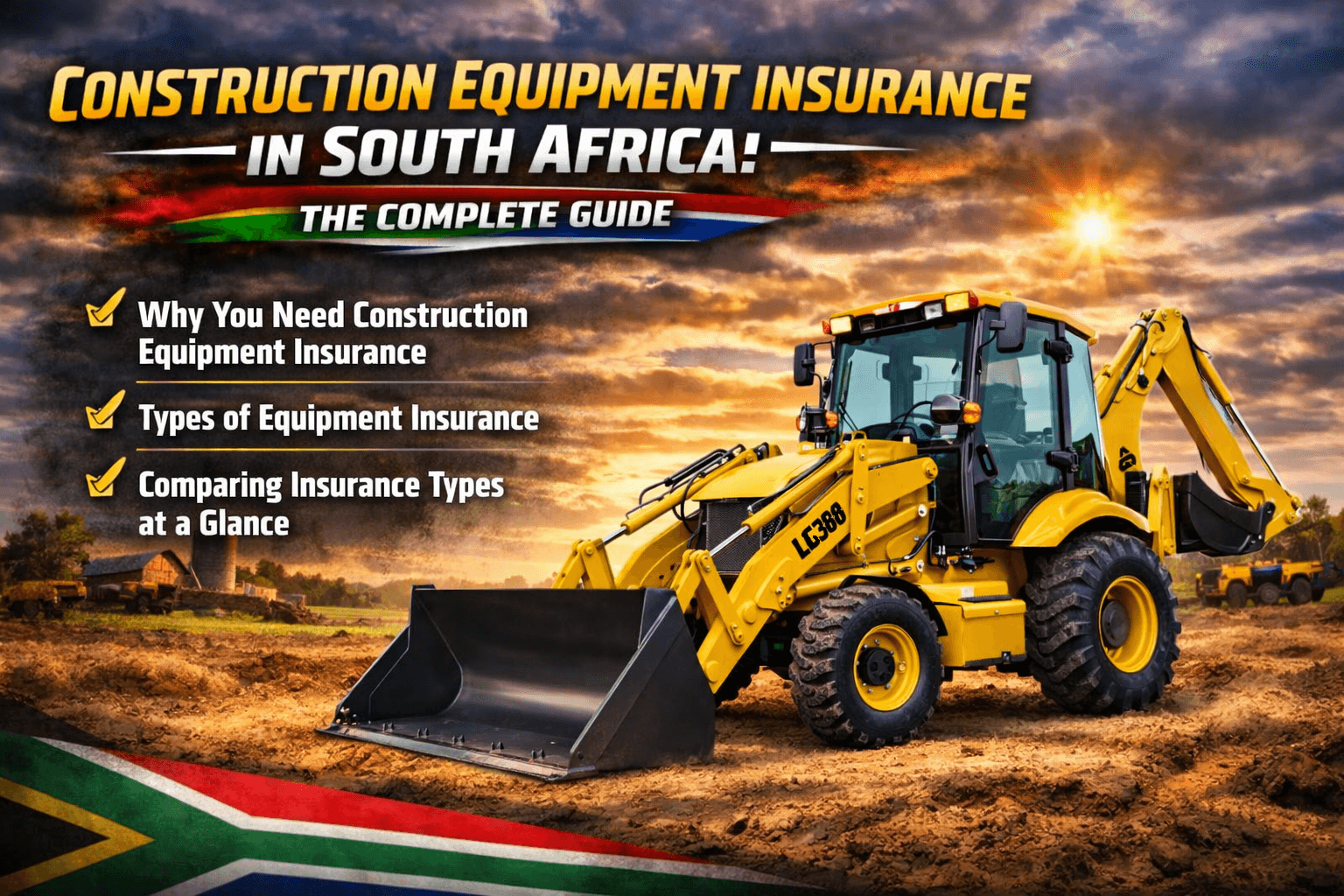
Construction equipment insurance is a policy that is designed to cover machines against theft, accidental damage, fire and overturning, both on site and while a machine is in transit between jobs.
The right cover provides financial protection for an expensive asset, and a well-structured policy allows you to keep working after a loss instead of carrying the full replacement cost yourself.
Choosing a policy involves understanding sum-insured, excess and the difference between on-site and transit cover, and this guide describes what construction and plant insurance includes in South Africa.
Construction equipment insurance protects your TLBs, front end loaders, excavators, forklifts, and road rollers against theft, damage, and breakdown — and most South African banks and finance houses require it before releasing funds. MCM Group helps you navigate these requirements with branches in Cape Town, George, Gauteng, and Bloemfontein.
Construction equipment insurance in South Africa covers your machinery against accidental damage, theft, fire, and natural disasters — whether the machine is on site, in transit, or in storage. If you finance a machine through a bank or asset finance provider, comprehensive cover with a noted financial interest in favour of the financier is generally required. Without confirmed cover, the finance payout usually cannot proceed.
Need help understanding your insurance obligations before buying? Contact MCM Group — our finance team can explain what cover your lender typically requires and connect you with specialist brokers.
Why You Need Construction Equipment Insurance
A single machine can represent an investment of R300,000 to R2,000,000 or more. Without cover, one theft or accident wipes out that investment entirely. In fact, theft remains one of the most common causes of construction equipment claims in South Africa — and it happens on active sites, in locked yards, and during transit.
Insurance does more than protect your asset. It also protects your cash flow, because a total loss on a financed machine without cover means you still owe the bank the full outstanding balance — but you have no machine to earn with. As a result, most contractors treat insurance as a non-negotiable running cost from day one.
Finance Houses Generally Require It
In practice, major South African banks and asset finance providers typically require comprehensive insurance on financed equipment for the full term of the agreement. On top of that, they generally require the financier’s interest to be noted on the policy — often by way of cession or first-loss-payee wording — so any valid claim payment can first settle the outstanding finance balance. If you want to understand how equipment finance works in detail, read our guide on what banks look at when approving equipment finance.
Types of Equipment Insurance in South Africa
South Africa offers several insurance products for construction machinery. The right choice depends on whether you own the machine, lease it, or use it on contract sites.
Plant All Risk (PAR) Insurance
Plant All Risk covers your machine against accidental loss or damage while in storage, transit, or on site. This is the most common policy for individual machines like backhoe loaders, excavators, and loaders. PAR typically covers fire, theft, accidental damage, overturning, and collision. You can also extend it to cover hired-in plant, hired-out plant, and hire charges lost while the machine is out of action.
Contractors All Risk (CAR) Insurance
CAR is a broader policy that covers the contract works themselves — not just the machines. It includes damage to the works under construction, surrounding property, and public liability. Contractors working on large civil or building projects typically need CAR cover as a tender requirement. In practice, many contractors hold both PAR (for their fleet) and CAR (for each contract).
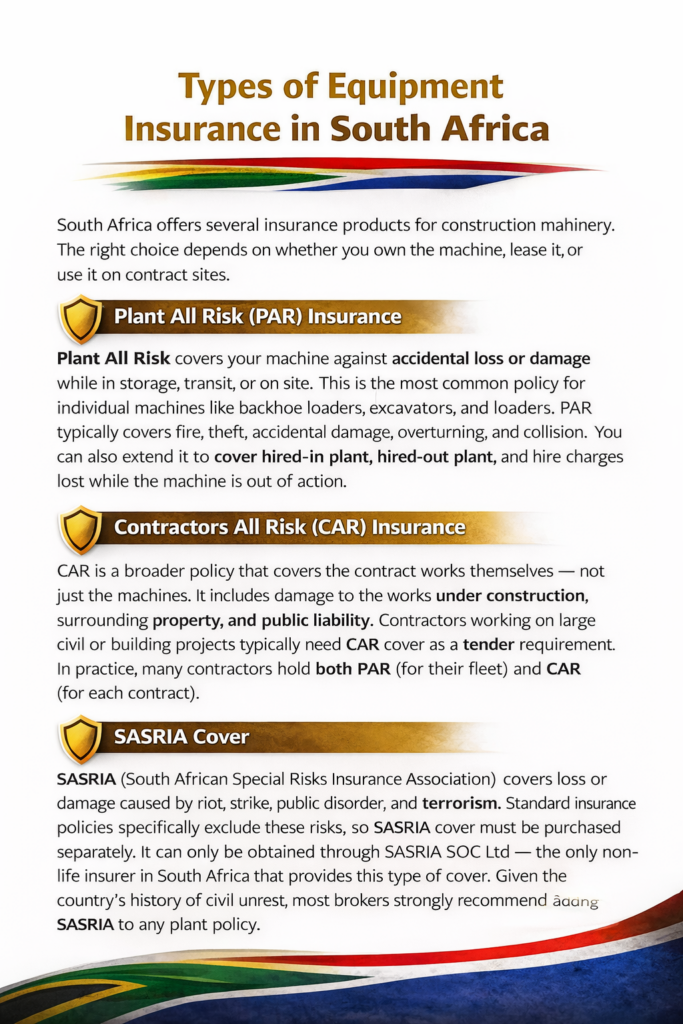
SASRIA Cover
SASRIA (South African Special Risks Insurance Association) covers loss or damage caused by riot, strike, public disorder, and terrorism. Standard insurance policies specifically exclude these risks, so SASRIA cover must be purchased separately. It can only be obtained through SASRIA SOC Ltd — the only non-life insurer in South Africa that provides this type of cover. Given the country’s history of civil unrest, most brokers strongly recommend adding SASRIA to any plant policy.
Comparing Insurance Types at a Glance
| Policy Type | What It Covers | Best For | SASRIA Add-On? |
|---|---|---|---|
| Plant All Risk (PAR) | Individual machines — theft, damage, fire, transit | Equipment owners and finance agreements | Yes — recommended |
| Contractors All Risk (CAR) | Contract works + surrounding property + public liability | Project-based contractors and tender compliance | Yes — often required |
| Machinery Breakdown | Sudden mechanical or electrical failure (subject to policy wording and maintenance standards) | Older machines or high-use fleet equipment | Optional |
| Goods in Transit | Damage during transport between sites | Machines moved frequently by truck | Optional |
What Affects Your Insurance Premium
Premiums vary significantly depending on several factors. Understanding these helps you budget accurately and potentially reduce your costs.
Asset Value
The insured value of the machine is the biggest premium driver. A compact TLB at R300,000 costs less to insure than a full-size TLB at R700,000. Make sure you insure for the correct value on the basis stated by your policy — often replacement value for newer financed equipment, or another valuation basis agreed with the insurer. Confirm this with your broker to avoid average-clause problems.
Operating Environment
Machines working near water, on steep slopes, in mining environments, or in high-crime areas attract higher premiums. In contrast, a forklift operating inside a secure warehouse carries lower risk and therefore a lower premium.
Claims History and Safety Record
A clean claims history reduces your premium over time. Similarly, businesses with formal safety procedures, trained operators, and pre-start checklists often qualify for discounts. Insurers view a well-managed fleet as a lower risk.
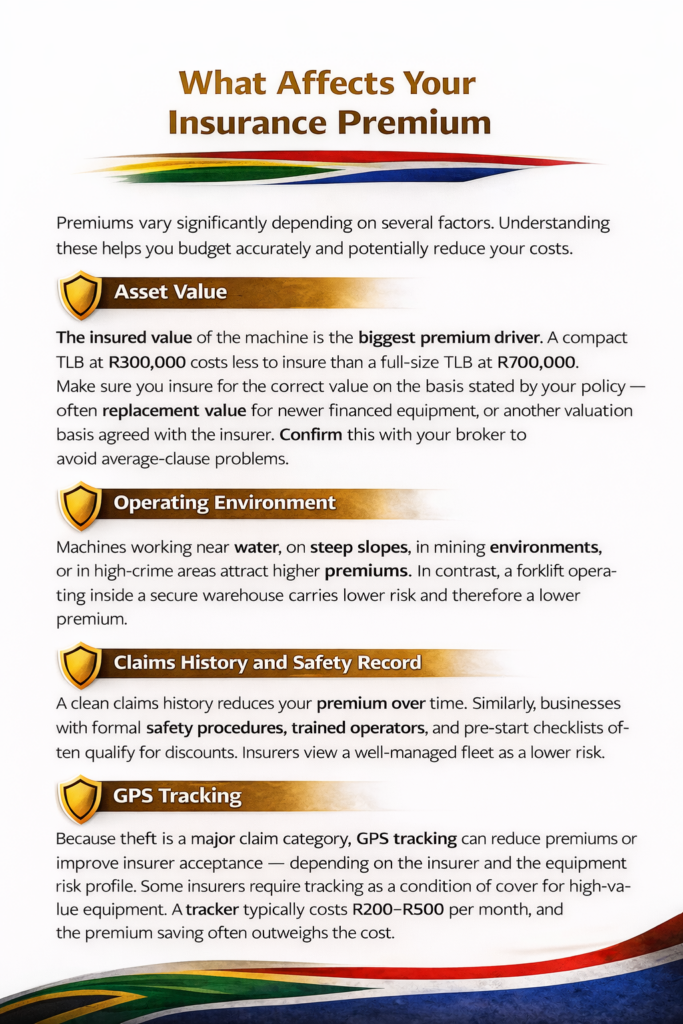
GPS Tracking
Because theft is a major claim category, GPS tracking can reduce premiums or improve insurer acceptance — depending on the insurer and the equipment risk profile. Some insurers require tracking as a condition of cover for high-value equipment. A tracker typically costs R200–R500 per month, and the premium saving often outweighs the cost.
The Under-Insurance Trap
Under-insurance is one of the most common and costly mistakes in construction equipment insurance. It works like this: if your machine has a replacement value of R800,000 but you only insure it for R500,000, the insurer applies the “average clause.” In this case, you are considered 62.5% insured. So if you suffer R400,000 in damage, the insurer only pays R250,000 — leaving you R150,000 short.
To avoid this trap, insure every machine on the correct basis and at the correct value. Review your insured values annually, because equipment prices change with exchange rates and supply conditions. Your broker can help you confirm the right valuation approach for each machine.
Common Exclusions to Watch For
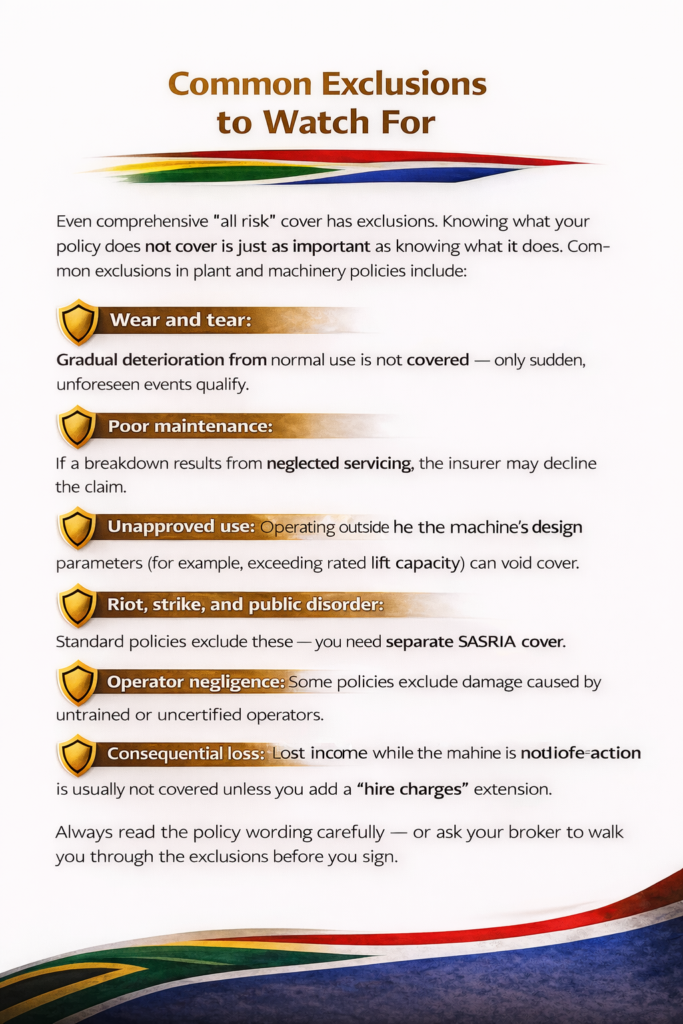
Even comprehensive “all risk” cover has exclusions. Knowing what your policy does not cover is just as important as knowing what it does. Common exclusions in plant and machinery policies include:
- Wear and tear: Gradual deterioration from normal use is not covered — only sudden, unforeseen events qualify.
- Poor maintenance: If a breakdown results from neglected servicing, the insurer may decline the claim.
- Unapproved use: Operating outside the machine’s design parameters (for example, exceeding rated lift capacity) can void cover.
- Riot, strike, and public disorder: Standard policies exclude these — you need separate SASRIA cover.
- Operator negligence: Some policies exclude damage caused by untrained or uncertified operators.
- Consequential loss: Lost income while the machine is out of action is usually not covered unless you add a “hire charges” extension.
Always read the policy wording carefully — or ask your broker to walk you through the exclusions before you sign.
Insurance and Equipment Finance — How They Connect
If you finance a TLB, road roller, or cherry picker through MCM Group’s finance partners, insurance is generally not optional. Here is what the process typically looks like.
- Finance approval: The bank approves your application — but the deal typically does not close until insurance is confirmed.
- Insurance arrangement: You arrange cover through your own broker or ask MCM to recommend one. The policy should be comprehensive Plant All Risk at the agreed insured value.
- Noting the financier’s interest: Your broker notes the financier’s interest on the policy — often by way of cession or first-loss-payee wording. This means any valid claim payment settles the outstanding finance balance first.
- Proof of cover: You submit the policy schedule and confirmation of the noted interest to the bank. Only then does the bank typically release funds to the supplier.
- Ongoing obligation: You must maintain cover for the full finance term (typically 36–60 months). If your policy lapses, the bank may arrange emergency cover at your expense — usually at a much higher premium.
For a deeper understanding of how different finance structures work, read our comparison of instalment sale vs financial lease vs operating lease.
How to Reduce Your Insurance Costs
- Fit GPS trackers: Tracking can reduce premiums and improve insurer acceptance, because recovery rates improve significantly for tracked machines.
- Increase your excess: A higher voluntary excess (the amount you pay per claim) lowers your monthly premium. Choose an excess you can afford if something goes wrong.
- Maintain a clean claims record: Avoid small claims where possible. A no-claims history builds up a discount over time.
- Secure your site: Fenced yards, locked gates, security cameras, and night guards all reduce theft risk — and your premium.
- Train your operators: Certified operators cause fewer accidents. Some insurers ask for proof of operator training before they issue cover.
- Bundle your fleet: Insuring multiple machines under one fleet policy often costs less per machine than individual policies.
- Shop around regularly: Plant insurance rates can vary between brokers and insurers. Review your cover every 12–24 months to ensure you still have competitive terms.
- Use a specialist broker: A broker who understands plant all risk insurance will typically find better rates and cover than a general short-term insurer.
Before You Insure — Quick Checklist
- Confirm the correct insured value and valuation basis for each machine
- Decide whether you need PAR, CAR, or both
- Ask your broker about SASRIA cover
- Check if your finance provider has specific insurer or cover requirements
- Fit GPS tracking before applying for cover
- Gather your claims history for the past 3–5 years
- Read the policy exclusions before you sign
- Budget for insurance as a monthly operating cost alongside your finance repayment
Your Questions Answered
Do I need insurance to finance construction equipment in South Africa?
What is the difference between Plant All Risk and Contractors All Risk?
What does noting the financier’s interest on my policy mean?
How much does construction equipment insurance cost in South Africa?
More Common Questions
What is SASRIA cover and do I need it?
What happens if my insurance lapses while I am still paying off the machine?
Does GPS tracking reduce my insurance premium?
Sources & References
Disclaimer: MCM Group is an equipment distributor, not an insurance provider or registered financial services provider. The information in this article is for general informational purposes only and does not constitute insurance, financial, or legal advice. Insurance terms, premiums, cover details, and exclusions depend on your specific policy, insurer, and circumstances. Always consult a qualified insurance broker or financial advisor before making decisions about equipment insurance.
- SASRIA SOC Ltd — South African Special Risks Insurance Association
- CivilSure — Plant All Risk Insurance Guide
- AS Brokers — Contractors Plant and Equipment Insurance South Africa
- Aon South Africa — Navigating the Risks of South Africa’s Construction Industry
Find Us Nationwide
MCM Group has branches in Cape Town (Kraaifontein), George, Gauteng (Samrand, Midrand), and Bloemfontein. Walk in, call, or get in touch online for equipment advice, finance assistance, and competitive quotes.