

Quick answer
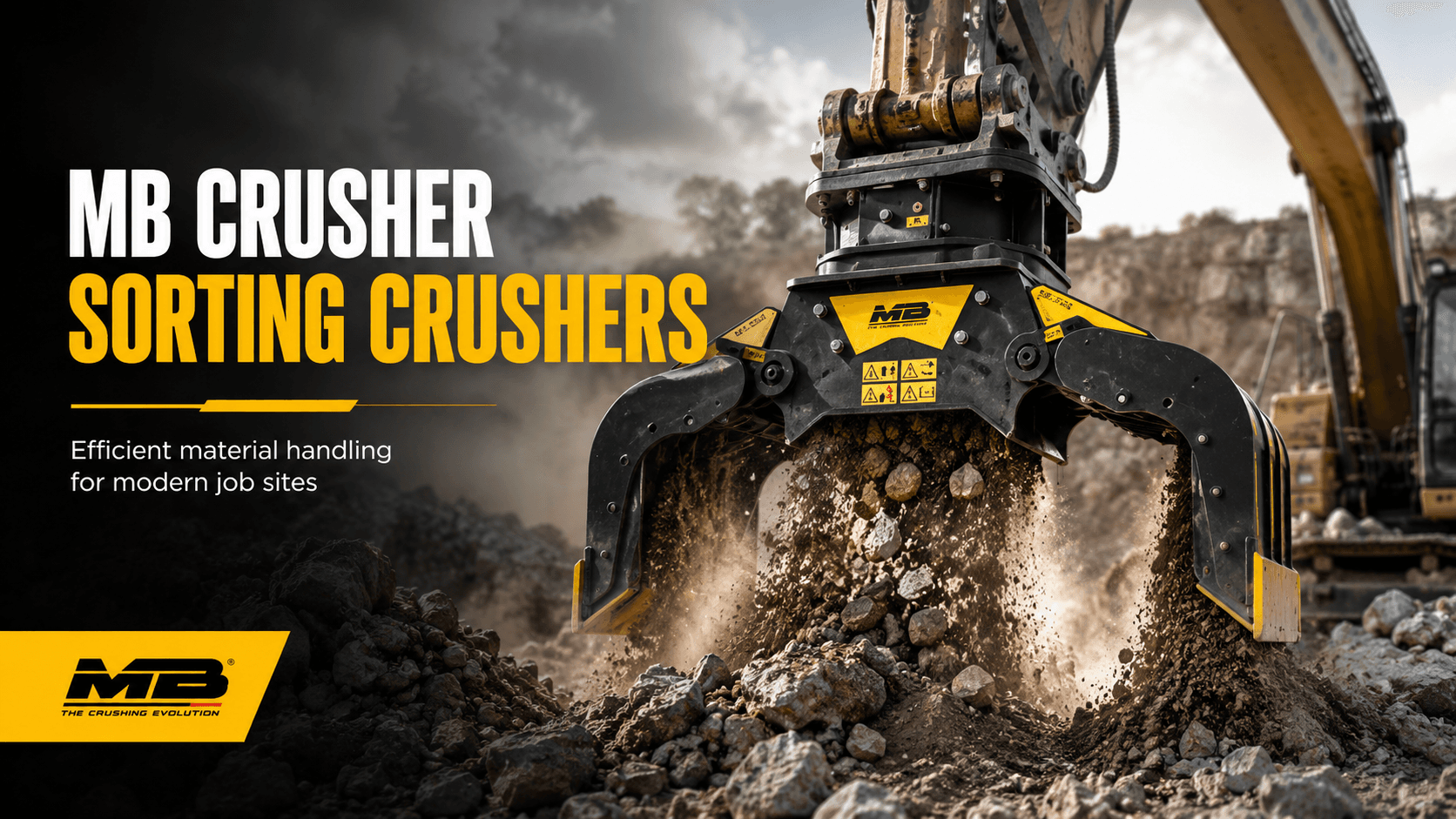
An MB sorting grapple is an excavator attachment that is designed to grab, sort and load demolition rubble, rock, scrap and bulky waste using two hydraulic jaws on a rotating head.
Matching the grapple to the machine is essential, because each MB-G model provides a different jaw size and weight, and the carrier tonnage allows you to run it safely without overloading the arm.
Choosing the right MB-G involves checking your excavator operating weight and hydraulic flow, and this guide describes which grapple fits each machine class so you size the attachment correctly.
Best for: demolition, recycling and earthworks contractors who need to grab, sort and load rubble, rock and scrap with an excavator.
In practice, MB sorting grapples turn an excavator from a digger into a precision pick-and-place machine. Choose the right model and you’ll move logs, rocks, scrap, and demolition debris with the same control a skilled operator gets from a backhoe bucket — only faster and cleaner. Choose the wrong one and you either overload a small excavator or under-utilise a big one. This guide walks through the full MB-G S4 range — from the MB-G350 for mini excavators up to the MB-G1500 for demolition-class machines — and explains how to pick the right one for your carrier. MCM Group supplies the full MB Crusher range across South Africa.
MB Sorting Grapples at a Glance
Importantly, every MB-G S4 sorting grapple is sized to a specific excavator weight class. As a result, match these correctly and the grapple delivers full closing force without straining the carrier’s hydraulics. Here is the full range in one table:
| Model | Excavator weight | Best for |
|---|---|---|
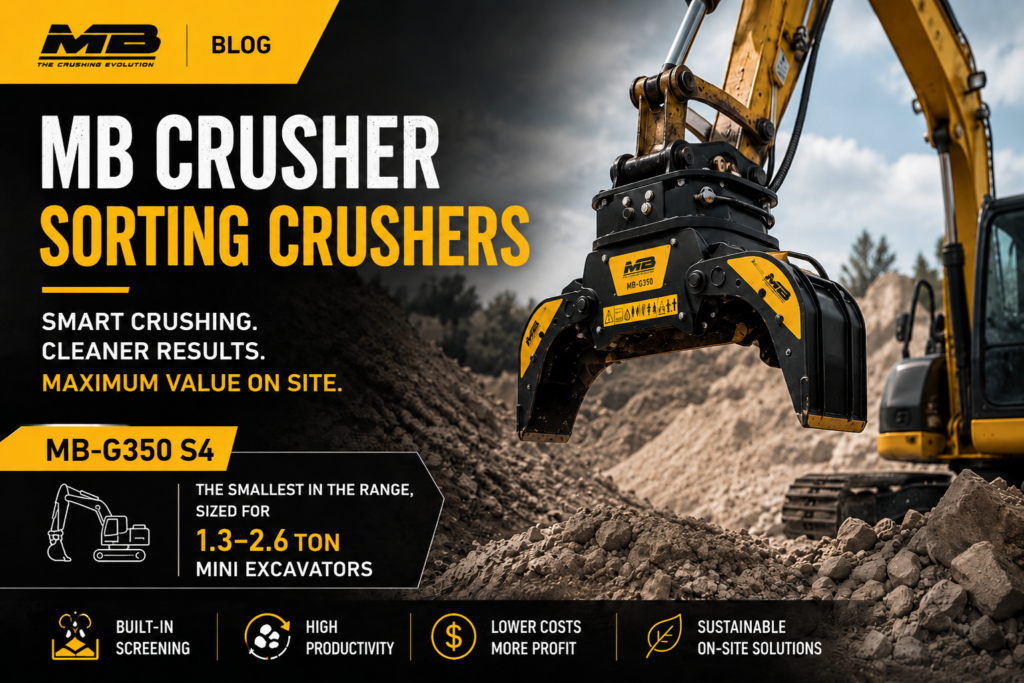
| MB-G350 S4 | 1.3 – 2.6 tons | Mini excavators, landscaping, dry-stone walling |
| MB-G400 S4 | 2.4 – 4 tons | Mini excavators, urban construction, agriculture |
| MB-G450 S4 | 3.5 – 5.5 tons | Midi excavators, mixed construction work |
| MB-G500 S4 | 5 – 8 tons | Midi excavators, forestry, light demolition |
| MB-G600 S4 | 7 – 12 tons | Mid-range demolition, recycling yards |
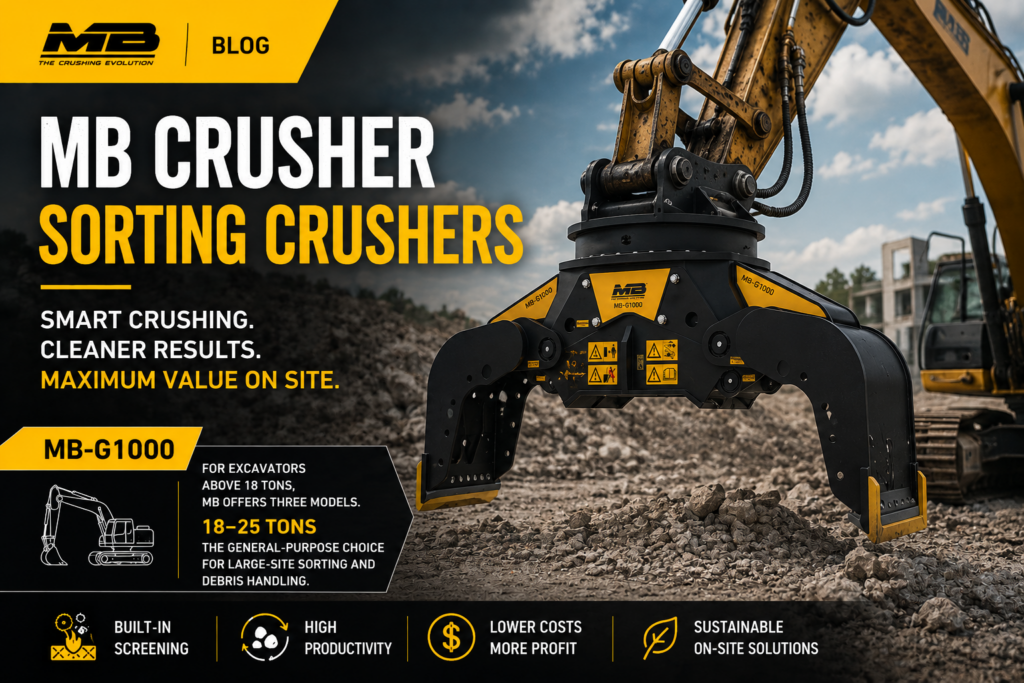
| MB-G1000 S4 | 18 – 25 tons | Large-site sorting, heavy debris handling |
| MB-G1200 S4 | 18 – 30 tons | Demolition, rubble sorting, loading |
| MB-G1500 S4 | 20 – 30 tons | Heavy-duty demolition, premium sorting |
What an MB Sorting Grapple Actually Does
Grip, Rotate, and Place
First, a sorting grapple is a two-jaw hydraulic attachment that mounts in place of the excavator’s bucket. The jaws close around irregular loads — logs, boulders, brushwood, concrete, rebar, scrap — that no flat bucket could carry cleanly. In addition, a 360-degree hydraulic rotator on top lets the operator orient the load before placing it. As a result, this is what separates “scooping with a grapple” from real sorting work.
Why This Beats a Bucket on Sorting Jobs
Furthermore, that ability to grip, rotate, and place changes what an excavator can do. Instead of pushing material into piles and reshuffling, you pick a piece up, rotate it 180 degrees, and set it precisely where you want it. Therefore, stone-wall builders, demolition contractors, recyclers, and forestry operators all rely on this for the same reason: it converts a slow, two-machine job into a one-operator workflow.
How to Size an MB Sorting Grapple to Your Excavator
1. Match the Tonnage Range
First and most important: the excavator’s operating weight must fall inside the grapple’s specified range. Specifically, going under means the grapple is too heavy and reduces lift capacity and stability. Going over means the carrier’s hydraulic flow and pressure can damage the grapple’s seals and cylinder over time. The table above tells you which MB-G fits which class.
2. Check the Hydraulic Lines
Generally, every MB-G S4 needs at least one auxiliary hydraulic line for jaw open/close. Continuous 360-degree rotation needs a second auxiliary line — or, on two-line carriers, an electrical kit that switches one circuit between the rotator and the jaws. Many mini and midi excavators ship with only one auxiliary line as standard. Therefore, factor the electrical kit into your quote if your carrier is two-line.
3. Confirm the Mounting
In particular, MB grapples ship with a top mounting bracket that pairs to your excavator’s quick-coupler. The pin diameter, pin centres, and quick-coupler standard (ISO, dedicated, Lehnhoff, etc.) must all be specified before the grapple is built. Get this wrong and the grapple cannot physically mount. Furthermore, send MCM a photo of the existing quick-coupler and the carrier model so we can confirm the bracket spec at quote stage.
4. Decide on Rotation
By default, all MB-G S4 grapples support 360-degree hydraulic rotation. Nevertheless, for some applications — pure scrap loading from a static pile, for example — a non-rotating grapple is cheaper and slightly more robust. For sorting, stone walling, or any precise placement work, the rotator is essential. Pay for it.
Picking the Right MB-G for Your Application
Mini Excavator Sorting and Landscaping
First, for carriers under 4 tons, the choice is the MB-G350 or MB-G400. Specifically, the G350 suits machines down to 1.3 tons, which covers the smallest urban excavators where space and weight are tight. The G400 steps up for 2.4–4 ton carriers — agricultural mini excavators and most landscaping units. Both are light enough that they don’t compromise lift over reach.
Midi Excavator Construction and Forestry
Next, the 4–8 ton range is covered by the MB-G450 (3.5–5.5 tons) and the MB-G500 (5–8 tons). These are the most popular grapples on South African construction and farm sites because the carrier class is the most common. The G500 in particular is a good fit for general site work — large enough to handle real construction debris, small enough to manoeuvre in tight spots.
Heavy Mini / Light Midi Demolition
Meanwhile, the MB-G600 spans 7–12 tons and is the bridge between midi sorting work and proper demolition. If you’re running a 10-ton excavator on mixed demolition and sorting, this is the unit. The jaws are heavier than the G500’s and the frame is built for repeated heavy gripping rather than occasional placement work.
Large-Site Sorting and Demolition
Finally, for excavators above 18 tons, MB offers three models. The MB-G1000 (18–25 tons) is the general-purpose choice for large-site sorting and debris handling. The MB-G1200 (18–30 tons) is tuned for demolition and rubble work — heavier jaws, more aggressive teeth. The MB-G1500 (20–30 tons) is the premium demolition unit, built for continuous high-cycle work in scrap yards and large recycling operations.
Features Worth Paying For
Not every spec sheet line item matters equally. Specifically, these five features make the biggest difference to wear life, safety, and day-to-day operator productivity on an MB sorting grapple:
- Interchangeable, reversible blades. When one edge wears, flip the blade and run it again. Doubles wear life before replacement.
- Hardox® steel wear parts. Standard on the S4 range. Significantly extends jaw and tooth life in abrasive material like demolition rubble and stone.
- Load-holding (anti-fall) valve. Hydraulic safety valve that prevents the jaws opening if a hose bursts. Essential for lifting loads over people.
- Silent block / vibration dampener. Reduces shock and noise on the rotator — important on urban and residential sites with noise restrictions.
- Electrical kit for two-line carriers. Lets a two-hose mini excavator drive both jaw and rotator functions through a single auxiliary circuit.
Additionally, for the manufacturer’s full technical documentation and certifications, see the MB Crusher international site.
Common Sizing Mistakes
Even experienced buyers slip up on grapple sizing. Specifically, the four mistakes below come up most often when MCM is called to swap or re-spec a unit after delivery:
- Buying the biggest grapple your excavator can lift. Lift capacity is only one factor. A grapple that’s too heavy for the carrier reduces over-reach capacity and makes precision placement harder.
- Ignoring the hydraulic flow spec. The grapple’s cylinder and rotator are designed for a specific flow range. Too much pressure damages seals; too little makes the jaws slow.
- Skipping the electrical kit on two-line carriers. Then trying to do rotation work with manual valve switching. It’s slow, the operator fatigues, and the workflow falls apart.
- Choosing a demolition grapple for sorting work. A demolition unit (G1200/G1500) is heavier and slower to actuate. For sorting cleaner materials, a general grapple of the same class is faster.
MB Sorting Grapples from MCM Group
In South Africa, MCM Group is an authorised MB Crusher dealer, stocking the full MB-G S4 sorting grapple range — from the MB-G350 for mini excavators up to the MB-G1500 for 30-ton demolition machines. We supply matched to your carrier with the correct mounting bracket and hydraulic kit, deliver nationwide, and back every unit with parts and service through our branch network in Midrand, Cape Town, Bloemfontein, and George.
Also, looking at the wider attachment line-up? Our full MB Crusher range also includes bucket crushers, screening buckets, drum cutters, and padding buckets — all built to the same standard and supported from the same parts network.
Your Questions Answered
Below are the most common questions buyers ask MCM Group about MB sorting grapples. Furthermore, if your situation isn’t covered here, our parts team is happy to walk through your specific excavator setup over a quick phone call.
Which MB sorting grapple fits my excavator?
Can I run an MB sorting grapple on a two-line mini excavator?
Do MB sorting grapples come with the correct mounting bracket?
What is the difference between the MB-G1000, G1200, and G1500?
More MB Sorting Grapple Questions
In addition, here are a few less common but important questions on wear life, availability, and finance for MB sorting grapples in the South African market.
How long do MB sorting grapple wear parts last?
Are MB sorting grapples available in South Africa?
Can I use an MB sorting grapple on a wheel loader or telehandler?
Does MCM Group offer finance on MB sorting grapples?
Talk to MCM Group About MB Sorting Grapples
Ultimately, if you’re still not sure which MB-G fits your excavator, Send us your carrier make and model, operating weight, quick-coupler type, and a photo of the existing mounting. Our parts team will confirm the right grapple, the correct bracket, and whether you need an electrical kit — all before you commit to a quote.
Contact MCM Group for current pricing, stock availability, and finance options.
Shop the range: browse MCM Group’s excavators for sale for current models, specs and pricing.
Why buyers trust MCM Group
MCM Group has supplied and serviced construction and agricultural equipment across all nine South African provinces since 2008. Every machine is backed by a local warranty, a National Parts Division and technical support from four branches in Cape Town, George, Bloemfontein and Midrand.