

Quick answer
Cherry picker service and compliance is a legal requirement in South Africa, because a mobile elevating work platform is designed to lift people and must be inspected to stay safe and certified.
A regular service interval provides documented proof that the machine is sound, and an annual load test allows you to keep a valid certificate that an inspector or client can ask to see on site.
Compliance involves routine maintenance, a load test and operator training, and this guide describes the service intervals and certificates that keep a cherry picker legal, safe and insurable.
A load test is an inspection in which a cherry picker is lifted to its rated capacity, and it provides the certificate that proves the machine is safe to carry workers at height on a South African site.
A well-serviced cherry picker earns its keep. A poorly-serviced one is a liability — to the operator, to the people working below, and to the owner who signed the safety file. In South Africa, regular cherry picker service isn’t just good practice; it’s a legal requirement under the Occupational Health and Safety Act and its Driven Machinery Regulations. This guide explains exactly how often to service a cherry picker, what each interval covers, and what the DMR and the relevant SANS standards expect. MCM Group supplies and services cherry pickers across South Africa.
The Quick Answer
- Before every shift — operator walk-around inspection.
- Every 50 hours — light service: lubrication points, hose check, hydraulic fluid top-up.
- Every 250 hours — minor service: filter changes, engine oil, hydraulic system check.
- Every 500 hours — major service: full fluid replacement, electrical and safety device test.
- Every 1 000 hours — overhaul service: structural inspection, ram seal check, brake test.
- Every 12 months — statutory inspection by a registered Lifting Machine Inspector (LMI), regardless of hours.
The exact hour intervals follow your OEM service manual. In practice, the annual LMI inspection is non-negotiable in South Africa, and skipping it puts the operator and the business at legal risk.
Why Regular Cherry Picker Service Matters
The Safety Case
A cherry picker hoists a person several metres above ground. As a result, a hose burst, a cracked weld, or a failed limit switch isn’t a productivity hit — it’s a fall. Routine service catches the early warning signs (weeping seals, frayed cables, sticky control valves) long before they fail under load. Therefore, a serviced machine is a known machine; an un-serviced one is a guess.
The Legal Case
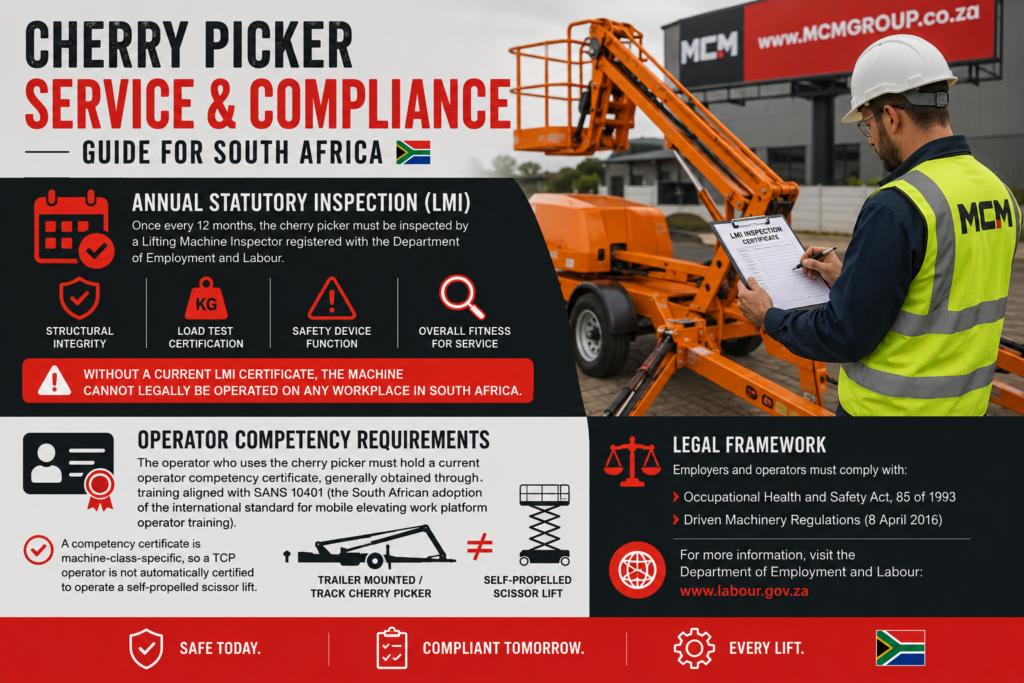
Under the Occupational Health and Safety Act (Act 85 of 1993) and the Driven Machinery Regulations (DMR), every lifting machine in South Africa must be inspected by a competent person at least every 12 months. Furthermore, the machine must be load-tested and certified before being put back into service after any major repair. A cherry picker without a current LMI certificate cannot legally be used on a workplace.
The Cost Case
Routine service is the cheapest part of cherry picker ownership. By contrast, a single hydraulic ram replacement, a structural repair, or a downtime week during harvest costs many times more than a year of scheduled maintenance. Additionally, machines with a clean service history resell at a noticeably higher value than those without one.
Daily Pre-Use Inspection
Before every shift, the operator walks the machine. Specifically, the daily check takes five to ten minutes and should cover:
- Visible damage on the boom, basket, chassis, and outriggers — dents, cracks, fresh paint over old welds.
- Hydraulic hoses for leaks, weeping at fittings, and signs of abrasion.
- Hydraulic oil level at the reservoir sight glass.
- Tyre condition and pressure on towable units; track tension on tracked models.
- Outrigger pads for cracks and free movement.
- Control panel functions — basket controls, ground controls, emergency stop, emergency lowering.
- Safety devices — tilt sensor, overload warning, basket interlock.
- Battery — terminals clean, charge indicator green (on electric and hybrid models).
Importantly, the daily inspection is recorded in a logbook kept with the machine. In addition, an unrecorded pre-use check counts as no check at all under an OHS investigation.

Cherry Picker Service Intervals Explained
50-Hour Light Service
First, the 50-hour service is the routine touch-up. Generally, this means greasing all pivot points, checking and topping up hydraulic fluid, inspecting all hoses for early wear, and verifying that the basket levelling and tilt sensors respond correctly. Many operators do this themselves; it requires no specialist tools.
250-Hour Minor Service
Next, at 250 hours the minor service kicks in. Specifically, this covers engine oil and oil filter (on diesel or petrol-engined units), fuel filter, hydraulic return filter, and air filter replacement. In addition, the technician checks battery condition, alternator output, and tests all safety circuits end-to-end.
500-Hour Major Service
At 500 hours, the machine gets a major service. Therefore, expect a hydraulic fluid replacement (not just a top-up), full filter replacement, brake adjustment and test, and a structured inspection of the boom welds and pivot bushings. Furthermore, this is the service where small problems are caught before they become big ones.
1 000-Hour Overhaul Service
Finally, at 1 000 hours (typically once a year for a heavily-used machine), the overhaul service inspects the structural integrity of the boom and basket, checks all rams for seal weep or scoring, replaces wear-prone hoses preemptively, and verifies that every safety circuit performs to specification. Critically, this service often runs alongside the annual statutory LMI inspection.
Annual Statutory Inspection (LMI)
Once every 12 months, the cherry picker must be inspected by a Lifting Machine Inspector registered with the Department of Employment and Labour. Specifically, the inspection covers structural integrity, load test certification, safety device function, and overall fitness for service. Without a current LMI certificate, the machine cannot legally be operated on any workplace in South Africa.
In addition, the operator who uses the cherry picker must hold a current operator competency certificate, generally obtained through training aligned with SANS 10401 (the South African adoption of the international standard for mobile elevating work platform operator training). Furthermore, a competency certificate is machine-class-specific, so a TCP operator is not automatically certified to operate a self-propelled scissor lift.
For more on the OHS Act and the Driven Machinery Regulations, see the South African Department of Employment and Labour.
Common Service Issues to Watch For
Specifically, the issues below come up most often in MCM’s cherry picker service workshop. Catching any of these early turns a small bill into an even smaller one:
- Weeping ram seals. A small drip turns into a slow ram drift, then a failed cylinder. Replace seals at the first sign.
- Hose abrasion at the boom pivot. Hoses rub through their outer jacket as the boom cycles. Inspect and re-route before the inner braid is exposed.
- Outrigger pad cracks. Aluminium pads crack from hard ground impact. A cracked pad reduces stability — replace it.
- Sticky control valves. Cold mornings, old hydraulic fluid, or contamination cause valves to stick. A flush and fresh fluid usually solves it.
- Tilt sensor drift. The tilt cut-out drifts out of calibration over time. A failed tilt sensor lets the operator extend on an unsafe slope. Calibrate annually.
- Battery sulphation on electric/hybrid units. Batteries left flat over weekends sulphate and lose capacity. Always plug in after use.
Cherry Picker Service from MCM Group
In South Africa, MCM Group supplies and services cherry pickers through branches in Midrand, Cape Town, Bloemfontein, and George. Specifically, our service offering covers the full range of intervals — daily checklist support, 50/250/500/1 000-hour services, annual LMI inspection coordination, and out-of-warranty repairs on the MCM TCP12 and other cherry picker models on our books.
Also, looking at the wider range? Our cherry picker product range is supported by genuine parts, OEM-trained technicians, and finance options through our preferred banking partners. In addition, every machine sold by MCM ships with a service logbook so the maintenance history travels with the unit.
Your Questions Answered
Below are the most common questions MCM Group gets from cherry picker owners. Furthermore, if your situation isn’t covered here, our service team is happy to walk through your specific machine and usage profile over a quick phone call.
How often should a cherry picker be serviced in South Africa?
Is annual LMI inspection legally required?
Do operators need a separate competency certificate?
What happens if I skip a service interval?
More Cherry Picker Service Questions
In addition, here are a few more questions on parts availability, service costs, and what to do when a cherry picker fails the annual inspection.
Can I service a cherry picker myself?
How much does a cherry picker service cost in South Africa?
What if my cherry picker fails the annual LMI inspection?
Does MCM Group offer service contracts on cherry pickers?
Talk to MCM Group About Cherry Picker Service
Ultimately, if you’re unsure when your cherry picker is next due for service — or your annual LMI inspection is approaching — send us your machine make, model, and current hour reading. Our service team will map out the next 12 months of maintenance and inspection in a single quote.
Contact MCM Group for service bookings, parts, LMI inspection coordination, or a maintenance plan quote.
Shop the range: browse MCM Group’s cherry pickers for sale for current models, specs and pricing.