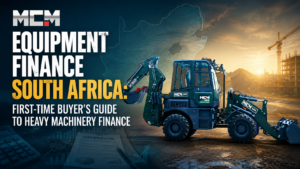

MCM Group explains how South African contractors can claim construction equipment tax deductions through SARS — including wear and tear allowances, Section 11(e) deductions, and capital allowances — with finance guidance from branches in Cape Town, George, Gauteng, and Bloemfontein.
Yes, you can claim construction equipment on tax in South Africa. SARS allows businesses to deduct the cost of machinery and equipment used for trade through annual wear and tear allowances under Section 11(e) of the Income Tax Act. The rate depends on the asset type and its expected useful life, so understanding your construction equipment tax obligations can save your business thousands of rands each year.
Need help structuring your equipment purchase for maximum tax benefit? Contact MCM Group for expert finance options and documentation support.
How Construction Equipment Tax Deductions Work in South Africa
When you buy a machine for your construction business, SARS does not let you deduct the full purchase price in the year you buy it. Instead, the deduction spreads across several tax years through a system called “wear and tear” allowances. This approach reflects the fact that equipment loses value over time as you use it on-site.
The Income Tax Act governs these deductions, and SARS Interpretation Note 47 provides the official guidelines. Your tax practitioner will use these rates when preparing your annual return, so it helps to understand the basics before you buy.
Because the deduction only applies to assets used for business purposes, keeping clear records from day one is essential. Mixed-use assets attract a reduced claim, while purely personal items qualify for nothing at all.
Section 11(e) for Farmers: Wear and Tear on Agricultural Equipment
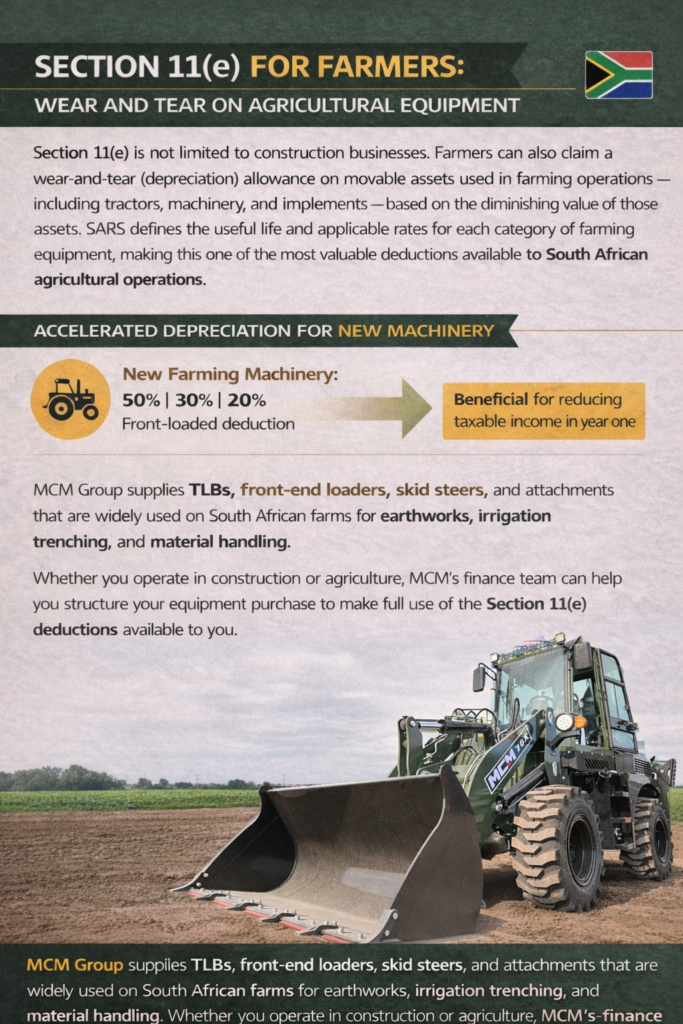
Section 11(e) is not limited to construction businesses. Farmers can also claim a wear-and-tear (depreciation) allowance on movable assets used in farming operations — including tractors, machinery, and implements — based on the diminishing value of those assets. SARS defines the useful life and applicable rates for each category of farming equipment, making this one of the most valuable deductions available to South African agricultural operations.
In most cases, farming wear-and-tear deductions are claimed on a straight-line basis over the SARS-prescribed period. However, the Income Tax Act provides an accelerated depreciation allowance for specific new machinery used in farming: 50% in year one, 30% in year two, and 20% in year three. This front-loaded deduction reduces taxable farming income significantly in the first year of ownership — a meaningful benefit when capital outlay on new equipment is high.
MCM Group supplies TLBs, front-end loaders, skid steers, and attachments that are widely used on South African farms for earthworks, irrigation trenching, and material handling. Whether you operate in construction or agriculture, MCM’s finance team can help you structure your equipment purchase to make full use of the Section 11(e) deductions available to you.
Section 11(e) — Wear and Tear Allowances for Equipment
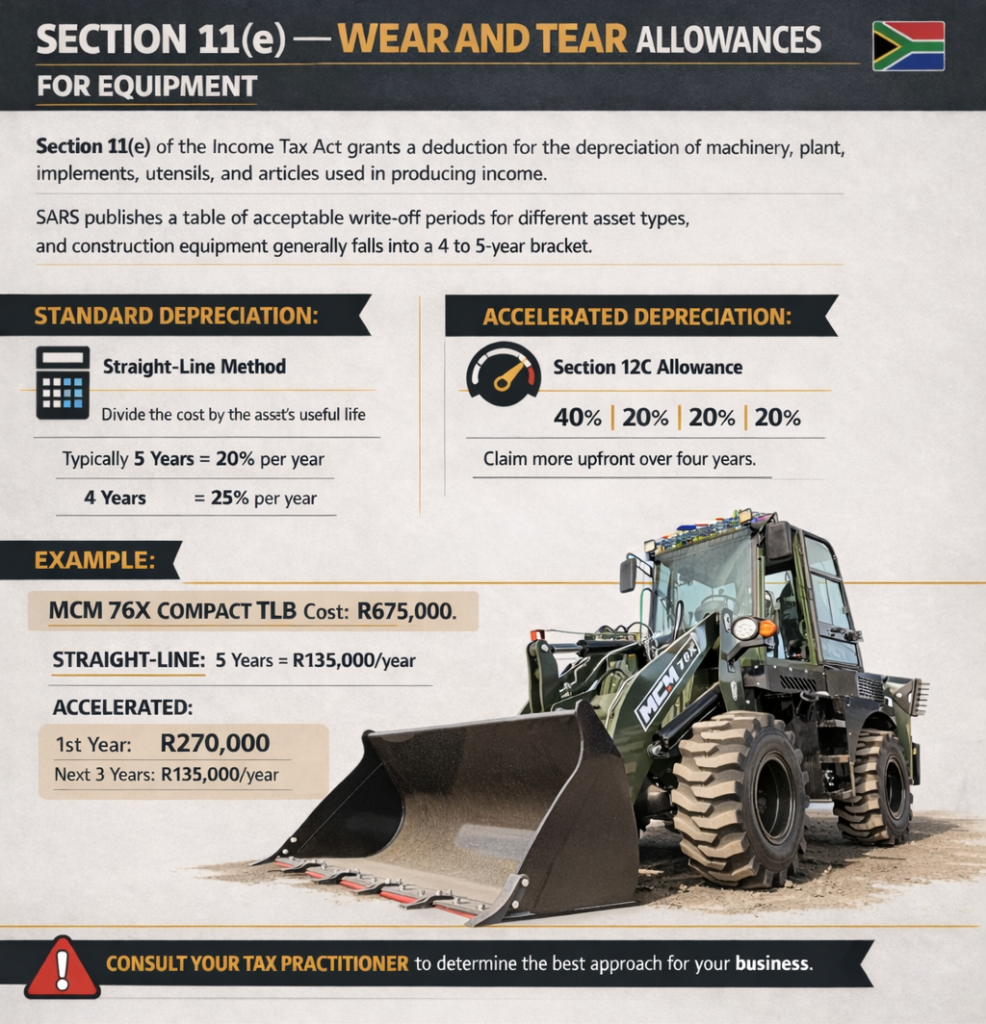
Section 11(e) of the Income Tax Act grants a deduction for the depreciation of machinery, plant, implements, utensils, and articles used in producing income. SARS publishes a table of acceptable write-off periods for different asset types, and construction equipment generally falls into a 4 to 5-year bracket.
The standard straight-line method applies in most cases. That means you divide the cost of the asset by its useful life and claim an equal portion each year. For example, a machine with a 5-year write-off period gives you a 20% annual deduction, while a 4-year asset gives you 25% per year.
Certain businesses involved in manufacturing or production processes may also qualify for accelerated depreciation under Section 12C, which allows a 40/20/20/20 split over four years. Section 12C specifically requires the asset to be used in a process of manufacture or a similar process — which means most standard construction activities (earthworks, trenching, demolition) are unlikely to qualify. If your operation includes on-site production such as concrete batching or asphalt mixing, ask your tax practitioner whether Section 12C applies to you.
What SARS Allows You to Claim on Construction Equipment Tax Returns
SARS allows wear and tear deductions on a wide range of construction machinery, as long as you use the asset to produce income. The following equipment types typically qualify for the deduction:
- TLBs (backhoe loaders) — typically written off over 4–5 years
- Excavators — including mini excavators and 35-ton machines
- Front end loaders and wheel loaders
- Forklifts — diesel, electric, and rough terrain models
- Compaction rollers — ride-on and walk-behind
- Skid steers and mini loaders
- Plate compactors and rammers
- Concrete mixers, generators, and site lighting equipment
- Attachments — breakers, augers, buckets, and crusher buckets
Each asset must appear on your company’s fixed asset register, and you need to keep the purchase invoice, delivery note, and proof of payment. Without these documents, SARS can disallow the deduction during an audit.
What You Cannot Claim as a Tax Deduction
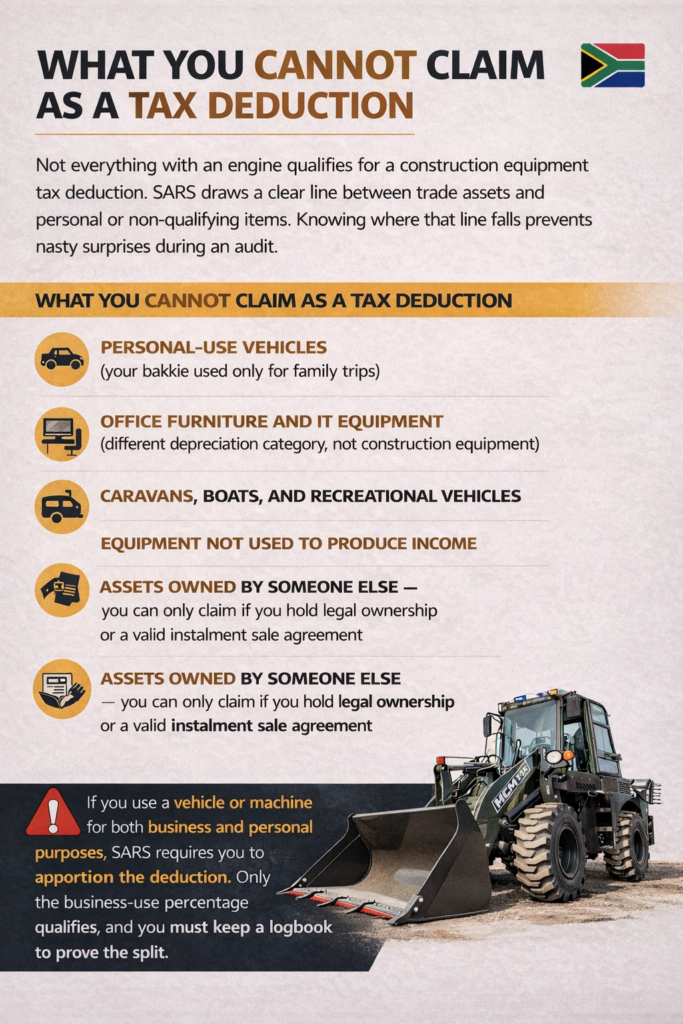
Not everything with an engine qualifies for a construction equipment tax deduction. SARS draws a clear line between trade assets and personal or non-qualifying items. Knowing where that line falls prevents nasty surprises during an audit.
- Personal-use vehicles (your bakkie used only for family trips)
- Office furniture and IT equipment (different depreciation category, not construction equipment)
- Caravans, boats, and recreational vehicles
- Equipment not used to produce income
- Assets owned by someone else — you can only claim if you hold legal ownership or a valid instalment sale agreement
If you use a vehicle or machine for both business and personal purposes, SARS requires you to apportion the deduction. Only the business-use percentage qualifies, and you must keep a logbook to prove the split.
How to Calculate Your Construction Equipment Tax Deduction
Let’s work through a real example so you can see exactly how the numbers play out. Suppose you buy an MCM 76X TLB for R675,000 (excluding VAT) and SARS assigns it a 5-year useful life.
| Tax Year | Deduction Rate | Annual Deduction | Remaining Book Value |
|---|---|---|---|
| Year 1 | 20% | R135,000 | R540,000 |
| Year 2 | 20% | R135,000 | R405,000 |
| Year 3 | 20% | R135,000 | R270,000 |
| Year 4 | 20% | R135,000 | R135,000 |
| Year 5 | 20% | R135,000 | R0 |
At a company tax rate of 27%, each R135,000 deduction saves you R36,450 in tax per year. Over the full 5 years, that adds up to R182,250 in tax savings on a single machine. Because the deduction reduces your taxable income rather than your tax bill directly, the actual benefit depends on your marginal tax rate.
If your business qualifies for the accelerated 40/20/20/20 deduction under Section 12C (applicable to manufacturing or similar production processes, not standard construction), your first-year deduction jumps to R270,000 — saving you R72,900 in year one alone. Confirm with your tax practitioner whether your specific activities meet the Section 12C requirements before filing.
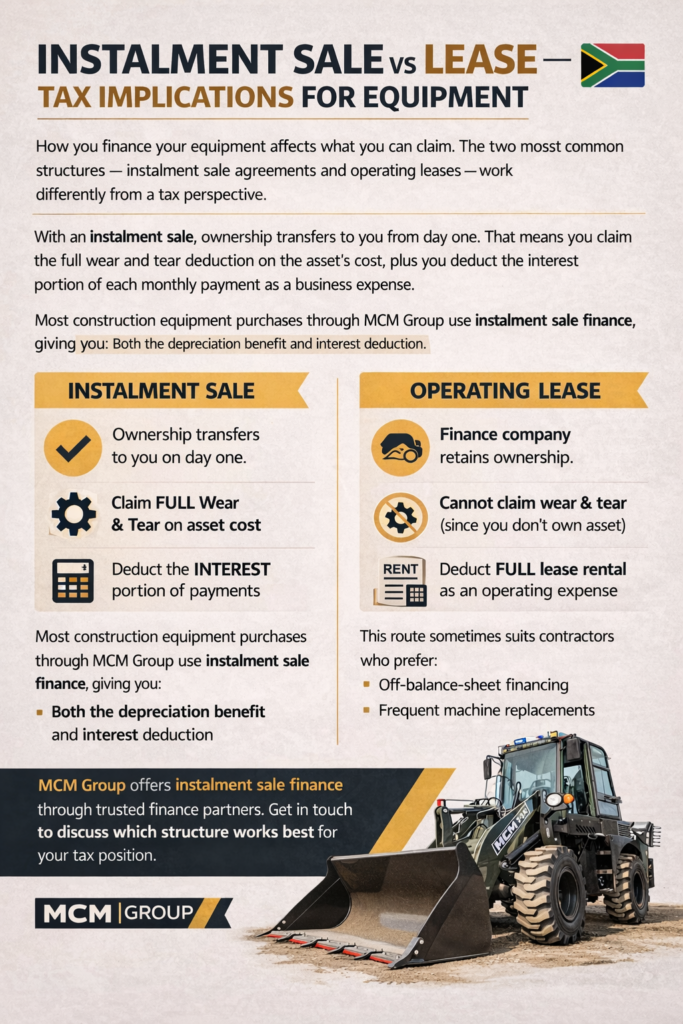
Instalment Sale vs Lease — Tax Implications for Equipment
How you finance your equipment affects what you can claim. The two most common structures — instalment sale agreements and operating leases — work differently from a tax perspective.
With an instalment sale, ownership transfers to you from day one. That means you claim the full wear and tear deduction on the asset’s cost, plus you deduct the interest portion of each monthly payment as a business expense. Most construction equipment purchases through MCM Group use instalment sale finance, which gives you both the depreciation benefit and interest deduction.
Under an operating lease, the finance company retains ownership. You cannot claim wear and tear because you don’t own the asset, but you deduct the full lease rental as an operating expense each month. This route sometimes suits contractors who prefer off-balance-sheet financing or who replace machines frequently.
MCM Group offers instalment sale finance through trusted finance partners. Get in touch to discuss which structure works best for your tax position.
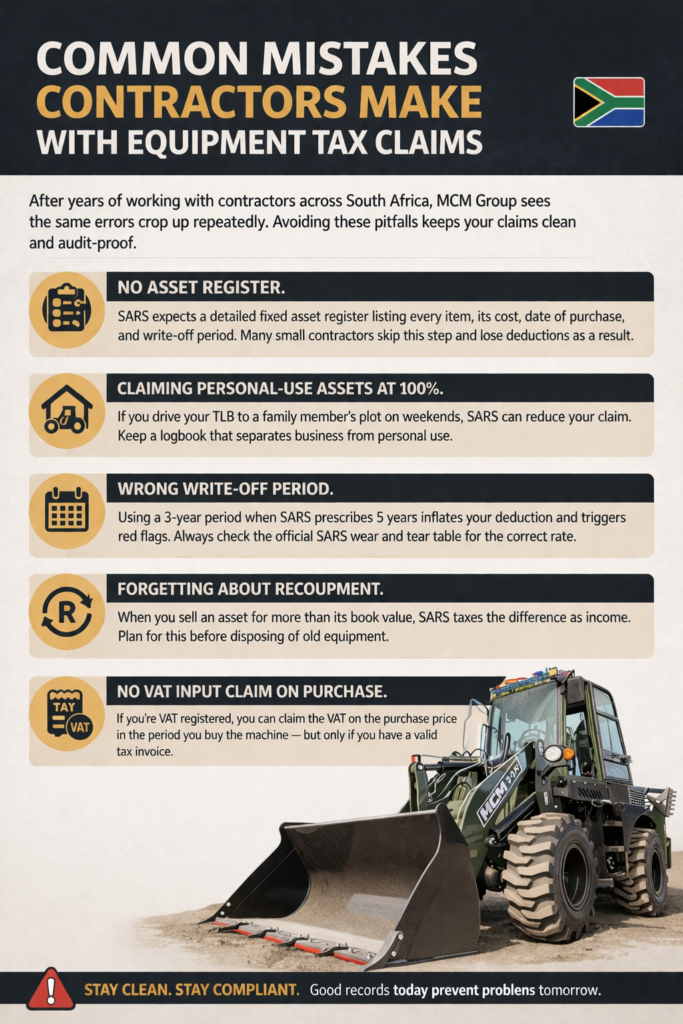
Common Mistakes Contractors Make with Equipment Tax Claims
After years of working with contractors across South Africa, MCM Group sees the same errors crop up repeatedly. Avoiding these pitfalls keeps your claims clean and audit-proof.
- No asset register. SARS expects a detailed fixed asset register listing every item, its cost, date of purchase, and write-off period. Many small contractors skip this step and lose deductions as a result.
- Claiming personal-use assets at 100%. If you drive your TLB to a family member’s plot on weekends, SARS can reduce your claim. Keep a logbook that separates business from personal use.
- Wrong write-off period. Using a 3-year period when SARS prescribes 5 years inflates your deduction and triggers red flags. Always check the official SARS wear and tear table for the correct rate.
- Forgetting about recoupment. When you sell an asset for more than its book value, SARS taxes the difference as income. Plan for this before disposing of old equipment.
- No VAT input claim on purchase. If you’re VAT registered, you can claim the VAT on the purchase price in the period you buy the machine — but only if you have a valid tax invoice.
Before You Claim — Quick Checklist
- Confirm the equipment appears on your fixed asset register with the correct cost and purchase date
- Check the SARS-prescribed write-off period for your specific asset type
- Keep the original tax invoice, delivery note, and proof of payment
- Separate business use from personal use with a logbook (if applicable)
- Verify your finance agreement type — an instalment sale allows depreciation, while an operating lease allows rental deductions
- If your activities include manufacturing or production, ask your tax practitioner whether accelerated depreciation under Section 12C applies
- Claim VAT input on the purchase if you are VAT registered
- Consult your accountant or tax practitioner before filing — this guide is educational and does not replace professional tax advice
Disclaimer: This article provides general information about construction equipment tax deductions in South Africa. It does not constitute tax or legal advice. Always consult a registered tax practitioner or accountant for advice specific to your circumstances.
Frequently Asked Questions About Construction Equipment Tax in South Africa
Your Questions Answered
Construction Equipment Tax — Your Questions Answered
Can I claim a TLB on tax in South Africa?
What is the wear and tear rate for construction equipment?
Can I claim equipment bought on instalment sale?
Do I need to be VAT registered to claim equipment?
More Common Questions
What records does SARS need for equipment tax claims?
Can I claim equipment I use for both business and personal?
Does MCM Group help with equipment finance documentation?
About the Author
Sources & References
- SARS — Guide on Allowances and Deductions Relating to Assets
- PWC South Africa — Corporate Deductions
- SARS — Income Tax Act (Section 11(e))
- SA Tax Guide — Wear and Tear Allowances
Find Us Nationwide
Cape Town Branch
9 Karee Road, Kraaifontein Industria
+27(0)21 001 8686
info@mcmgroup.co.za
George Branch
Jura Lands, Beach Road, Hansmoeskraal, George
+27(0)44 873 3355
george@mcmgroup.co.za
Gauteng Branch
26 Sterling Road, Samrand Business Park, Midrand
+27(0)12 940 9026
gauteng@mcmgroup.co.za
Bloemfontein Branch
Bloem Showgrounds, Curie Avenue, Bloemfontein
+27(0)51 101 0095
bloemfontein@mcmgroup.co.za
Ready to buy construction equipment with maximum tax benefits? MCM Group’s finance team helps you structure your purchase for the best possible deduction. Get a competitive quote today and start saving on tax from day one.