
Quick answer
Forklift fork extensions are slide-on sleeves that fit over your existing forks to provide extra length for handling longer or bulkier loads such as timber, pipe and oversized pallets.
Extensions allow you to carry loads your standard forks cannot reach, but they are designed to be used within strict capacity limits, so the safe length is determined by your forklift’s rated capacity and load centre.
Fork extensions are a low-cost attachment that allows you to handle occasional long loads without buying a second forklift, but they reduce safe working capacity, so they are designed for light, well-balanced loads rather than maximum weight.
Forklift fork extensions are slip-on steel sleeves that extend the reach of a forklift’s standard forks. They let you handle longer or deeper loads without buying a bigger machine. For South African operators moving timber, panels, pipework, irrigation tube, or oversized pallets, a good set of forklift fork extensions is one of the cheapest productivity upgrades you can make. MCM Group supplies them in a range of lengths and capacities, with nationwide delivery and fitment guidance.
What Are Forklift Fork Extensions?
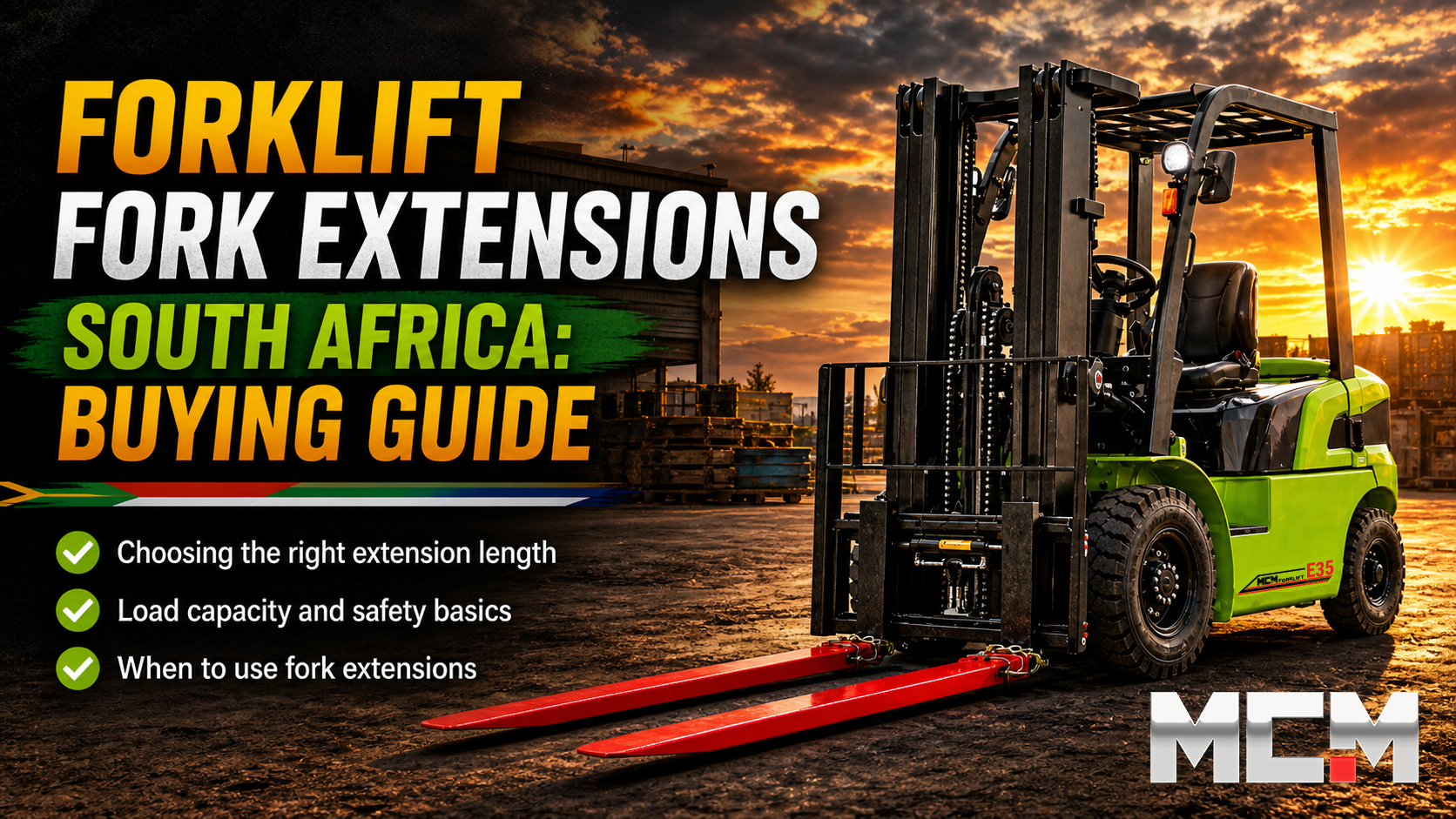
A forklift fork extension (also called a fork sleeve or slip-on extension) is a steel sleeve that fits over the existing fork tine. It increases the effective length of the fork by 50% to 100%. As a result, the operator can pick up loads that the standard fork length cannot safely support. A retaining pin or heel plate locks the extension flush against the back of the original fork.
Operators slip extensions on and off in seconds. So the same forklift can switch between standard and extended duties throughout the day. They do not normally require welding or drilling. However, you must still check the forklift’s safe working load for the new load centre before use.
When You Need Forklift Fork Extensions
The standard fork length on most South African forklifts is 1070 mm (42″). That is fine for a single Euro pallet. However, it is limiting in plenty of real-world tasks. Operators reach for extensions when:
- Handling double pallets of fertiliser, feed, or building materials at depth.
- Moving long crates of timber, plasterboard, steel sheet, or roofing.
- Loading PVC, HDPE, or polyethylene pipe onto trucks at irrigation suppliers.
- Loading or unloading shipping containers where the load sits at the far end.
- Lifting irregular shapes such as cable drums, machinery crates, or stone slabs.
- Servicing implements on agricultural equipment that sit deeper than a standard fork can reach.
Choosing the Right Forklift Fork Extensions
Three measurements decide which extension fits your forklift: fork width, fork thickness, and required extension length. Get them wrong and the extension will either rattle loose or refuse to slide on at all.
Fork Width and Thickness
First, measure the existing fork at its widest and thickest points. Common inner sizes are 100 × 40 mm, 125 × 45 mm, and 150 × 50 mm. The sleeve must match the fork snugly. Too tight and it won’t seat fully. Too loose and the load will rock. Add 2–3 mm of clearance for paint and minor wear, but no more.
Extension Length
International standards such as ISO 13284 and ANSI/ITSDF B56.1 cover technical and safety requirements for fork-arm extensions. As a practical rule, many suppliers specify that an extension should not exceed 1.5 times the original fork length. So a 1070 mm fork can take an extension of up to roughly 1600 mm (60″). Common off-the-shelf lengths are 1500 mm, 1800 mm, and 2400 mm. Anything beyond that is usually a custom build.
A Practical Sizing Example
For example, suppose your forklift has 1070 mm forks that are 125 mm wide and 45 mm thick. In that case, a sleeve with an internal profile suited to 125 × 45 mm forks works well. Additionally, a practical extension length of 1500–1600 mm usually fits the load and forklift rating. Always check this sizing against your specific forklift’s load chart before ordering.
Capacity and Load Centre
Forklift fork extensions move the load centre forward. Therefore, the safe lifting capacity drops. The longer or deeper the load, the more this matters. Do not rely on the forklift’s original rated capacity. That rating assumes a specific load centre.
Before using extensions, check the forklift data plate, the load chart, the weight of the load, and the new effective load centre. As a rough guide, the further the load centre moves forward, the more capacity drops. However, the exact derated figure must come from the forklift load chart, manufacturer guidance, or a competent forklift supplier. Also, the derated safe working load should be clearly visible to the operator for regular workplace use.
Safety Rules for Forklift Fork Extensions
- Always engage the heel. The extension must seat fully against the heel of the original fork. A gap means the extension tip carries the load — that is exactly how extensions get bent.
- Lock the retaining pin. Every reputable extension uses a sprung pin or chain that locks it onto the fork shank. Use it. Otherwise, the extension can lift off as you set a load down.
- Mark the safe working load. Display the forklift’s safe working load at the new, extended load centre where the operator can see it.
- Inspect before each shift. Look for visible bending, cracks at the heel weld, and pin damage. A bent extension is scrap. You cannot straighten it safely.
- Match the colour code. Most South African suppliers paint extensions yellow or orange so other operators on the floor see them clearly. Don’t repaint them in colours that hide the fact that the truck is running long.
- Use trained operators. Train forklift operators for the lifting machine type. In addition, set a clear procedure for fitting, removing, and storing extensions.
Forklift Fork Extensions vs. a Bigger Forklift
Extensions cost a fraction of a larger forklift. Also, they take seconds to fit. However, they are not a substitute for a properly sized truck. If you run extensions every day, on every load, the truck is probably under-specified for the work. Extensions earn their keep on occasional long loads — the timber delivery once a week, the long crate at month-end, the irrigation pipe job that lasts three days. For continuous heavy or oversized work, look at a higher-capacity forklift or a telehandler from MCM Group’s range.
What MCM Needs to Quote the Right Fork Extensions
To quote correctly the first time, send the following to our parts team:
- Forklift make and model
- Fork length
- Fork width
- Fork thickness
- Load weight
- Load length or pallet depth
- How often the extensions will be used
- A photo of the existing forks and data plate
With those details, we confirm the correct sleeve size, recommend an extension length, and check the derated safe working load against your forklift’s load chart.
Forklift Fork Extensions from MCM Group
MCM Group supplies forklift fork extensions sized to the most common South African forklift fork profiles. Lengths run from 1500 mm up to 2400 mm. Each set ships with a sprung locking pin and a high-visibility finish. Furthermore, we match extensions to your existing fleet and confirm fit before dispatch.
We deliver nationwide. In addition, our parts team helps you size correctly the first time so the extensions arrive ready to use. Where the requirement is unusual — extra-long loads, non-standard fork profiles, custom heel plates — we also build to specification. Browse our wider range of forklift and equipment attachments for related items.
Your Questions Answered
Are forklift fork extensions legal in South Africa?
How much do fork extensions reduce capacity?
Can I use one extension and leave the other fork standard?
Can fork extensions be repaired if they bend?
Do I need extensions for a rough-terrain forklift?
What sizes of forklift fork extensions does MCM Group stock?
Talk to MCM Group About Forklift Fork Extensions
Not sure which size you need? Send MCM Group your fork width, fork thickness, fork length, forklift model, load weight, and a photo of your current forks. Our parts team can match the correct forklift fork extensions to your machine and application.
We supply forklift fork extensions for common South African forklift sizes, with nationwide delivery and after-sales support through MCM Group’s branch network. Contact us for a quote and current stock.
Shop the range: browse MCM Group’s forklifts for sale for current models, specs and pricing.