
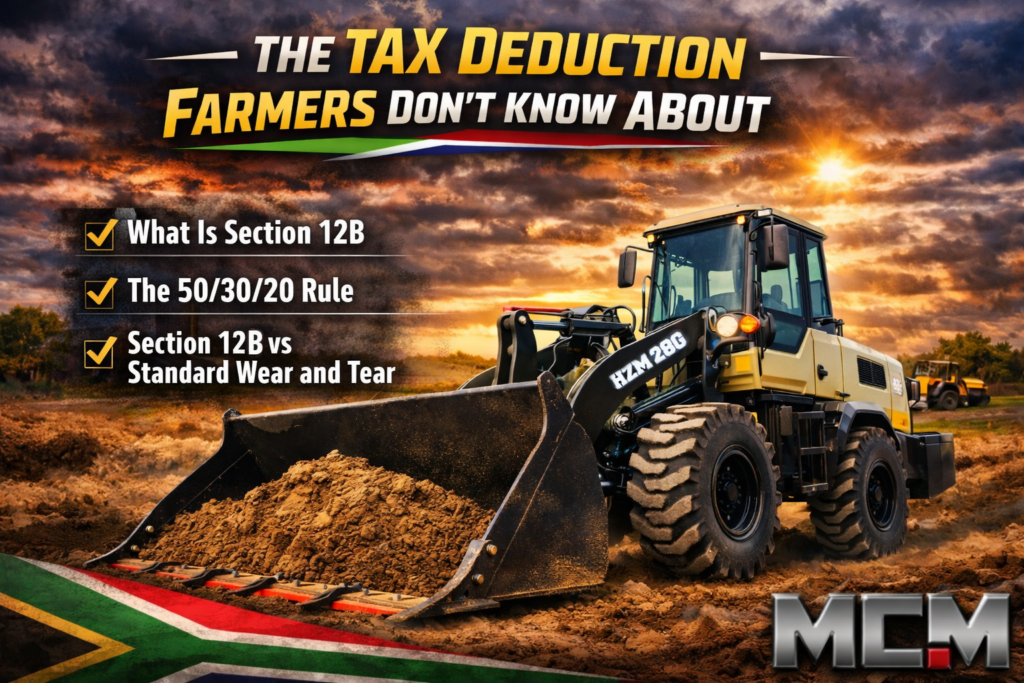
MCM Group explains how South African farmers can use the Section 12B farming equipment tax deduction to write off 50% of new machinery in year one — with TLBs, front-end loaders, excavators, and wood chippers available from branches in Cape Town, George, Gauteng, and Bloemfontein.
Section 12B of the Income Tax Act lets South African farmers deduct the cost of qualifying machinery and equipment over three years using a 50/30/20 split — meaning half the purchase price reduces your taxable income in the first year alone. This accelerated depreciation allowance applies to new and unused assets brought into farming operations, so it directly lowers your tax bill when you invest in equipment.
Ready to invest in qualifying farming equipment? Contact MCM Group for expert advice, competitive pricing, and flexible finance options on TLBs, loaders, excavators, and more.
What Is Section 12B? The Farming Tax Deduction Explained
Section 12B falls under the SARS Guide on the Taxation of Farming Operations (IT35), and it exists to encourage capital investment in agriculture. The provision allows farmers to claim an accelerated depreciation allowance on qualifying plant, machinery, and equipment used in farming operations.
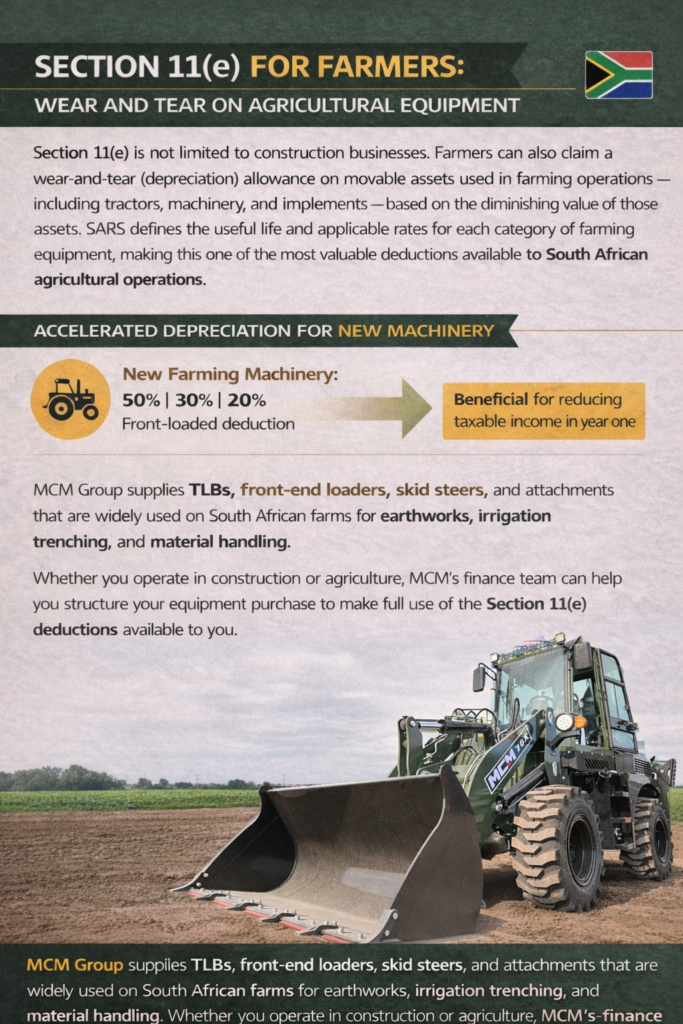
Unlike standard wear-and-tear allowances that spread deductions evenly over five or more years, Section 12B farming deductions front-load your tax benefit. You recover 50% of the asset cost in year one, which frees up significant cash flow during the period when you need it most — right after making a large equipment purchase.
SARS requires that the equipment be new and unused when first brought into your farming operation. The asset must also be used directly in the production of income from farming. Leased equipment does not qualify unless you hold the risks and rewards of ownership, so always confirm your finance structure with your tax practitioner before claiming.
The 50/30/20 Rule — How Section 12B Farming Deductions Work
The Section 12B depreciation schedule follows a fixed 50/30/20 split over three tax years. This means you claim 50% of the asset’s cost in the first year, 30% in the second year, and 20% in the third year. After three years, you have written off the full purchase price against your taxable farming income.
Here is a practical example using an R2,000,000 tractor purchased for farming operations:
- Year 1: R2,000,000 × 50% = R1,000,000 deduction
- Year 2: R2,000,000 × 30% = R600,000 deduction
- Year 3: R2,000,000 × 20% = R400,000 deduction
If you fall in the 45% marginal tax bracket, that R1,000,000 first-year deduction saves you R450,000 in tax — effectively returning almost a quarter of the tractor’s purchase price in year one. This accelerated write-off gives farmers a powerful reason to invest in new equipment rather than running old machines past their productive life.
Keep in mind that the deduction applies from the date the asset is brought into use, not the date of purchase. So if you buy a machine in February but only start using it in your next tax year, the 50% deduction kicks in during that later year. Plan your purchases accordingly to maximise the benefit.
Which Farming Equipment Qualifies for Section 12B?
A wide range of plant, machinery, implements, and equipment qualifies for the Section 12B deduction — as long as you use the asset directly in farming operations. MCM Group supplies several categories of qualifying equipment across South Africa, including:
- TLBs (Tractor-Loader-Backhoes) — essential for trenching, loading, and land clearing on farms
- Front end loaders — ideal for moving feed, silage, compost, and bulk materials
- Excavators — used for dam construction, drainage, and earthmoving on agricultural land
- Wood chippers — perfect for clearing bush, processing orchard prunings, and producing mulch
- Implements and attachments — buckets, augers, rippers, and other farming accessories
- Irrigation systems — centre pivots, drip systems, and pump installations
- Fencing equipment — fencing machines and post drivers used in livestock operations
- Storage infrastructure — grain silos, feed bunkers, and cold rooms (these may fall under Section 12C depending on classification)
The key test is whether the asset serves a farming purpose and whether you use it to produce farming income. A TLB used on a farm for trenching irrigation lines, clearing land, or building roads qualifies — but the same TLB used exclusively on a residential construction site would not.
What Does NOT Qualify for Section 12B?
SARS specifically excludes certain asset types from the Section 12B farming allowance, regardless of whether you use them on a farm. Understanding these exclusions helps you avoid rejected claims and potential penalties:
- Passenger vehicles — bakkies and cars used for personal transport, even if driven on the farm
- Caravans — mobile accommodation does not qualify as a farming plant
- Office furniture and equipment — desks, chairs, computers, and printers in the farm office
- Aircraft — unless used exclusively for crop spraying or livestock mustering
- Assets acquired from connected persons — buying second-hand equipment from a family member or related entity triggers special rules
Dual-use assets create a grey area. If you use a bakkie partly for farming and partly for personal trips, SARS will likely disallow the Section 12B claim entirely. Your tax practitioner can advise on apportioning costs where mixed use applies, although the safer route is to keep farming assets strictly for farming.
Section 12B vs Standard Wear and Tear — What Saves You More?
Many farmers default to the standard wear-and-tear allowance without realising that Section 12B delivers far greater early tax savings. The table below compares both methods using a R1,000,000 equipment purchase, so you can see the difference year by year:
| Year | Section 12B (50/30/20) | Standard Wear & Tear (20% p.a.) | Section 12B Advantage |
|---|---|---|---|
| Year 1 | R500,000 | R200,000 | R300,000 more |
| Year 2 | R300,000 | R200,000 | R100,000 more |
| Year 3 | R200,000 | R200,000 | Equal |
| Year 4 | R0 | R200,000 | R200,000 less |
| Year 5 | R0 | R200,000 | R200,000 less |
| Total Deducted | R1,000,000 | R1,000,000 | Same total |
Both methods write off the full R1,000,000 — but Section 12B puts R500,000 back in your pocket in year one versus only R200,000 under standard wear and tear, at a 45% tax rate, which translates to R135,000 more cash in hand during the first year. The time value of money makes Section 12B the clear winner for farmers who qualify, because early cash flow funds the next season’s inputs, labour, and operations.
Common Section 12B Mistakes Farmers Make
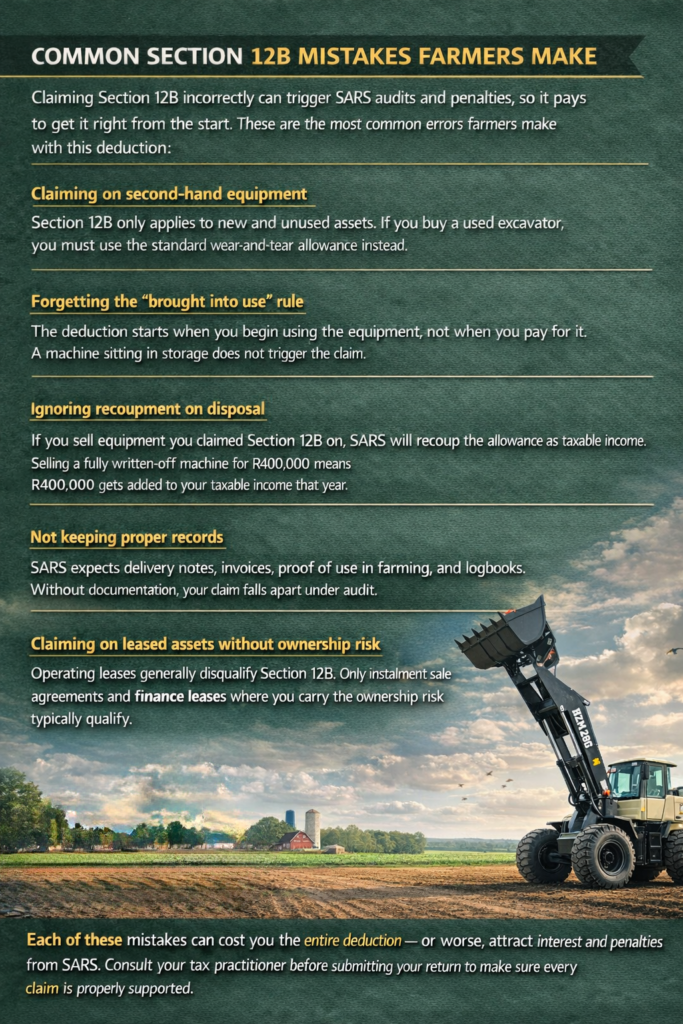
Claiming Section 12B incorrectly can trigger SARS audits and penalties, so it pays to get it right from the start. These are the most common errors farmers make with this deduction:
- Claiming on second-hand equipment — Section 12B only applies to new and unused assets. If you buy a used excavator, you must use the standard wear-and-tear allowance instead.
- Forgetting the “brought into use” rule — the deduction starts when you begin using the equipment, not when you pay for it. A machine sitting in storage does not trigger the claim.
- Ignoring recoupment on disposal — if you sell equipment you claimed Section 12B on, SARS will recoup the allowance as taxable income. Selling a fully written-off machine for R400,000 means R400,000 gets added to your taxable income that year.
- Not keeping proper records — SARS expects delivery notes, invoices, proof of use in farming, and logbooks. Without documentation, your claim falls apart under audit.
- Claiming on leased assets without ownership risk — operating leases generally disqualify Section 12B. Only instalment sale agreements and finance leases where you carry the ownership risk typically qualify.
Each of these mistakes can cost you the entire deduction — or worse, attract interest and penalties from SARS. Consult your tax practitioner before submitting your return to make sure every claim is properly supported.
Before You Claim — Quick Checklist
- Confirm the equipment is new and unused when first brought into your farming operation
- Verify that the asset is used directly in farming activities that generate farming income
- Check your finance structure — instalment sale agreements qualify, while operating leases usually do not
- Record the date the asset was brought into use, since this determines which tax year the deduction starts
- Keep all invoices, delivery notes, and proof of farming use for at least five years
- Discuss recoupment implications with your tax practitioner if you plan to sell or trade in the equipment
- Ask about MCM Group’s financing options and how they affect your Section 12B eligibility
Frequently Asked Questions About Section 12B Farming
Your Questions Answered
What is Section 12B of the Income Tax Act?
Does Section 12B apply to second-hand farming equipment?
Can I claim Section 12B on a TLB used for farming?
What is the 50/30/20 depreciation rule for farmers?
More Common Questions
Can game farmers claim Section 12B?
What happens if I sell equipment I claimed Section 12B on?
Does MCM Group help with equipment finance for farmers?
About the Author
Related Articles in This Series
- Can I Claim My Construction Equipment on Tax in South Africa? What SARS Says — Section 11(e) wear-and-tear, Section 12C, and how tax deductions work for contractors
- Instalment Sale vs Financial Lease vs Operating Lease — which finance structure saves you the most tax when buying farming or construction equipment
Sources & References
Disclaimer: MCM Group is an equipment distributor, not a financial institution or registered financial services provider. The information in this article is for general informational purposes only and does not constitute financial, tax, or legal advice. Always consult a qualified accountant, registered tax practitioner, or financial advisor before making decisions about equipment financing, tax deductions, or lease structures. Terms, rates, and eligibility criteria are determined by the relevant bank or finance house.
- SARS — Guide on the Taxation of Farming Operations (IT35)
- SA Tax Guide — Farming Expenditure and Allowances
- Cliffe Dekker Hofmeyr — Taxation of Farmers in South Africa
- PWC South Africa — Corporate Deductions
- Moonstone — SARS Application of Section 12B Tax Incentive
Find Us Nationwide
Cape Town
7 Jig Avenue, Montague Gardens, 7441
Phone: +27(0)21 001 8686
Email: info@mcmgroup.co.za
George
14 Mellville Street, George Industria, George
Phone: +27(0)44 873 3355
Email: george@mcmgroup.co.za
Gauteng
28 Brits Road, Rosslyn, Pretoria
Phone: +27(0)12 940 9026
Email: gauteng@mcmgroup.co.za
Bloemfontein
11 Woodrow Street, Bloemfontein
Phone: +27(0)51 101 0095
Email: bloemfontein@mcmgroup.co.za
Get Expert Advice on Section 12B and Farming Equipment
Investing in new farming equipment is one of the smartest ways to reduce your tax bill while boosting productivity on your operation. MCM Group supplies a full range of qualifying machinery — from TLBs and front end loaders to excavators and wood chippers — with flexible finance options designed for the agricultural sector.
Disclaimer: This article provides general information about Section 12B and should not be treated as tax advice. Always consult a registered tax practitioner or accountant before claiming any tax deductions. Refer to the SA Tax Guide and SARS for the latest legislation.