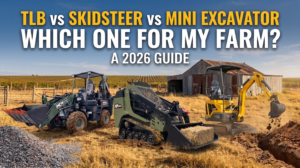

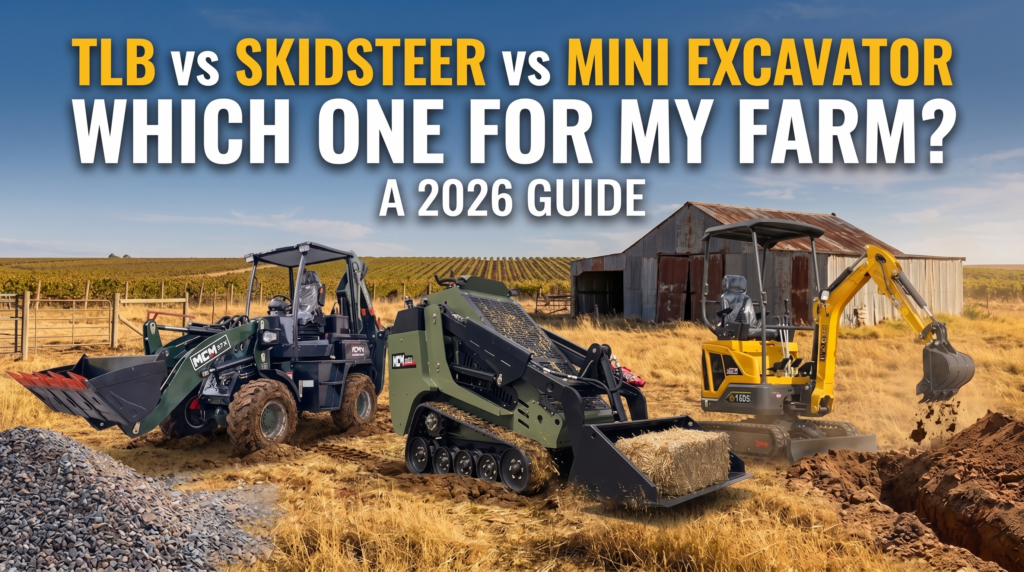
If you’ve outgrown a tractor’s loader but a full-frame loader is overkill, the choice usually comes down to a TLB, skidsteer, mini excavator, or some combination of the three. Each handles a different mix of loading, digging, lifting, and yard work. In addition, each carries a very different price tag and running cost in South Africa. This guide compares them honestly — strengths, weaknesses, and the real-world farm jobs each one wins. MCM Group supplies all three categories with nationwide delivery, finance, and after-sales support.
The Quick Answer: TLB, Skidsteer, Mini Excavator
- Choose a TLB if you need one machine to load and dig, you regularly move bulk material (feed, soil, gravel), and you want a single operator station for both tasks.
- Choose a skidsteer (or mini skidsteer) if your work is mostly yard, stable, and small-area — moving pallets, cleaning kraals, post-holing, light landscaping — and you need a machine that can swap attachments quickly.
- Choose a mini excavator if digging is the primary job — trenches for water lines, fence post holes, drainage, dam clean-outs — and loading is a secondary task you can solve another way.
Furthermore, the rest of this guide unpacks why, with the costs and trade-offs spelt out for each TLB, skidsteer, and mini excavator buyer profile.
TLB, Skidsteer, Mini Excavator: What Each Machine Does
The TLB (Backhoe Loader)
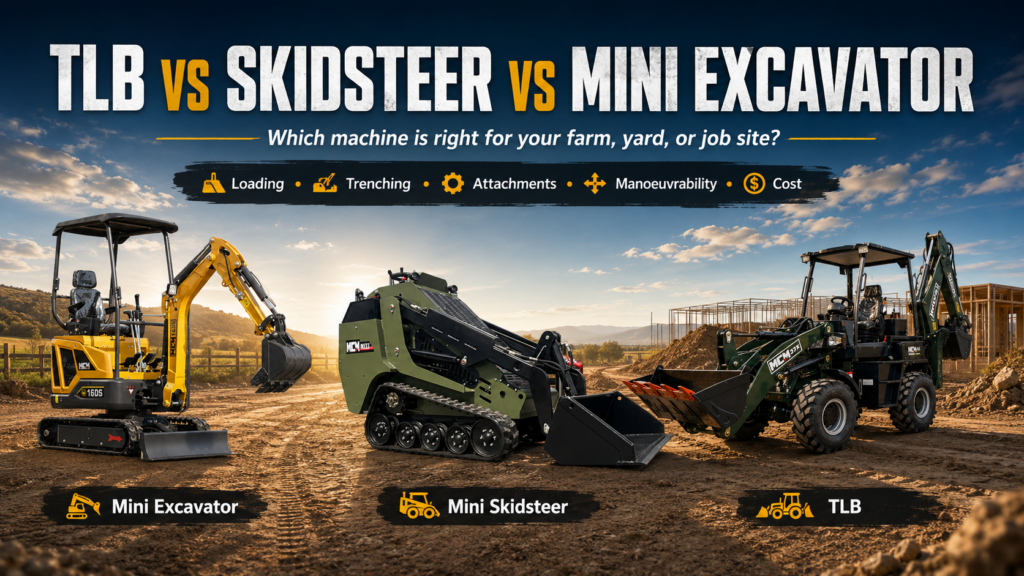
A TLB — Tractor Loader Backhoe — is a single machine with a loader bucket at the front and a backhoe (digger arm) at the back. The operator turns the seat to switch between tasks. For a farm running mixed work, this is the most versatile single purchase you can make. One unit handles feed loading, manure scraping, road grading, drainage digging, and lifting onto a trailer. Modern compact TLBs like the MCM 27X have shrunk the format. As a result, they fit through a 2.5 m gate and park under a normal carport.
The Skidsteer (or Mini Skidsteer)
A skidsteer is a small, agile loader on four wheels (or tracks). It steers by braking one side — hence “skid” — giving it a zero-radius turn that’s perfect for tight spaces. The killer feature is its quick-attach plate. Forks, augers, trenchers, brooms, breakers, mowers, and grapples all clip on in seconds. Mini skidsteers (like the MCM MS33) are smaller again. Most are walk-behind or stand-on, sized for landscaping, paving, and tight-access farm yards.
The Mini Excavator
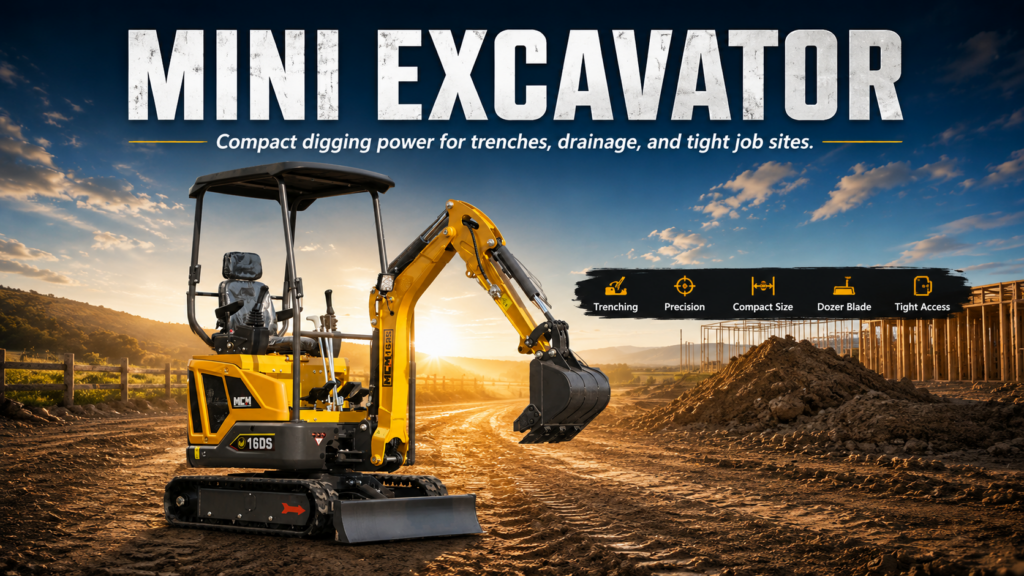
A mini excavator is a tracked digging machine with a single arm and bucket on a rotating turret. It is purpose-built for digging. Therefore, it produces deeper trenches, cleaner trench walls, and more precise placement than a TLB’s backhoe can manage. Most have a small dozer blade at the front for back-filling and grading. However, a mini excavator does not load, lift to height, or carry across distance well. It is a specialist that earns its keep when there is enough digging to keep it busy. For the international standard naming of these machines, see ISO 6165.
TLB, Skidsteer, Mini Excavator Head-to-Head
Loading Bulk Material
The TLB wins decisively. A 0.4–0.6 m³ front loader bucket, paired with a stable wheeled chassis, moves feed and soil quickly. It has full reach into a tipper or trailer. A skidsteer can do it too, but with a smaller bucket and lower lift height. A mini excavator can’t really load at all — its single bucket has to swing and dump, which is slow compared to a dedicated loader.
Digging Trenches and Holes
The mini excavator wins. A 360-degree slewing house, deeper dig depth (2.5–3.5 m on compact models), and a dozer blade for back-filling make it the right tool for serious trenching. Think water reticulation, drainage, fence lines, and dam edges. A TLB backhoe will dig the same hole, but more slowly, with more re-positioning, and not as cleanly. A skidsteer can dig only with a dedicated trencher attachment — fine for shallow lines, useless for deep trenches.
Attachment Versatility
The skidsteer wins. A universal quick-attach plate means one chassis runs forks, augers, brooms, mowers, breakers, mulchers, grapples, snow blades, and dozens of specialty attachments. Therefore, for a farm with mixed yard duties — landscaping, paving, post-holing, sweeping — the attachment ecosystem is unmatched. A TLB and a mini excavator both accept attachments too. However, the libraries are smaller and the change-over takes longer.
Manoeuvrability and Yard Footprint
Skidsteer wins for tight spaces — zero turning radius and a footprint under 2 m wide. Mini excavator is second, with tracks that crawl over uneven ground but no ability to drive long distances quickly. The TLB is the longest of the three and turns through a larger arc. However, on open farmland that rarely matters.
Operator Comfort and Weather
The TLB wins. A full enclosed cab — with air-con on closed-cab variants — keeps the operator working through summer heat and winter dust. Most compact skidsteers and mini excavators come with a canopy, not a full cab. As a result, the operator is exposed to weather. For long days, the difference shows up in operator fatigue and the willingness to keep running the machine.
TLB, Skidsteer, Mini Excavator Cost in South Africa
2026 Price Bands
Pricing varies by brand, model, and spec. However, as a rough 2026 guide:
- Mini skidsteer: the cheapest entry — usually under R 300 000 for a workhorse unit with a few attachments.
- Compact TLB: sits in the R 500 000 – R 900 000 band for a brand-new unit, depending on size and cab spec.
- Mini excavator: R 250 000 (sub-2-tonne) to R 700 000 (5–6 tonne with dozer blade and full cab).
- Full-size skidsteer: R 450 000 – R 800 000 depending on engine size, lift capacity, and tracks vs wheels.
Which Is Cheapest “Per Job”?
For most farms, the TLB is the most expensive single buy but the cheapest “per job”. That’s because one machine covers what would otherwise need two. The skidsteer beats both on attachment count per rand. Meanwhile, the mini excavator only makes sense as a standalone buy if you have months of trenching ahead.
Maintenance and Running Costs
Three Rules of Thumb
- Hours per service interval are similar across all three (250 / 500 / 1000-hour intervals). So on a per-hour basis, oil and filter costs are comparable.
- Tracks cost more than tyres. A track skidsteer or mini excavator will need rubber track replacements eventually. Budget R 15 000–R 30 000 a side depending on size and quality. Wheeled TLBs and skidsteers spend less per year on running gear.
- Hydraulic-attachment-heavy use (breakers, augers, mulchers) is harder on the machine than bucket-only work. Skidsteers running breakers daily wear pump and motor components faster than a TLB that mostly just loads.
Resale Value
Resale also matters. TLBs and mini excavators hold value well in South Africa because they sell into both farm and construction markets. By contrast, mini skidsteers are a niche resale market — easier to sell privately, but to a smaller buyer pool.
A Decision Tree for Farm Buyers
Use these questions to narrow down the TLB, skidsteer, or mini excavator decision quickly:
- Do you load feed, soil, gravel, or manure more than once a week? → TLB or skidsteer. Mini excavator is wrong.
- Do you dig trenches longer than 20 m or deeper than 1.5 m? → Mini excavator. A TLB backhoe will do it but more slowly.
- Do you need to swap between many specialised attachments? → Skidsteer.
- Do you work mostly in tight kraals, sheds, or paved yards? → Skidsteer or mini excavator. The TLB is too long.
- Do you only have budget for one machine? → TLB, almost every time. It’s the most versatile single buy.
- Do you already own a tractor with a front loader? → Look at adding a mini excavator or skidsteer rather than a TLB. The tractor already covers loading.
TLB, Skidsteer, and Mini Excavator Range from MCM Group
MCM Group supplies all three categories across South Africa, with branches in Midrand, Cape Town, Bloemfontein, and George. Our range includes the MCM TLB lineup (27X, 18X, 76X and full-size models), the MCM skidsteer and mini skidsteer range (MS-Series), and a full mini excavator range from Yuchai and MCM.
In addition, we can run a side-by-side demo on your farm, supply with finance through our partner banks, and back every machine with a national parts and service network. If you’re between two of these categories, our sales team will happily map out the cost-per-hour case for each rather than push the most expensive option.
Your Questions Answered
Is a TLB or a skidsteer better for a small farm?
Can a TLB do the same digging job as a mini excavator?
How much does a TLB cost in South Africa?
Are mini excavators worth buying for a farm?
Which is cheaper to maintain: a TLB, skidsteer, or mini excavator?
Can I tow a TLB behind a bakkie or tractor?
Talk to MCM Group About the Right Machine
Still unsure which category fits your farm? Send us a quick description of the jobs you run — loading volumes, dig depths, yard size, daily hours. Our sales team will map out the right TLB, skidsteer, or mini excavator within a phone call. We’d rather sell you the correct unit once than the wrong one twice.
Contact MCM Group for a quote, current stock, finance options, or a side-by-side demo at one of our branches.