
TLB fuel consumption in South Africa varies from approximately 4 to 12 litres per hour depending on engine size, workload, and operating conditions, with MCM Group offering seven TLB models ranging from the compact 25kW MCM 18X to the full-size 76kW MCM 76X, available from branches in Cape Town, George, Gauteng, and Bloemfontein.
TLB fuel consumption in South Africa typically ranges from 4 to 12 litres per hour depending on engine size, workload, and operating conditions. MCM Group offers seven TLB models with varying fuel efficiency ratings to match different budgets and project requirements.
View all models in the MCM TLB range or read on for a detailed fuel consumption breakdown.
Need help choosing? Contact MCM Group for expert advice and a competitive quote.
When people search for TLB fuel consumption in South Africa, they are usually trying to answer a practical question: how much will it cost to run a TLB every day on site or on the farm? The answer depends on machine size, engine power, operator habits, terrain, attachment use, and the type of work being done. A compact machine used for light loading and occasional trenching will naturally consume less fuel than a full-size TLB doing heavy daily excavation.
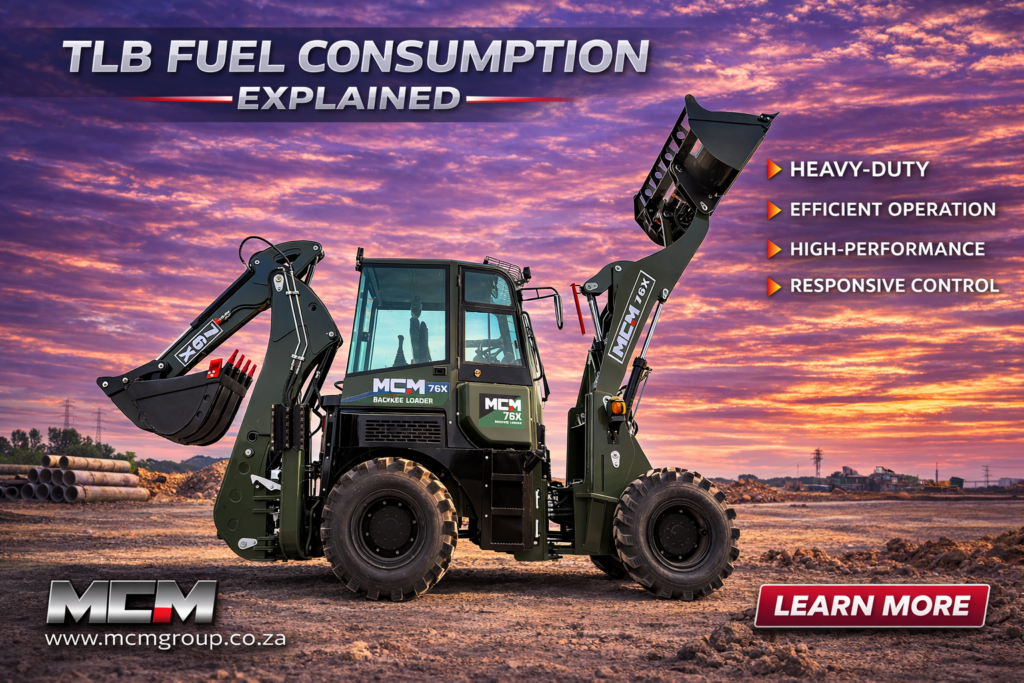
For buyers in South Africa, fuel use should never be looked at in isolation. The real question is how much work a TLB delivers for the fuel it uses. At MCM Group, a trusted name in construction and agricultural machinery distribution, we help contractors and farmers compare machine size, productivity, and long-term running costs across models such as the MCM 18X TLB, MCM 37X TLB, and ACE Phantom TLB.
What affects TLB fuel consumption?
TLB fuel consumption is mainly affected by engine size, machine weight, workload, and how the machine is operated. A lighter machine doing lighter work will generally use less fuel, which means than a larger machine under continuous heavy load.
Fuel consumption rises when a TLB spends long hours digging hard ground, carrying heavy loads, climbing slopes, idling excessively, or operating at high RPM unnecessarily. It can also increase when tyre pressures are incorrect, filters are dirty, or the machine is poorly maintained.
In South Africa, where TLBs are often used for mixed applications across farms, civil works, landscaping, trenching, and loading, usage patterns vary widely. Because of this, there is no single fuel figure that suits every operator. What matters most is matching the right machine to the job.
Does a bigger TLB always use more fuel?
Yes, in most cases, a bigger TLB uses more fuel, but it can still be more efficient for the work being done. A larger machine may burn more litres per hour, yet complete the same task faster and more effectively.
This is where many buyers make a mistake. They focus only on fuel burn instead of cost per job. For example, a compact TLB may appear cheaper to run, but if it takes far longer to complete excavation, loading, or backfilling work, the total operating cost may end up higher.
For farmers and smaller contractors, compact FEL-frame machines often offer the best balance between fuel economy and practical output. On demanding commercial jobs, a heavier machine may be the better investment because it finishes more work in less time.
Which TLB size is best for fuel efficiency?
Compact TLBs are generally the most fuel-efficient choice for lighter and mixed-duty work. Full-size TLBs are better suited to heavier applications where higher output offsets higher fuel use.
Below is a useful comparison of the MCM Group TLB range by class and intended use.
| Model | Power | Operating Weight | Type | Typical Best Use | Fuel Efficiency Position |
|---|---|---|---|---|---|
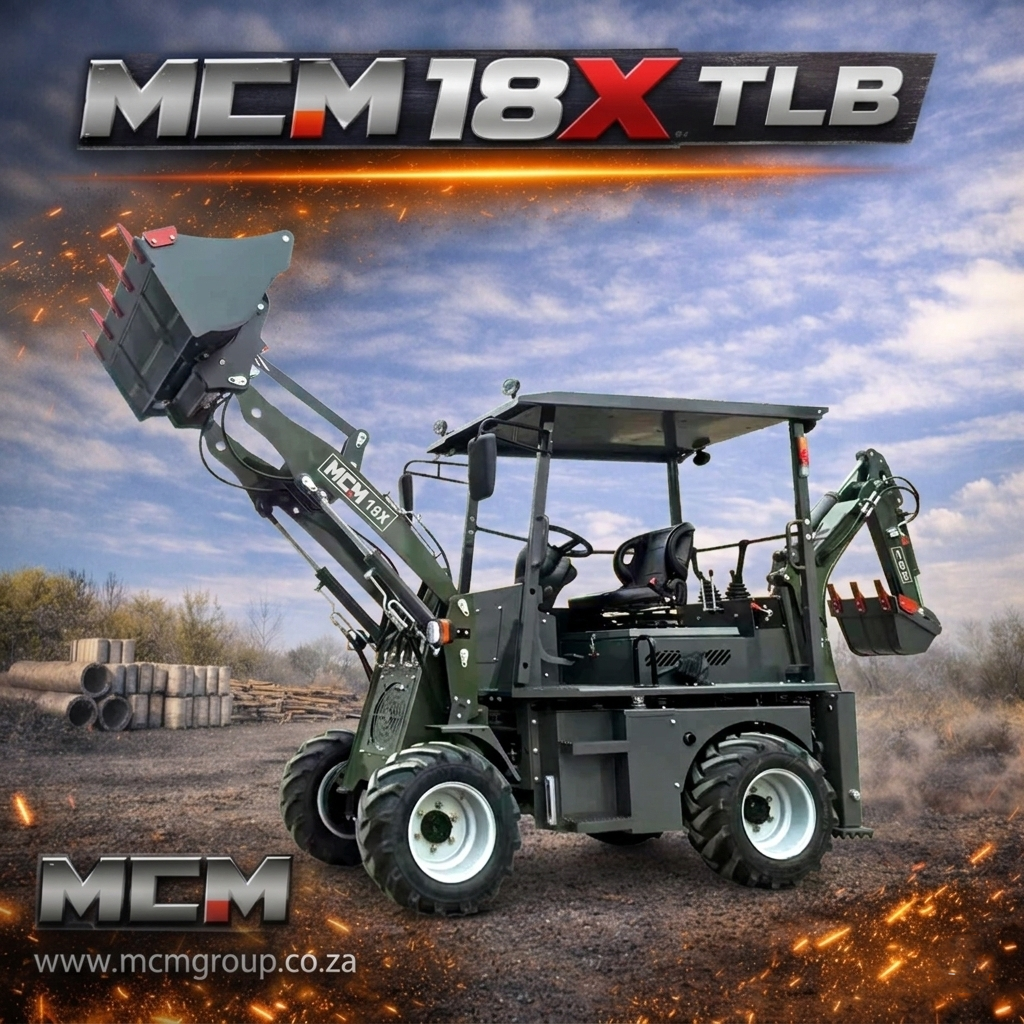
| MCM 18X TLB | 25kW | 2,350 kg | Compact FEL-Frame | Small farms, estates, light contractor work | Highest efficiency |
| MCM 27X TLB | 37kW | 2,800 kg | Compact FEL-Frame | Mixed farm and small site work | Very efficient |
| MCM 37X TLB | 36.8kW | 5,000 kg | Compact FEL-Frame | Medium-duty contractor work | Balanced efficiency |
| MCM 58X TLB | 58kW | 5,200 kg | Compact FEL-Frame | Higher-output site work | Moderate |
| MCM 76X TLB | 76kW | 6,800 kg | Compact FEL-Frame | Heavy compact applications | Lower than small units, higher output |
| LGMA LG388 TLB | 75kW | 8,200 kg | Tractor-Built Full-Size | Commercial excavation and loading | Heavy-duty class |
| ACE Phantom TLB | 71.5kW | 8,040 kg | Tractor-Built Full-Size | Large farm and contractor work | Heavy-duty class |
How do MCM Group TLB models compare?
Smaller MCM TLBs usually suit operators who want lower fuel use, while larger models suit operators who need greater output. The best fuel decision is the one that matches the machine to the workload
MCM 18X TLB
The MCM 18X TLB is a strong option for buyers focused on economy. With 25kW and a 2,350 kg operating weight, it is well suited to lighter farm work, maintenance, loading, and general property use where compact size and low running costs matter.
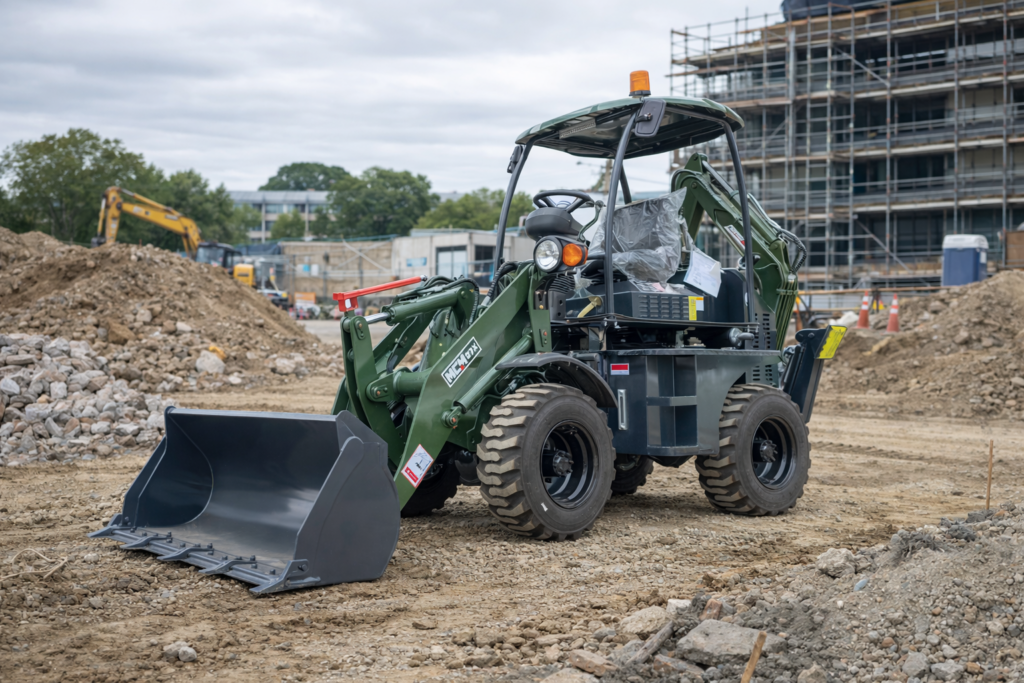
MCM 27X TLB
The MCM 27X TLB adds more power while remaining compact and efficient. It is a practical choice for farmers and small contractors who need more digging and loading ability without stepping into a larger fuel-use category.
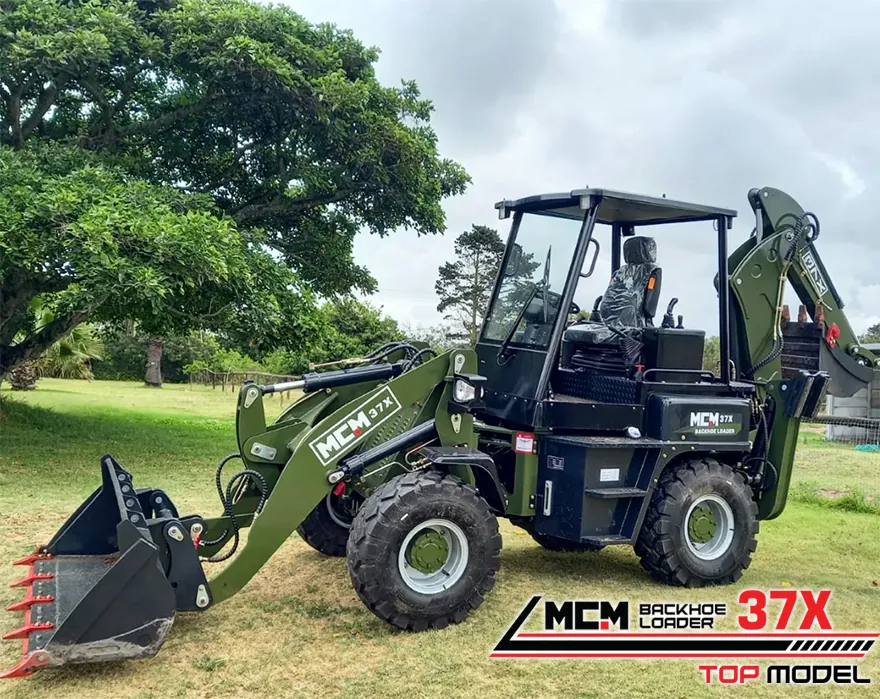
MCM 37X TLB
The MCM 37X TLB offers a balance between compact design and more serious site performance. For many users, this is the point where fuel use and productivity begin to balance very well.
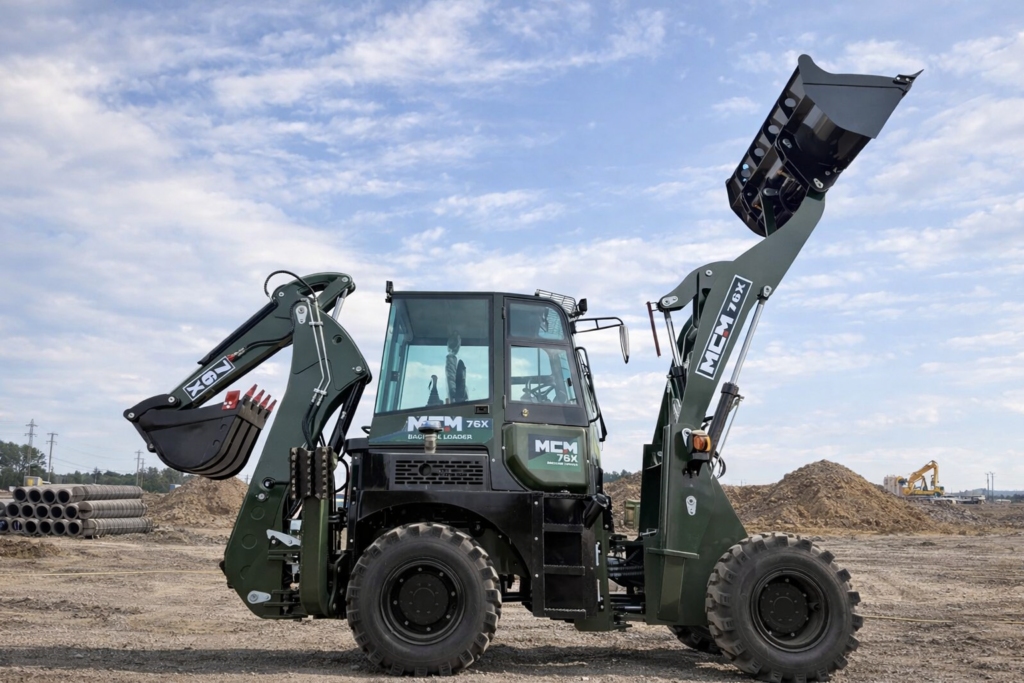
MCM 58X and MCM 76X TLB
The MCM 58X TLB and MCM 76X TLB are better suited to operators who need stronger daily performance. While fuel consumption will be higher than smaller models, these machines MCM builds them for heavier workloads and higher output.
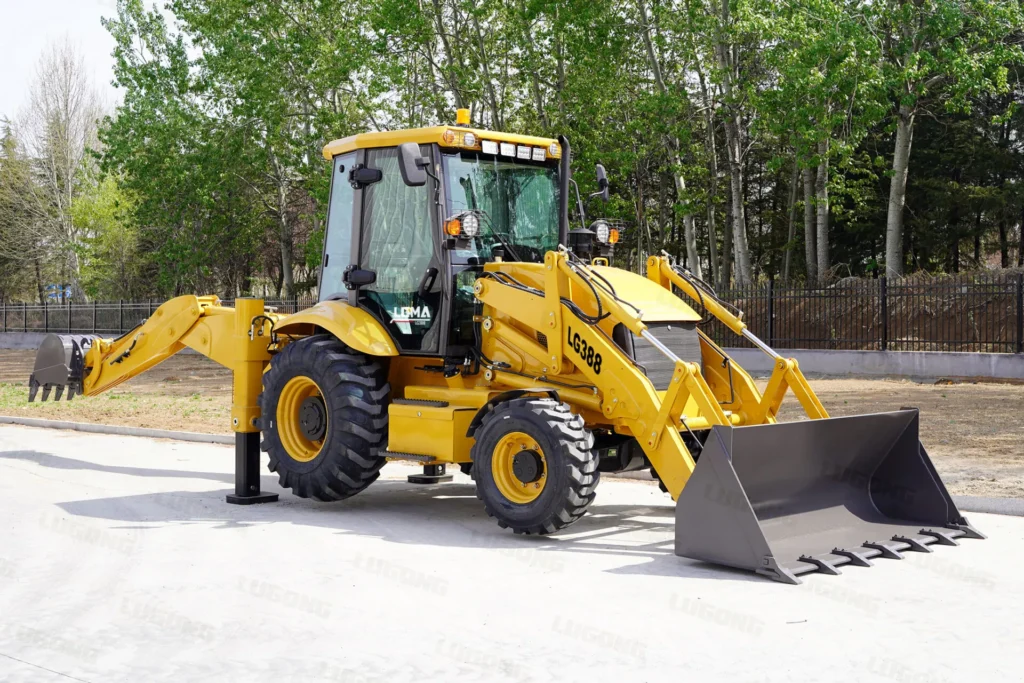
LGMA LG388 and ACE Phantom TLB
The LGMA LG388 TLB and ACE Phantom TLB sit in the full-size category. These MCM designs them for bigger jobs where machine capacity, reach, and durability matter more than minimum fuel burn.
How can operators reduce TLB fuel consumption?
The fastest way to lower fuel consumption is to reduce unnecessary engine load and idle time. Good operating habits and routine maintenance make a major difference.
Start with the basics. Avoid excessive idling, keep tyre pressures correct, service the engine on schedule, and use the machine within its intended capacity. Smooth operation also matters. Sudden acceleration, harsh bucket movements, and unnecessary travel all waste fuel.
On farms and construction sites in South Africa, machine selection also plays a big role. A compact TLB used for compact work will usually be more efficient than forcing a large machine into light-duty tasks. That is why working with an experienced supplier in construction and agricultural machinery distribution helps buyers avoid costly mismatches.
Why is fuel consumption only one part of the cost equation?
Fuel matters, but uptime, support, and output matter just as much. The cheapest machine to fill up is not always the most profitable machine to own.
A reliable TLB backed by parts availability and after-sales service can save far more money over time than a machine chosen only for lower fuel use. At MCM Group, our focus is not just on supplying machines, but on supporting them across South Africa with local backup and spare parts.
For contractors, that means less downtime. For farmers, it means confidence that the machine can keep working when needed most. In real-world operating conditions, that support is part of total ownership cost.
See It in Action
TLB Running Cost Checklist
Before making your decision, confirm:
- You have compared fuel consumption per hour across different TLB models
- You understand how engine size affects both power and running costs
- You have factored in maintenance, parts, and service intervals
- You have considered productivity per job (not just fuel per hour)
- You have explored finance options to spread the purchase cost
Frequently Asked Questions
What is the most fuel-efficient type of TLB?
Do full-size TLBs use much more fuel?
How can I lower fuel consumption on my TLB?
Which MCM TLB is best for balancing fuel use and productivity?
What financing options are available from MCM Group?
Where can I buy a fuel-efficient TLB in South Africa?
Find the right TLB for your workload
If you are comparing TLB fuel consumption in South Africa, the best decision is not simply choosing the smallest engine. It is choosing the machine that gives you the best combination of fuel efficiency, productivity, and long-term support. Explore the full MCM TLB range and view product pages for the MCM 27X TLB, MCM 76X TLB, and ACE Phantom TLB to compare the right fit for your farm or site operation.
CAPE TOWN
- 9 Karee Rd, Kraaifontein Industria,
Cape Town, 7570
SALES
GEORGE
- Jura Lands, Beach Road, Hansmoeskraal, George, 6529
SALES
FREE STATE
- Bloem Showgrounds, Curie Avenue, Generaal De Wet, Bloemfontein, 9301
SALES
GAUTENG
- 26 Sterling Rd, Unit 1, Samrand Business Park, Midrand, 0117
SALES
Browse the MCM TLB range for more information and to request a quote from MCM Group.